
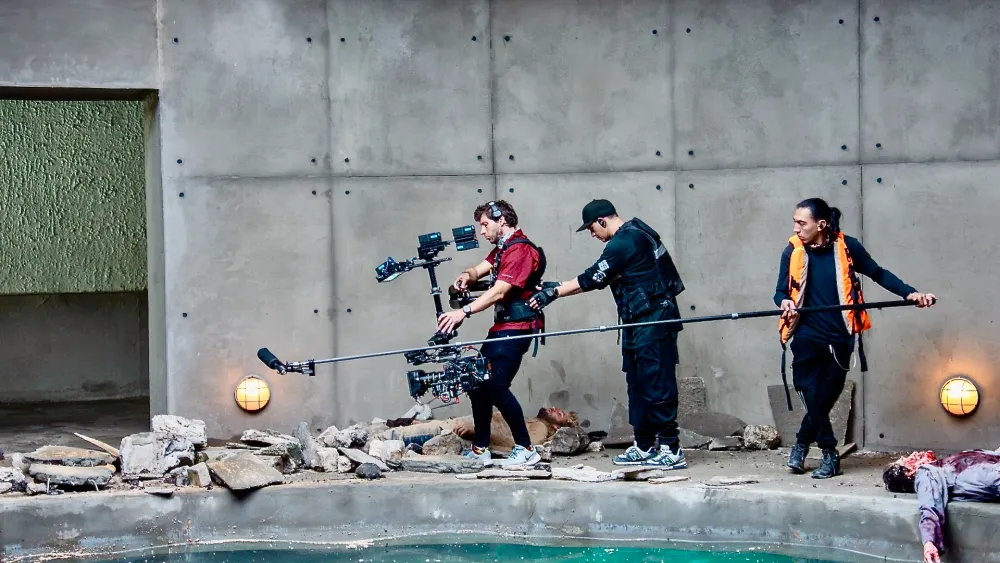
When the producers of shark thriller “The Black Demon” decided to make a sequel, making it in Colombia was a no-brainer. Mucho Mas Media, led by Javier Chapa, had already shot three other movies in the country with local production company Jaguar Bite.
The first pic they shot in Colombia, golf drama “The Long Game,” was set in Texas, their second, “Rosario,” in New York and the third, biopic “Jenni,” in Long Beach, California. “That tells you a lot right there,” says Chapa.
He credits his “The Black Demon” production designer Carlos Osorio, a Colombian, for introducing him to Jaguar Bite. “We quickly connected with [Jaguar Bite execs] Simón Beltrán and JP Solano, and the rest of the team at Jaguar Bite. And then after that, it just made a lot of sense to keep doing it.”
“They’re not only incredible partners, but over time we’ve developed a real shorthand with them. They’ve also become great friends and there’s a deep level of trust between us. That’s really why we keep going back.”
In the sequel, “The Black Demon: Atlantis” the megalodon returns “faster, fiercer, and deadlier than ever,” to a fortress-like prison island known as the Atlantis, in the middle of the Pacific Ocean. It follows Jerry Simms (played by Jack Kesy), an undercover DEA agent who enters the maximum-security prison after a fellow operative vanishes while investigating a string of inmate deaths. These are linked to Diego Núñez (Harold Torres), the prison’s most feared convict, whose cult-like influence is fueled by rumors of ancient powers.
As mutilated bodies pile up and rumors of blood rituals spread, the prison descends into chaos. With only Chato (Julio César Cedillo), a haunted inmate who knows Atlantis’s darkest secrets, as an ally, Jerry must fight to survive when the legendary Black Demon erupts from the depths, transforming the prison into a brutal nightmare.
Making “The Black Demon: Atlantis” meant building a giant water tank in a warehouse and involved seven weeks of prep and a 27-day shoot, which just wrapped on July 1. This was all done in Bogotá, which at 8,600 feet makes it the third highest capital city in the world.
“There was one set in a TransMilenio [underground facility] and another in a warehouse. We built multiple sets, both small and large, so it was really a combination of different sets and practical locations. The director was going for a very brutalist look, and Carlos [Osorio], along with our location manager and art director, found some great locations that matched the sets we were building. We kind of reverse-engineered everything from there. Carlos and his right-hand man, Charlie, also created some great artwork, so we had a really good sense of what this prison set piece in the middle of the ocean was going to look like.”
The sequel is the feature directorial debut of Colombian-born Carmen Cabana, a cinematographer whose notable credits include the series “Resident Evil,” “Ms. Marvel” and “Narcos” and Mucho Mas Media’s “Rosario.” The rest of the crew, including the heads of department, were also Colombian.
“She’s a very accomplished and talented cinematographer. We’d been trying to find something to do together. And she’s a huge horror genre lover and loves shark films so when the opportunity presented itself, she was the first person that came to mind.” Chapa relates.
Read more Xbox to Lay Off Up to 3,200 Staffers in ‘Most Significant Restructure’ in Company’s History
“We have an incredible shorthand with Carmen, built on friendship and a lot of trust. It’s also really important to us to give first-time filmmakers a shot, especially Latinos and Latinas.”
“Every movie has its challenges – you can always use more days. With this one, the biggest challenge was obviously the amount of water work. There were a lot of stunts and special effects, so when you put all those variables together, you’re dealing with something that can be pretty challenging. Then there were the practical considerations, like keeping the water tanks warm for the cast and crew.”
Dealing with altitude sickness was not too big an issue. They drank a lot of coca tea, as suggested, and got acclimatized fairly quickly, he says.
“It’s been a great shoot overall. The most important thing for us was safety, obviously – especially when you’re working in these conditions with water, special effects and stunts. We had an incredible safety team, and Jaguar does a great job of hiring local crews who really understand production planning and safety needs and how to make sure our cast and crew are safe on these sets.”
“Buyers really want things good, fast, and cheaper, so Colombia becomes a very compelling proposition—the numbers really pencil out there. But more importantly, the human capital makes a lot of sense in Colombia. The crews on both sides of the camera are incredible, and the crafts people there are really talented. And you know, as they say where I’m from in Texas, if it ain’t broke, don’t fix it.”
“Colombia has a lot of texture, it has real atmospheres that don’t feel generic and that matters for a film like this because you’re really trying to build a world. It’s not just a shark in the water, it’s a prison, it’s mythology, it’s danger…a whole environment that really needs to feel alive.”
The producers alongside Chapa are Arianne Fraser, Delphine Perrier and Caleb Ward. Robert Muñoz, Kristopher Wynne, Beltrán and Solano serve as executive producers.
Highland Film Group is handling worldwide sales, and the plan is for a theatrical release before it lands at a streaming platform. The original streams on Prime Video where it was No. 1 for the first week.