
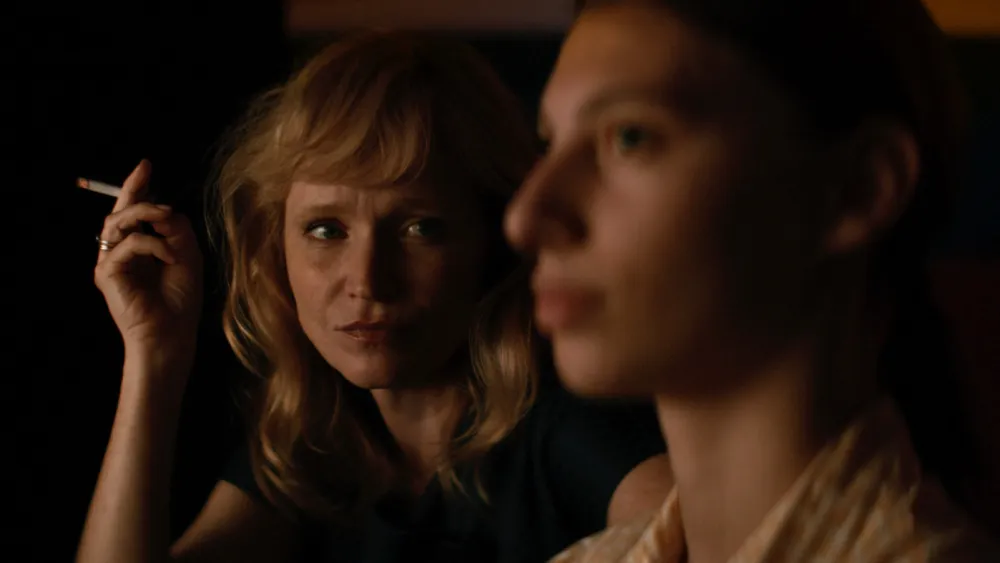
The fashions and furnishings of Czechoslovakia in the 1980s — the height of the state’s racist program of suppressing the Roma population through coerced sterilization — are painstakingly evoked in Slovakian filmmaker Ivan Ostrochovský’s “Only Beautiful Things to Look At.” But the film’s attractive yet oddly bloodless presentation gives the impression of a period drama set much farther back, as though we’re peering at the prettily mounted arrowheads and artifacts of a long-gone atrocity through museum glass. Alongside the decision to centralize the perspective of a white female doctor, this old-school, soft-focus approach robs an undeniably well-intentioned movie of a vital edge of urgency and discomfort, allowing viewers to consign the cruelties it outlines to some imaginary distant past, when in truth, the sterilization policy continued well into the 21st century in both the Czech and Slovak Republics.
Read more ‘A Happy Family’ Review: Anna Schinz’s Powerful Lead Performance Elevates a Confused Custody Drama
The film begins with a montage of young Roma women, each shot as though for a studio portrait, impassively absorbing an offscreen voice lecturing them about family planning. “Sterilization,” the voice concludes disingenuously, “allows Gypsy women to improve their family’s quality of life.” The intention behind the portraiture is noble: to put faces to a crime more often recounted in impersonal statistics, when it is acknowledged at all. But although framed and lit with dignity by cinematographer Juraj Chlpík, none of these Roma women speak. The first words of argument or protest we hear are from Ingrid (Anna Geislerová), the film’s white protagonist, and she is not talking about reproductive rights at all. Instead, she is facing an all-male panel of her peers as she interviews for the role of head doctor at the hospital where she works. Ingrid knows the position will very likely go to one of her male colleagues, but that doesn’t stop her being angry and disappointed when it actually does.
Outside her work at the hospital, which in large part comprises assessing and performing the sterilizations in a procedure that leaves patients with a small scar beneath the navel nicknamed “the bow,” Ingrid has what can only be described as a beautiful life. With her music teacher husband Maros (Vlad Ivanov), she lives in a gorgeous house in the countryside, where her bedroom, glass-paned on two sides overlooking a lush forest, looks almost like a fairytale princess’ lair. In the warm-lit evenings she and Maros read and drink wine and listen to classical music; on her days off she goes for walks in the forest or, when it’s hot, visits the nearby river and looks on benignly as Roma children bob along playfully on tire tubes.
It is only through her burgeoning friendship with Agata (a radiant Simona Boledovičová), a sweet-natured orderly who is reticent about her Romani idenitity, that Ingrid eventually starts to become uncomfortable with the work she does helping the hospital meet its government-recommended quotas for sterilizations. Ostrochovský’s film, co-written with Marek Leščák, is not anything quite as crude as a white savior narrative, but it is certainly one that assumes the best conduit for a wide audience to understand the cruelty visited on Czechoslovakian Roma families, is the moral awakening of a white woman.
This faulty focus is particularly frustrating because Agata’s own story, and the manner in which she comes to reconcile herself with her Roma background, is by far the more intriguing narrative strand. As an orphan, Agata was separated from her sister Jula (an excellent Eva Mores), with each then going on to lead very different lives. Jula married within the Roma community, has had two children and is pregnant with an unwanted third. Agata, who at first barely acknowledges their connection, has been more independent, living with a roommate and working at the hospital, and recently getting serious with a boyfriend. “He’s white?” queries Jula in surprise when she hears that he’s a soldier. “Good for you.”
The tides of unspoken resentment and disapproval that flow between the sisters are fascinating, with Agata able to move between Jula’s world, in a cramped flat in a crumbling building where kids play in dirty stairwells, and Ingrid’s enviably refined domestic environment. Eventually, just like Chlpík’s limpid camera, Agata comes to see the beauty in both, when in the film’s most moving moment, the sisters tacitly reconcile while Jula’s kids splash about in the tub at bathtime. There would have been the opportunity here to probe the long-term consequences for the Roma women bearing “the bow,” many of whom had been conned into a procedure that was misrepresented to them, in a language they did not speak, or in documentation they could not read.
Instead, the film insistently returns us to Ingrid. As she’s kept awake by the first stirrings of her conscience, as she lazes in rumpled white bedsheets watching a beetle trundle across her pillow, as she’s depicted in macro close-ups that emphasize the blondeness of her hair, the fairness of her skin, the blueness of her eyes. Indeed, right up to a finale which resolves the remaining conflict with a rather glib miracle, the film’s loveliness practically becomes a liability, placing the real plight of the Roma several removes of perspective and aesthetic manipulation away, until you begin to wonder why we’re being given only beautiful things to look at, when there are so many ugly things that better warrant the attention.
‘Only Beautiful Things to Look At’ Review: A Handsome but Muffled Portrait of State-Sanctioned Cruelty
Reviewed at Karlovy Vary Film Festival (Competition), Jul. 5, 2026. Running time: 88 MIN.
-
Production:
(Slovakia-Czech Republic-Hungary) An Aerofilms (in Czech Republic) release of a Punkchart Films, Negativ Film Productions production in co-production with Proton Cinema, Radio and Television Slovakia, Czech Television. (World sales: Punkchart Films, Bratislava). Producers: Ivan Ostrochovský, Albert Malinovský, Katarína Tomková. Co-producers: Pavel Strnad, Petr Oukropec. -
Crew:
Director: Ivan Ostrochovský. Screenplay: Marek Leščák, Ostrochovský. Camera: Juraj Chlpík. Editors: Martin Malo, Josef Krajbich. Music: Michal Novinski. -
With:
Anna Geislerová, Simona Boledovičová, Eva Mores, Vlad Ivanov, Éva Bandor, Attila Mokos. (Czech, Slovak, Hungarian, Romani dialogue)