
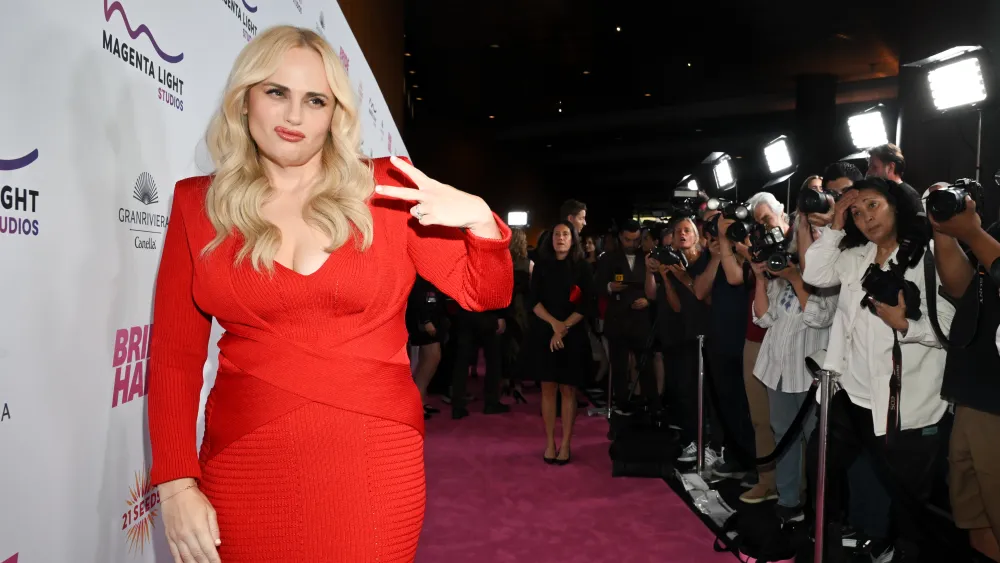
Rebel Wilson has prevailed in a defamation case brought by Charlotte MacInnes, the lead actor in Wilson’s feature directorial debut, “The Deb.”
Read more Sony Pictures Mulls Deal for Hollywood’s Cinerama Dome, With Alamo Drafthouse Possibly Operating
Justice Elizabeth Raper of the Federal Court of Australia in Sydney dismissed MacInnes’ defamation and breach-of-confidence claims on Wednesday and ordered her to pay Wilson’s legal costs.
MacInnes sued over four sets of Instagram posts published between September 2024 and July 2025. She argued that the posts portrayed her as having changed her account of an incident involving “The Deb” producer Amanda Ghost in order to benefit her career.
The dispute centred on events on Sept. 5, 2023, when MacInnes and Ghost went swimming at Bondi Beach before returning to the Sydney apartment where they were staying.
Ghost said she suffered a severe reaction to the cold water. MacInnes and Ghost subsequently entered a bath together while still wearing their swimming costumes.
Wilson maintained that MacInnes told her the following day that the situation had made her uncomfortable and later stepped back from that account. MacInnes denied making such a complaint and said she had not felt uncomfortable.
“To say that the circumstances surrounding how they came to be in the bath are unusual would be an understatement,” Raper wrote.
The judge found that only one of the meanings alleged by MacInnes was conveyed by any of the four publications. That meaning, contained in Wilson’s Sept. 23, 2024, post, was that MacInnes had changed her account of feeling uncomfortable about what happened in the bathroom.
Raper ruled that the meaning was not defamatory, finding that an assertion that someone had changed their story would not necessarily cause an ordinary reasonable person to think less of them.
The judge also made two alternative findings. She ruled that MacInnes had not shown that the publication caused, or was likely to cause, serious harm to her reputation. She further found that Wilson had established that the conveyed meaning was substantially true.
Raper found on the balance of probabilities that MacInnes had felt uncomfortable about the situation, had said something about it to Wilson the following day and later changed her account.
The judge described the versions given by MacInnes and Ghost as inconsistent and called both women “unreliable historians.”
Raper found that Ghost, then 49, had placed MacInnes, then 25, in an awkward and stressful position by requiring the younger actor to care for her during the episode.
The judgment did not determine that Ghost’s behaviour was sexual or that sexual harassment had occurred. Raper explicitly said the parties had not asked the court to decide whether the conduct had a sexualised dimension.
The court instead found that MacInnes had complained about feeling uncomfortable in a situation that could be explained without reference to sexual harassment.
MacInnes had argued that Wilson’s posts exposed her to online abuse and harmed her professional standing. Raper found no evidence that the publications had deprived her of work or other career opportunities.
The judgment noted that MacInnes signed a recording contract with Atlantic Records in October 2025 and subsequently released two singles. Her agent did not identify any specific opportunity lost because of Wilson’s publications.
MacInnes’ breach-of-confidence claim also failed. Raper found that MacInnes had not established that she made a complaint of sexual harassment, which was the information she alleged Wilson had improperly disclosed. The judge also found that the other required elements of the claim had not been proven.
During closing arguments in May, MacInnes’ barrister, Sue Chrysanthou SC, strongly attacked Wilson’s credibility. “She is a fantastical liar who has made up terrible, terrible allegations about multiple people and her own witnesses have discredited her,” Chrysanthou told the court.
Raper said in the judgment that she had serious concerns about the reliability of the evidence given by MacInnes, Ghost and Wilson. She nevertheless accepted Wilson’s evidence on the central question of whether MacInnes had raised her discomfort and subsequently changed her position.
The ruling concerns MacInnes’ Australian case against Wilson. Separate legal disputes involving Wilson and producers of “The Deb” remain distinct from the proceeding.
Following the decision, Wilson thanked the court for considering the evidence and said she was relieved that the proceedings had concluded. “This has been a long process and throughout I have tried to stay grounded in my values and what I believed was right,” Wilson said in a statement.
Wilson also reiterated her support for “The Deb,” describing it as a film about individuality, resilience and the courage to be oneself. “Right now, what I’m focused on is what matters most, my family and my work,” she said.
Wilson also addressed the ruling in an Instagram post, writing that she was “grateful this chapter has reached its conclusion” and was looking forward to returning to “what I love most, my family and my work.” She thanked “the Judge and the Australian legal system,” saying she has “the utmost respect” for both.
Read more Mike Preston, ‘Mad Max 2: The Road Warrior’ and ‘Hot Pursuit’ Actor, Dies at 93