
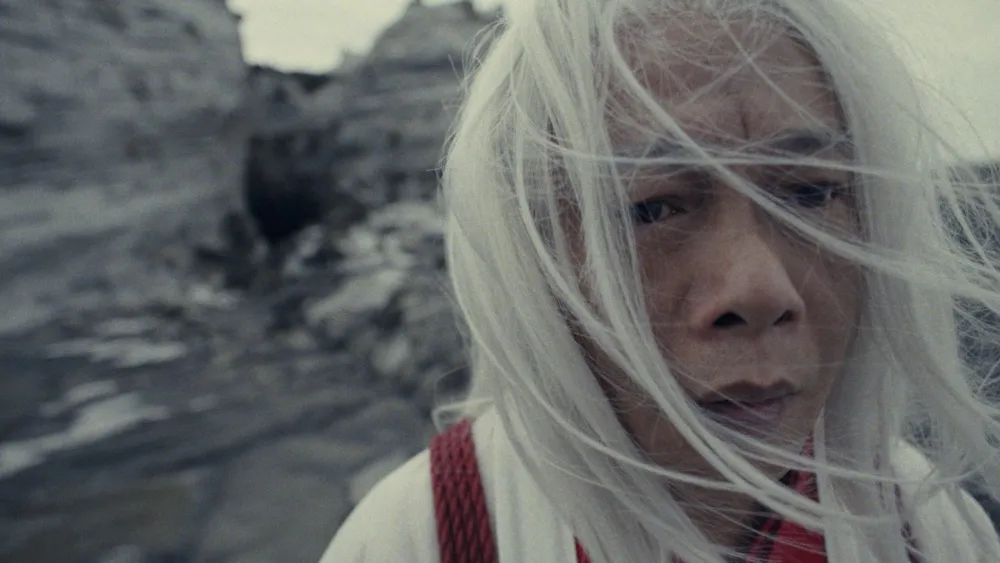
Singapore has never really had a wuxia feature film – though the genre was a fixture of local television in the late 1980s and early 1990s, when a wave of wuxia serials cast actors like Li Nanxing and Zhu Ming.
Nelson Yeo is closing that gap with “The House on the Moon,” a lunar reimagining of the Chang’Er myth landing in Locarno’s international competition. Variety is exclusively unveiling a clip from the film, ahead of its world premiere.
Wuxia is the Chinese genre of sword-fighting heroes and martial fantasy that has powered everything from King Hu’s classics to Wong Kar-wai’s “Ashes of Time.”
“It was quite ambitious when we first started having this idea of picking wuxia,” Yeo tells Variety. “For this one I decided to fully embrace genre and see where the film can take us.”
Yeo has a habit of returning to Locarno. He attended the festival’s Filmmakers Academy in 2018, then premiered his 2023 debut feature, “Dreaming & Dying,” there, where it won the Filmmakers of the Present Golden Leopard and the Swatch First Feature Award. Three years on, he’s back for a third time.
“I’m super glad to be back in Locarno,” Yeo says.
The film reimagines the legend of Chang’Er, the moon goddess, and her husband, the archer Hou Yi, picking up the story after Chang’Er ascends to the moon and setting her on a journey to its dark side alongside a bandit from Earth. For Yeo, the appeal was less about honoring the myth than filling in what it leaves out.
“The original myth has always been so simple,” Yeo says. “As a kid, you can pretty much recite the whole story in a couple of lines and people will get it. But then at the same time, you always wonder what are these characters really going through? What are their emotions like?”
He points to Peng Meng, the disciple mentioned only in passing in the traditional tale, as the character who benefited most from that expansion. “It’s just a very basic foundation,” Yeo says. “So I felt like I have more, I can take more liberties in terms of like building the character.” Even so, he adds, the story remains centered on its heroine: “Chang’Er is traveling to the dark side of the moon throughout the film, but essentially, it’s about a journey inside herself and finding herself again and finding her own voice, in fact.”
That affinity for late-1980s and 1990s wuxia runs deep. Yeo grew up on Hong Kong genre cinema and the wuxia television serials that were once a fixture of Singaporean TV, and he cites Tsui Hark’s “Zu: Warriors From the Magic Mountain” as a touchstone alongside Wong Kar-wai’s “Ashes of Time.” But reviving that language now came with practical headaches. “Sourcing for the props was a nightmare,” Yeo says. “And in terms of location wise, because Singapore being such a modern city, we had a lot of trouble finding proper locations to shoot the film.”
Those constraints pushed part of the production to Taiwan, Yeo’s first time filming there. “It was quite an eye opener in terms of how things are done there,” he says. The Taiwan leg also brought him into the orbit of Lee Kang-sheng, the Taiwanese thespian and longtime Tsai Ming-liang regular, a collaboration Yeo calls a highlight of the production. “He’s amazing because he’s a one-take wonder,” Yeo says. “Everything that he does on the first day is just perfect. And I’m so fortunate to work with him.”
The film’s tonal balance owes much to its bandit character, written to speak Singlish and cast, Yeo says, to give audiences an entry point among a story otherwise populated by immortals. “I really wanted that character to be the one that the audience can really relate to,” he says. “After all, he a mortal in among all these immortals. He’s the closest to the audience.” The role also reshaped the film’s register. “The original character that was written was much darker and the film was much darker,” Yeo says. “I felt like having this different element, this slightly more comedic character, lightens things up a little bit.”
Shot partly through virtual production, “The House on the Moon” pushed Yeo toward tools he still regards with caution. “First and foremost, I feel like virtual production is a game changer,” he says. “At the same time, it’s not so accessible to independent filmmakers because of the inherent cost of it.” He’s warier still of artificial intelligence’s growing role in production. “Nothing beats being on the real locations, having the actors interact with the space,” Yeo says. “There’s so much more room for creative freedom on set in terms of blocking or improv.
Working with a cast and crew spanning Singapore, Taiwan and beyond, including a German visual effects team and an Indonesian composer based in Berlin, was, Yeo says, a deliberate widening of his usual process.
As for what the film’s Locarno premiere means to him, Yeo would rather audiences approach it without a map. “I guess just to give in to their senses and not go in with any expectations,” he says. “The plot maybe on the surface it sounds really complicated, but as long as you follow the characters’ emotions, I think you’ll be fine.”
Whether “The House on the Moon” spins off into a franchise remains an open question for Yeo. “If it happens, if it happens,” he says. “I won’t force it. I won’t force myself to make a sequel of the film.” He’s already looking elsewhere: a horror project he’s drafted, and “Black Sun,” a film he’s been trying to get made for more than a decade.
“The House on the Moon” is produced by Tan Si En, Wendy Lie and Kuek Shee Heng for Momo Film Co (part of Fremantle), and Aview Images, in co-production with Weydemann Bros., 9LB Film, KawanKawan Media and Widewall Pictures. It is financed by the Taiwan Creative Content Agency (TAICCA). The film’s proof of concept secured support from the VP Innovation Fund by Singapore’s IMDA.
Parallax Films holds worldwide exclusive sales rights (excluding German speaking territories, Taiwan, and Singapore) and non-exclusive rights for all other regions in Southeast Asia.
The film stars Lim Shi-An, Dominick Rustam, Harry Chang and Akira Huang, with a special appearance by Lee Kang-sheng.
Read more Hwang Bo-reum, Lee Geum-yi Among Authors in Busan Story Market’s 2026 Selections
Watch the clip here: