
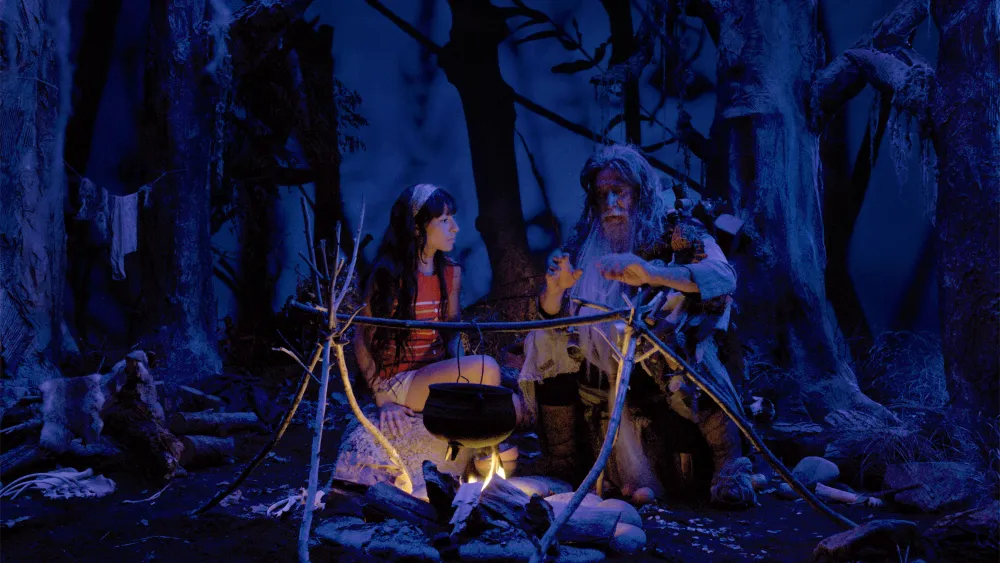
Chilean duo Cristobal León and Joaquín Cociña made a dream nightmare debut with “The Wolf House,” a stop-motion fantasy that turned heads both with its wholly original design — incorporating claymation, puppetry and papier-mâché to palpably handmade but immersively surreal effect — and its trajectory from a seemingly juvenile storybook premise to very grownup recesses of horror and trauma. Their 2024 follow-up “The Hyperboreans” captured fewer imaginations with its dense, narratively abstruse melange of history, psychology and political theory, but still dazzled with technique, adding live-action cinematography to the filmmakers’ varied visual quiltwork. In their beguiling third feature, “Donkey Princess,” León and Cociña split the difference between their first two, continuing their singular exploration of hybrid live-action cinema, but fruitfully returning to adult fairytale terrain.
Premiering in the international competition at Locarno, this is distinctive, aesthetically rich filmmaking that consolidates its helmers’ auteur status, and has the right balance of accessible and avant-garde components to ensure a life beyond the festival circuit — though the substance of its story lingers slightly less in the mind than its remarkable presentation. “Donkey Princess” doesn’t quite match “The Wolf House” for darkly enveloping atmosphere and gnawing emotional impact, but not much does; still, its portrayal of a mythic princess, whose tortured daddy issues follow her even after she’s spirited into the real world, builds to a climax both touching and disquieting.
As suggested by the title, the script (written, like “The Wolf House,” by the directors in collaboration with novelist Alejandra Moffat) riffs on the 17th-century Charles Perrault tale “Donkeyskin” — not one that Disney ever dared touch, giving its discomfiting incest-themed premise, though Jacques Demy gave it delightfully offbeat film treatment in 1970. More downbeat in its whimsy, “Donkey Princess” centers on Princess Diana (“Hyperboreans” star Antonia Giesen), who doesn’t bear any resemblance to her famous British namesake, save for the fact that she’s suffocated by the demands of her very patriarchal kingdom.
Said kingdom is realized in a mixture of animated imagery and winningly ramshackle production design by Natalia Geisse: toadstool-shaped castle turrets rendered in what looks like cake frosting, fiberglass mountain formations and forests forged from stray, dry branches, accessorized with the odd flurry of 2D cartoon butterflies and birds. (Fans of the directors’ stop-motion interlude in Ari Aster’s “Beau is Afraid” will spot some familiar landscape textures here.) Tinted in queasy shades of turquoise and puce, it does not look like a world made to last, and for Diana, it isn’t. Guarded obsessively by her father (Francisco Melo) since her mother’s untimely death, she yearns for escape from his clutches; when she meets charming commoner Lalo (Andrew Bargsted), she falls swiftly in love, both with him and the prospect of life outside the royal court.
Read more Olivia Rodrigo Debuts ‘Pretty Sad’ Songs at Sweltering Brooklyn Surprise Show: Concert Review
For the King — who really has taken very badly to widowed life, having outlawed love throughout the land — this will not do. Lalo is swiftly banished to an orange-skied hellscape strewn with thorns and vultures: a witty fusion of silhouette animation and tactile set construction. Before he goes, however, he gives Diana a bracelet said to grant wishes across space and time; in short order, she’s transported to the urban bustle of contemporary Chile. There, she and Lalo live together as parallel versions of themselves, also working alongside each other in the pest control business. If this seems a pretty compromised happily-ever-after, there’s also the fact that her father, too, has been teleported to this new realm: an aging invalid stripped of his powers, but still plenty burdensome.
That’s not the last dimensional shift in “Donkey Princess,” as Dina is shuffled through various lives and personae, but is never quite free or happy in any of them: The naïve yet despairing time-travel mechanics of Bertrand Bonello’s recent “The Beast” come to mind here, as its various temporal paths do eventually converge into a single, climactic tragedy, with the open-ended possibility of freedom. León and Cociña’s storytelling style can be opaque — the film’s opening salvo, in particular, feels hurried and scrambled — but it gains in grace and clarity, with a concluding shift in register toward near-total realism. That’s the biggest surprise from these most feverishly world-building of filmmakers, even if their most satisfying feature to date remains their most animated one. “Donkey Princess” might lack “The Wolf House’s” intensity of vision and purpose, but it feels an intriguingly transitional work in an oeuvre that could go anywhere from here.
‘Donkey Princess’ Review: A Princess Escapes the Kingdom, but Not the Patriarchy, in an Inventive, Shape-Shifting Fairytale
Reviewed at Locarno Film Festival (International Competition), Oct. 7, 2026. Running time: 86 MIN. (Original title: “Princesa Burro”)
-
Production:
(Chile-France-Uruguay-Netherlands-Germany) A León & Cociña Films, Globo Rojo Films production in co-production with Metonymie, Montelona, Viking Films, Autentika Films. (World sales: Bendita Film Sales, Santa Cruz de Tenerife.) Producer, executive producer: Catalina Vergara. Co-producers: Kim El Moumen, Claire Gadéa, Marleen Slot, Francisco Magnou, Paulo de Carvalho, Naomie Lagadec, Gudula Meinzolt. -
Crew:
Directors: Cristóbal León, Joaquín Cociña. Screenplay: León, Cociña, Alejandra Moffat. Camera: Benjamín Echazarreta. Editors: León, Cociña, Soledad Salfate, Maria Salazar. Music: Jean-Benoît Dunckel. -
With:
Antonia Giesen, Andrew Bargsted, Francisco Melo. (Spanish dialogue)