
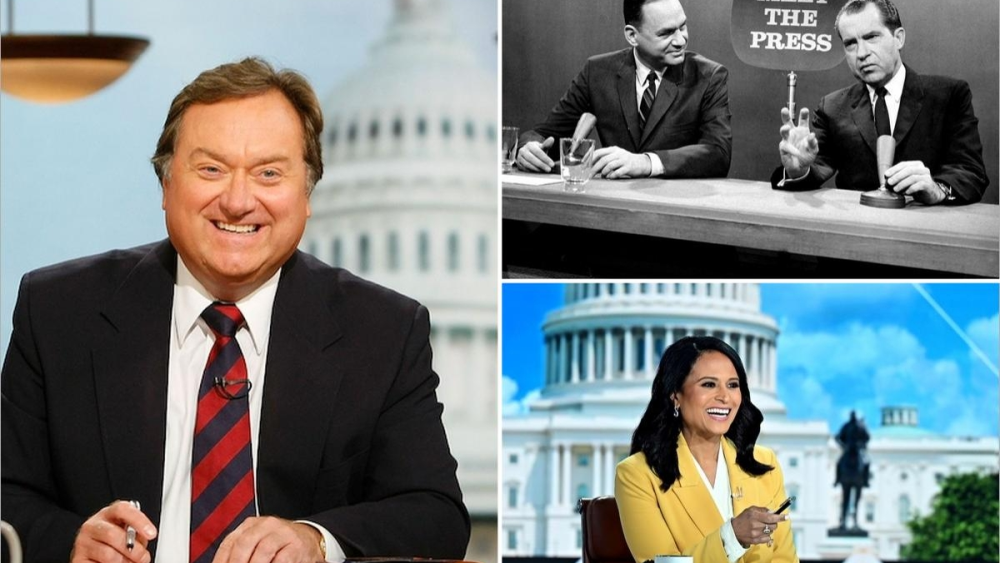
When Kristen Welker was named host of NBC’s “Meet the Press” in 2023, she went back and re-watched pivotal episodes and interviews conducted by the show’s legendary moderator Tim Russert.
Read more Riz Ahmed on Why ‘Bait’ Is His Most Vulnerable and Personal Piece of Work to Date
Russert, who died in 2008, reinvented “Meet the Press” in 1991 when he moved away from the show’s original press conference format and turned it into a show known for its one-on-one conversations with politicians and newsmakers.
“I wanted to revisit so many of those moments,” Welker says. “And what struck me was the interviews that he did that were for the history books, like interviewing former vice president Dick Cheney at Camp David after the U.S. had gone to war, and also some of the lighter moments on the show — like when he interviewed Yogi Berra, they talked about some of his famous sayings and their shared love of baseball and sports, and how that was so much a part of the American experience.”
“Meet the Press” is the longest-running program in television history. It launched as a radio show in 1945 before moving to the fledgling NBC television network in 1947. That means the show will hit its 80-year milestone next year, just a year after NBC marks its 100th. “We like to go big here at NBC, so we’re already talking about it,” Welker says of the anniversary.
There will be plenty of material to cite in that celebration. Besides being TV’s longest-running program, “Meet the Press” has made history several times over the years. That includes the moment in 1975 when Gerald Ford became the first time a sitting U.S. president to appear on a live network news program.
Welker likes to point out another historic fact about “Meet the Press”: The series was created by a woman, pioneering journalist Martha Rountree, who served as the show’s first moderator from 1947 to 1953.
“It’s important to point out, I’m the second woman to moderate ‘Meet the Press,’ and I always keep her in mind,” says Welker, who also made history as the first Black journalist and woman of color to host the show. “I think about her strength and her courage, and what she must have faced when she first came up with this idea.”
Read more Top 61 Showrunners of the 2026
There’s quite a bit of NBC News DNA in both Welker and “Meet the Press” executive producer David Gelles. She first joined NBC as an intern with the “Today” show while still in college, while Gelles started as a page at the network. He later worked with Russert as a producer in the NBC News Washington bureau, and also collaborated with several other “Meet the Press” hosts including Tom Brokaw, David Gregory and Welker’s predecessor, Chuck Todd.
“When Kristen and I got together, we discussed about how important it was to honor the traditions of the show,” Gelles says. “At the same time, I think we obviously recognize that the audience is changing, and we’ve had to make the show relevant for the audiences of today.”
That includes the daily edition, “Meet the Press Now,” which airs on NBC News’ streaming platform, as well as social media extensions. “We have a linear television show, but we have a lot of platforms at NBC News to reach people,” Gelles says. “We’ve on mobile, on streaming, and even on YouTube with Steve Kornacki. I really think that we’re reaching people where they are.”
Welker and Gelles have also expanded “Meet the Press” with segments like “Meet the Moment,” where they’ve interviewed figures like documentarian Ken Burns about American history, actress Olivia Munn about her battle with breast cancer, poet Amanda Gorman about the power of poetry and more. And in a nod to this polarized era, the program developed the “Common Ground” series, featuring joint conversations with figures from opposite ends of the political spectrum.
With the midterm elections coming up, Welker and Gelles say they they’re prepped for what will be a busy fall — and continue to focus on their mission to “do something for the history books.”
Says Gelles: “We really hope that historians will study what we’ve done on each week’s show and that it’ll be part of way people understand where our politics were.”