
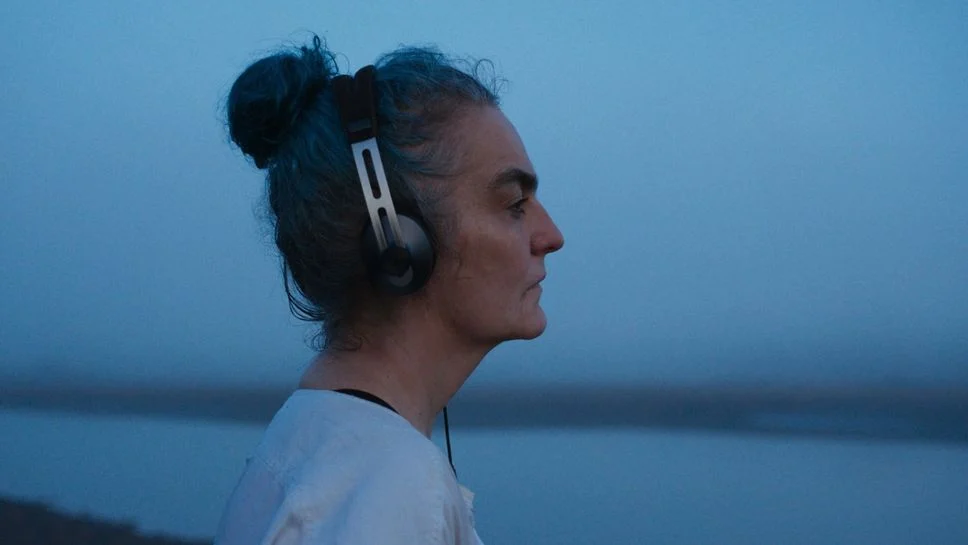
In “Far From the Trees,” (“Lejos de los árboles”) Meritxell Colell asks viewers to listen before they try to understand.
Premiering in Locarno’s international competition, the Spain-Italy-Peru production from Allegra Films follows Adela, a 50-year-old Mexican sound artist who travels from the Peruvian jungle to the Andes recording endangered languages. Accompanied by a guide and translator, she is continuing the work of her grandfather, a Catalan Republican exiled in Mexico. But news of her grandmother’s possible death fractures the journey, drawing Adela into childhood memories, family silences and fantastical visions.
For the director, the film began with an absence.
“‘Lejos de los árboles’ came into being in 2020 following the death of a very close family member. At the time, I knew only that I wanted to address the inability to say goodbye—the inability to view a dead body and the emotions that entails—and to link this to sound,” Colell told Variety.
She initially searched for displaced or migrant sound artists and encountered Angélica Castelló, a Mexico-born, Vienna-based composer whose grandfather had also gone into exile.
“The film emerged from her story and those initial impulses; years later, I realized it also connected deeply with my own life – specifically, with the legacy of silence passed down by my grandparents,” Colell explained.
Rather than reconstructing her own family history directly, she created Adela: a fictional figure whose identity is formed by migration, artistic vocation and the simple fact of being often elsewhere.
“I was determined to center the film on the complexity of hybrid identities shaped by exile and migration –identities where the status of ‘foreigner’ becomes the self – and on the burden of that inheritance,” she said.
The geographical distance was crucial. Adela follows her grandfather’s footsteps while transforming his political and anthropological work into art, weaving a sound map from languages at risk of disappearing. The connection between Indigenous languages in Peru and Catalan exile was not part of the earliest drafts, but became the idea that brought the film into focus.
“Once the idea of vulnerable languages came up, everything fell into place,” said Colell. “It became clear that her work was carrying on her grandfather’s legacy, adding a new dimension to his figure.”
The grandfather became an activist-anthropologist dedicated to recovering native languages in Mexico, a calling linked to his flight from a Catalonia where Franco’s regime suppressed languages other than Castillian Spanish.
“In a way, the film is an ode to the beauty of languages, to their collective value, and to multilingualism as a viable social reality,” Colell says. “Language is a form of thought, a way of seeing and inhabiting the world. We don’t necessarily have to understand every form; we simply need to listen to them, however we can.”
That principle shapes the film itself. We hear the birds, wind, voices, music, the whirr of a grandmother’s sewing machine and a thud against a trunk of a tree.
“Sound is essential in cinema – not only on narrative and contextual levels but also on perceptual and emotional ones,” observed Colell. “That is why I was so eager to make a film featuring a sound artist as the protagonist.”
The film’s Super 16mm passages, which inhabit memories, visions and reveries, were shot without synchronized sound. The voices of Adela’s grandparents and Paula were recorded separately, leaving Castelló free to build what Colell calls “a sonic tapestry woven from a multitude of sounds.”
Castelló’s presence reshaped the film over years of residencies, meetings and debate. The director was determined, however, that Adela would firmly be fictional rather than becoming a portrait of the performer.
“It was a way to lighten the role, turn it into a game, and distance it from reality,” she said. “It was crucial for me to portray a person in her fifties who had left her home country to pursue her passion– music – and to depict a type of woman rarely seen on screen.”
“As time went on, my initial intuition upon meeting her was confirmed: She was the film.”
Producer Mayca Sanz L-Higueras began assembling the project in 2021, initially seeking a European structure that could connect with Latin America through Ibermedia. Italy’s Exit Media joined first; Peru’s Animalita Cine later came on board, while RTVE helped complete the financing.
“In Peru, the biggest challenge has been finding someone willing to commit to filming with a fiction crew – albeit a very small one – in a country completely unprepared for such a project, and with a story that required the commitment of non-professional actors whom the director had sought out, selected and worked with over time, following location scouting trips spanning three years,” said Sanz.
The shoot unfolded in five blocks over more than a year, beginning in February 2024 and ending with Teresita Sánchez’s scenes in July 2025. Colell also became a mother during production.
“At times, I worried that shooting in such fragmented stages might result in something of a Frankenstein’s monster; I’m used to filming in chronological order,” she says. “The surprise came when we started editing and saw that everything actually fit together perfectly.”
For Allegra Films, Locarno’s selection validates a leap into a more ambitious international model. For Colell, it offers a setting suited to a film that resists tidy explanations.
“I love open cinema– films that engage the viewer and connect them to their own lived experience. Cinema that pierces you and settles deep in your gut, beneath your skin, in your chest,” she says.
She hopes younger viewers will leave the screening wanting to investigate the history of exile, or to ask their own relatives what was never said.
“The film speaks to the need to listen, the importance of passing things on, and how we people act as both transmitters and receivers of memory,” said Colell. “And, in a sense, the film itself is a body of memory.”
The collaboration between director and lead allows “Far From the Trees” to examine the cost of building a life elsewhere. Adela’s strained relationship with those tasked with caring for her grandmother, raises questions about who stays, who leaves and who inherits responsibility.
“Distance is inherently complicated, yet it can also be liberating,” said Colell. “I wanted to explore this issue without judgment: to discuss the consequences of living far from family, how that shapes one’s identity, and how it affects those who take on caregiving duties.”
She recalls Castelló telling her: “I am a permanent foreigner. My home – my refuge – is sound. Music.”
“That statement encapsulates the film’s central quest,” Colell concludes. “I would love for the film itself to become that home, that refuge.”
Read more Andreas Dresen, Doris Dörrie Films to World Premiere at Zurich Film Festival