
For “Sacred Creatures” director Frieda Luk, belief can be comforting, ridiculous, exhilarating and hard to explain.
Read more Here’s How to Watch Claressa Shields vs. Kaye Scott Boxing Live Online
“I’m really fascinated by when people believe in something,” she tells Variety. “One person believes in something, and then a group of people, and then it slowly becomes this massive phenomenon. It goes viral.”
That fascination drives Luk’s debut feature, which world premieres in competition at the Edinburgh International Film Festival. Starring Olivia Luccardi, James Cusati-Moyer and Romina D’Ugo, the Canada-Italy production follows three estranged siblings reuniting in rural Italy after middle sister Miriam (Olivia Luccardi) is released from psychiatric treatment following an experience she understands as a spiritual awakening rather than a breakdown.
“This movie is my exploration of believing in something and belief,” says Luk. “Miriam has agency. She knows herself and she makes choices. However, when she becomes a figure that people rally around, people are imbuing her with meaning. When she becomes abstract, she no longer controls the message.”
That uncertainty extends to the film itself, which slips between psychological drama, comedy and magical realism without settling comfortably into any of them. For Luk, the tonal slipperiness developed naturally from writing. “I set up the situation and these characters, and as I’m writing, I’m following what they’re doing. What I’m waiting for is how they surprise me,” she says.
One influence was Marco Ferreri’s “La Grande Bouffe,” the grotesque story of four men attempting to eat themselves to death. “The comedy is following through that premise in a serious way, because if you actually are going to eat yourself to death, you’re going to have gastrointestinal problems,” Luk says. “It’s also very silly. It never takes itself too seriously.” Italian cinema was integral to “Sacred Creatures” from the start. Luk points to films of the 1970s, admiring their willingness to move between modes contemporary cinema can sometimes keep separate. “A lot of the ’70s movies, especially European ones, are completely in between genres.”
Luccardi was similarly keen to avoid reducing Miriam to a diagnosis. “She is healing from the lack of belief from people and everyone thinking that something was wrong with her,” Luccardi explains, adding that Miriam feels “meant for something greater.”
There was another, less metaphysical piece of direction that unlocked the character: Luk told her Miriam was like a cat.
“She’s very much like: ‘I’m letting you in on my terms. No, I actually don’t want you to touch me. I want to be a pet, but not like that,’” laughs Luccardi.
“I did a lot of cat direction,” Luk dryly admits.
As Miriam grows more secure in herself, Luccardi subtly changed the physical quality of the performance.
“There was more of a calmness in my breath,” she says. “She was more relaxed and calm and just flowed. Before, she may have been a little more stressed and tightly wound.”
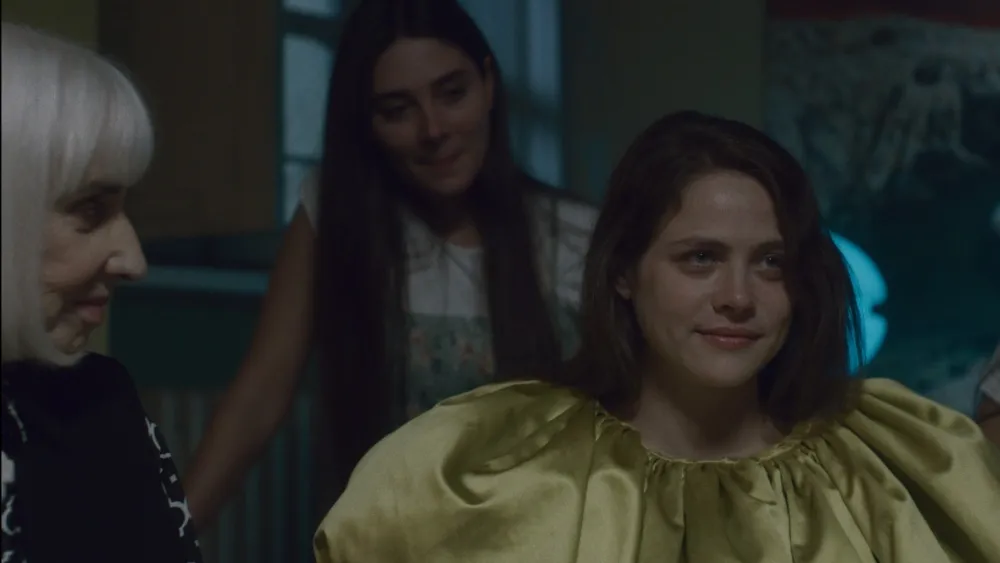
That growing self-possession becomes visual in the film’s party scene, where Miriam arrives in a voluminous yellow-green dress that immediately separates her from the room around her. There is something of Bette Davis’ party entrance in “All About Eve” to the moment: costume becomes a declaration of presence, allowing Miriam to suddenly occupy a different plane from everyone watching her.
Luk wanted the dress to be “kind of ridiculous looking, but also kind of chic,” something that would “take up some space” without seeming entirely out of place. “Miriam is new and a little ridiculous,” she says, with its uncontained “fluffiness” signalling “an irreverence to what has come before.”
Luccardi’s relationship with it was rather less reverential by the end of the shoot. “At the beginning, it was great. At the end… I wore it a long time,” she jokes. “As with every costume, you love it at the beginning and then you’re like: ‘Can we burn it, please?’”
The surrounding family remain skeptical of their sister’s burgeoning allure to those around her. Luk, an only child who grew up surrounded by cousins, was amused by the way relatives can inhabit incompatible versions of the same history.
“They’re always competing,” she says.
The instinct of creating a story that makes life easier to comprehend ultimately expands beyond the siblings.
Luk grew up without religion, but many childhood friends were religious and invited her to churches and youth groups. Watching from the outside, she was intrigued by their ability to surrender themselves to faith.
“I would watch them read a text and believe in that text and treat it like this holy thing,” she recalls. “It was really hard for me to give myself over to something like that.”
At Catholic services, she found herself captivated by the incense, clothing and ceremony.
“I was like: ‘This is so fun and theatrical.’ I can see how it could be really comforting,” she says. “There’s a community-oriented spirit to it. Being a fan of a big sport is kind of fun. Yelling at a team is fun.”
The director began thinking about fandoms, sports and social media with much the same curiosity. What separates a few people who regularly gather from a movement?
“What if people hung out, and then that becomes a movement?” she says. “A few people hang out, and then more people hang out. Then you do it regularly, and what happens?”
The film is shot in Piedmont and Italy provided a fertile landscape for those questions. Luk recalls seeing reports about a teenage protester and wondering why there couldn’t be a patron saint for protest, and what the origin story of a new saint might look like.
But after all that construction of a film, a family history, a faith and perhaps even a saint, the director isn’t interested in providing audiences with a final answer about Miriam.
“I want people to come away examining why they believe in something and how,” she says, “and that there is a pleasure in believing something.”
“You never know if you are right or you are wrong. You might be wrong.”
Or, as Luccardi puts it: “You never know if someone’s crazy or if someone’s enlightened. Who knows?”
“It’s a fine line.”