
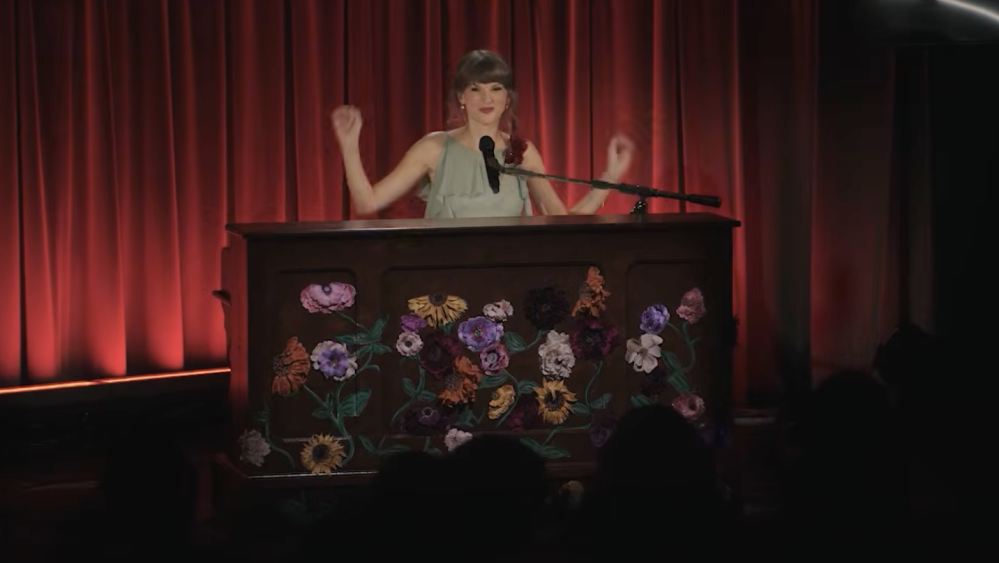
Most Taylor Swift fans probably do not think of the sad events of “All Too Well” and the ultimately happy “Toy Story 5” as occurring in the same cinematic or musical universe. But, to the contrary, Swift sees a clear thematic connection between her epic romantic tragedy of 14 years ago and the happily-ever-after saga of Jessie in this year’s Pixar film, with some choice “Folklore” from the years in-between as connective tissue — namely, “I Knew It, I Knew You,” “August” and “All Too Well.”
Read more Hulu Cancels Mindy Kaling-Created Comedy ‘Not Suitable for Work’ After One Season (EXCLUSIVE)
The mashup of the three numbers comes as a surprise at the climax of a newly released video of a recent program at the Grammy Museum, which was released online Monday on the Recording Academy‘s YouTube channel. The fewer than 200 attendees at last week’s semi-secret session in the museum’s intimate Clive Davis Theater had done a good job of helping keep the nature of the performance under wraps until now.
Swift introduced the six-minute solo piano performance following a 42-minute interview with Recording Academy chief Harvey Mason Jr. Speaking directly to the audience, she explained that what they were about to hear would be an echo of the surprise medleys she performed on her record-breaking stadium tour that wrapped up in December 2024.
“This is the piano that I brought with me all around the world on the Eras Tour,” she says in the video, “and one of my favorite things that I would do on the Eras Tour and something that really became something the fans paid a lot of attention to and would make a lot of guesses about every night was, I had this section called the acoustic section. I would do different songs every night, one on guitar and one on piano, and I started to really have a blast with creating medleys towards the middle/end part of the tour. And I’d really just think about different songs I could mash up with other songs (as) kind of a surprise and delight moment for fans. And a way that I would pick the songs is, I’d find some sort of through line, whether that was rhythmically or these are all about a similar emotion. And I prepared one for you today that, if I was still on the Eras Tour, I would do this one. And it’s songs that are connected to each other by the common theme of being about memory and reliving certain detailed memories of your life and the significance of those memories.”
The strands of the three songs are interwoven in a way that makes it sometimes difficult to discern where one ends and another begins, especially as elements of the tunes are repeatedly reprised and entwined. The mashup starts with the wistful opening lines of “I Knew It, I Knew You” — “I knew you through the daze of the blades of the grass in summer / Parachutes for the free fall of being younger” — before “the rivers I cried when we said goodbye” turn to the sad strains of the breakup song “All Too Well.” Things turn sunnier again with sunny excerpts from “August,” and then, by the time the six minutes are up, the mashing has gotten more severe, with tangled lines like “I remember it, you were the free fall of being younger” and “I knew it, I knew it all too well.”
“I Knew It, I Knew You” continues to do well on the country chart — as well as on Billboard’s Hot 100 — and Swift spoke about resuming her romance with the genre that brought her to the dance. “I think this can happen as you grow up,” she told Mason, prior to moving to the piano. “I love my country roots more and more, the further along this path I get, and I want to honor them more and more, and I feel more tied and more loyal to them. The people that shaped who I am as an artist and as a writer, that all happened in Nashville.”
Swift spoke at the beginning of the program about her first single, “Tim McGraw” (while offering no clues about whether a deluxe edition of her debut album might yet come to fruition, as hoped). She picked out a line that might have alluded to slightly saucier circumstances than were directly stated.
“That song, when I look back on it, it kind of establishes a pattern of writing in detail,” she said. “That’s something that people bring up to me a lot about my work, is that I write in detail. But I do think it’s important to determine that the details have to have a significance to the story at hand. And in that song, there’s a line that says, ‘Just a boy in a Chevy truck that has a tendency of getting stuck on back roads at night.’ And if you look at that at face value, you’re like, ‘Oh, that truck broke down a lot.’ But if you look into it, the double meaning is these are two teenagers who used to, like, park and kiss and tell their parents that the truck broke down.”
“Ah. So now we know!” responded Mason.
Moving on to her third album, “Speak Now,” Swift said, “On that album, I really learned how to take a feeling I was feeling and then craft that on my own into a sound and kind of world-build the music around my feeling for it…. The song ‘Enchanted’ is about falling in love and that sort of glittery, twinkly fairy lights feeling. And that’s exactly how the song sounds. There’s a song called ‘Never Grow Up’ that is a song to a little kid who’s asleep in a crib, and it sounds exactly like a lullaby. There’s a song called ‘Mean,’ which was about criticism. And at that time, one of the criticisms I was facing was, ‘She’s not country enough.’ So I was like, ‘Put just as much banjo on this as we can possibly.’
Read more Imagen Awards Red Carpet: Andy Garcia, Karla Souza, Wilmer Valderrama and More Celebrity Photos
“So when I had learned that, how to match my feelings to really influence what I was writing, and how I was kind of influencing the production of it to sound exactly the same, it really helped later on when I would be able to write backwards from that. If somebody would send me a track, I’d listen to the first five seconds of the track and be like, ‘Oh my God, this is about a girl who goes home to her hometown on holiday break, and it’s cold, and she falls in love with her old high school flame again, but she has to go back to the big city, but she’s fallen in love with him over the course of two days. What’s she gonna do?’” (The song she’s referring to there, as all Swifties would immediately recognize, is the bittersweet fan favorite “Tis the Damn Season.”)
Asked by Mason how her lyrical approach changed from her early days being identified as a country artist, Swift says, “I think the main change would be, as a lyricist, just sort of he vernacular over the years that I would use. Because when it comes to writing different shades of my music, you can say the same thing many different ways. You can say ‘I’m into you’ by saying, ‘Your Midas touch on the Chevy door, November flush and your flannel cure.’ Or you can say, ‘You got that James Dean daydream look in your eye.’ They mean exactly the same thing: ‘Everything that you touch glows. You are the most important thing in my world, and I just saw you for the first time, and I can’t believe it, and I don’t know what to do with these feelings.’ But you can just choose to say them different ways.
“And I think that the way that I’ve chosen to express myself as a lyricist has changed over the years, and there are times when like those contradictions will come up where fans will be like, ‘I can’t believe the same person who wrote this wrote this.’ Because one will be very simplistic and silly, and one will be very detailed and deep andwe’re doing tons of allegory, and we’re just in a whole other world of atmospheric speech. But I think that that human contradiction is fun. I think that it’s fun to make playful songs. I think it’s fun to make songs that are desolate and lonely and just bedraggled lyrically as well. And that it’s that human contradiction that I find interesting.”
The “Reputation” album came up for discussion as a key point in which Swift deliberately played with negative perceptions that were plaguing her and turning them to her music’s advantage. “It was a time in my life when, for the very first time, not the last, people had really actively tried to misunderstand me just in general, and to misunderstand what I was trying to say and to purposely misinterpret it. And it felt very stifling, as a person, as a human being, but ultimately as a writer. It gave me this really, when I look back on it, this really sort of gnarled bite when I would write my lyrics… This is when I learned, like, when people are in like a hate frenzy about a public figure or really anyone — it could be lyour daughter in her middle school class — when people decide we’re all gonna stand around someone and point and mock them, you can’t respond with outward sincerity. Any attempts you make to explain yourself earnestly or sincerely will just be mocked even worse. And so it was an interesting challenge as a writer to say, ‘What can you possibly say when everything you say is being returned to you in this sort of distorted… like, they overreact rather than react to anything that you say or do, any position you take?’
“And so I decided to put out a song called ‘Look What You Made Me Do’ as the first single where I, as a dead corpse, emerge from a grave, and then proceed to deliver this very tongue in cheek, sort of mischievous take on what it’s like to feel cornered in that way. But the fun part of that album is that it had a lot of sides to it. If you looked deeper into that album, it’s an album about feeling so upset about this mass shaming that you felt like you were going through, that you find this little cave, and you crawl in there, and you try to find a tiny bit of warmth, and that warmth sustains you for the entire time that you feel so massively misunderstood by people who don’t know you. … I think the things that I look back on now is, like, when I’ve gone through something that was sort of an attempt to drive me insane, when you don’t allow that to happen, and you use art and music as a way to barrel roll out of that, those are the moments I’m the most proud of.”
But Swift made it clear that she doesn’t think unleavened autobiographical writing is all it’s sometimes cracked up to be in the current world of spill-all-the-tea pop.
“I think that when I say the term ‘confessional songwriter’… I think it’s important to specify that not all shocking revelations you make about yourself are deep.” There was a pause, as a room full of songwriters — the event was specifically for the Recording Academy’s Songwriters & Composers Wing — erupted into laughter. “Just saying something dramatic, shocking and wild doesn’t make it something that’s gonna help people, resonate with people, (or) be an important story that sits in people’s minds, hearts and souls. We have to be purposeful. You can’t just cream something crazy and be like, ‘I’m a confessional songwriter.!’ Just for the same exact reason why details should not be strictly decorative. Like, let’s not be haphazard with these things. Let’s make them count.”
(Watch Swift’s account of how the song “I Knew You Were Trouble” in this video excerpt.)