
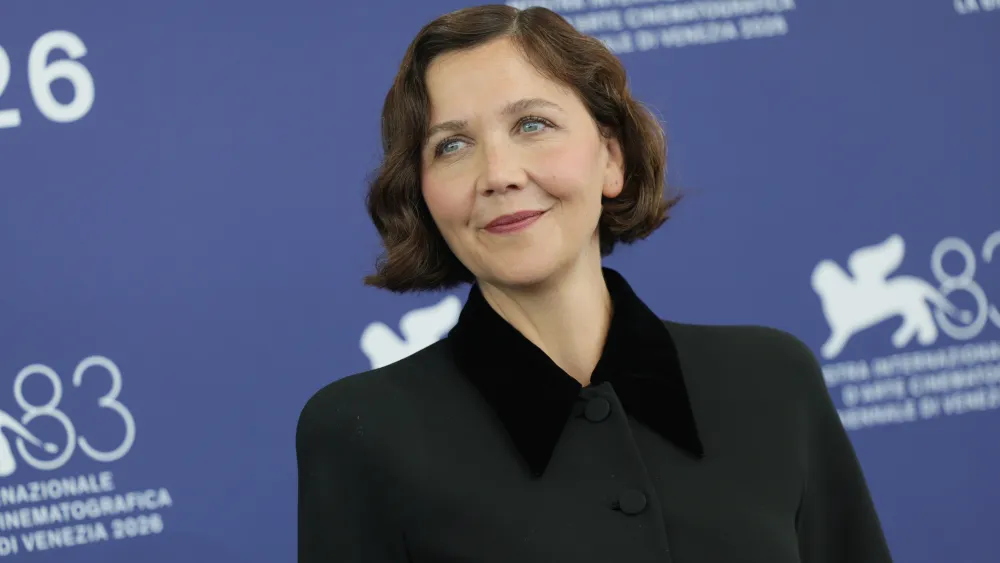
Venice jury president Maggie Gyllenhaal revealed that she experimented with artificial intelligence to transform Dakota Johnson into Marilyn Monroe for her short film Flesh Impact which plays on the Lido. But she ended up scrapping it because she felt that it stripped Johnson’s performance of the very humanity that made it compelling.
Speaking at the symposium alongside composer Alexandre Desplat, filmmakers Lee Daniels and Shannon Murphy, producer Lorenzo Mieli and artist Marc Quinn, Gyllenhaal said the short portrays a 100-year-old Marilyn Monroe with flashbacks to Marilyn Monroe when she’s in her 30s which Johnson plays.
“And the people who commissioned this project from me asked me to use AI. And I thought — I mean, they weren’t using OpenAI, they were using licensable AI, training it off of Marilyn Monroe films that we had licensed. And I went for it. I was like, all right, I’m curious, I don’t know, let’s see,” she says.
“The idea was that we trained it on her, we then put her face on Dakota’s face. We worked hard at it, and in the end, I threw it away because what was coming through Dakota playing Marilyn Monroe was so much more moving, human, alive,” she revealed during the symposium which was presented by Finch & Partners and CAA.
“It fundamentally did not work. All the reasons we decided to make this project to begin with were, were, were, were killed off in the AI version,” she continued.
Besides the creative shortcomings of AI, she stressed there’s also talked about the “huge environmental issues” it raises.
“In America anyway, there’s a big conversation in South Memphis about the data centers. That’s a problem, so we should acknowledge that.”
She also pointed that even Geoffrey Hinton, the pioneering computer scientist often referred to as the “Godfather of AI,” is “ringing bells of alarm.”
“He said that he thought that we should program AI with a maternal instinct,” she said. “Because what other model is there of a less intelligent creature kind of controlling a more intelligent creature than a baby and its mother?”
“I was like, first of all, so fascinating, but what does that mean to program AI with a maternal instinct coming from the godfather — that’s what he’s called — of AI?”
On the financial standpoint, she said found the whole “democratization” argument that AI is supposed to provide to filmmakers unconvincing because it comes from people who are behind these AI softwares.
“It concerns me a little bit because they own it. Who’s making the money off it? The people that are pitching that,” she joked, drawing an applause from the crowd.
Ultimately, filmmakers and talent might lose out if AI starts being used more frequently to make commercial movies.
She recalled being told that soon enough, “$40 million will now be able to cost $4 million if you do it with AI… and maybe even eventually $40,000 — which is what you were talking about in terms of democratizing or opening opportunities to people who wouldn’t otherwise have them.”
“But the thing is, is if you can make a commercial good enough movie for $40,000 or even for $4 million, who’s gonna give you $10 million to do it the old way? Nobody. I mean, maybe there’s a tiny, tiny little market for that. But, you know, that concerns me.”
Read more Indonesia’s ‘2nd Miracle in Cell No. 7’ Gets Philippine Remake From Viva Communications (EXCLUSIVE)