
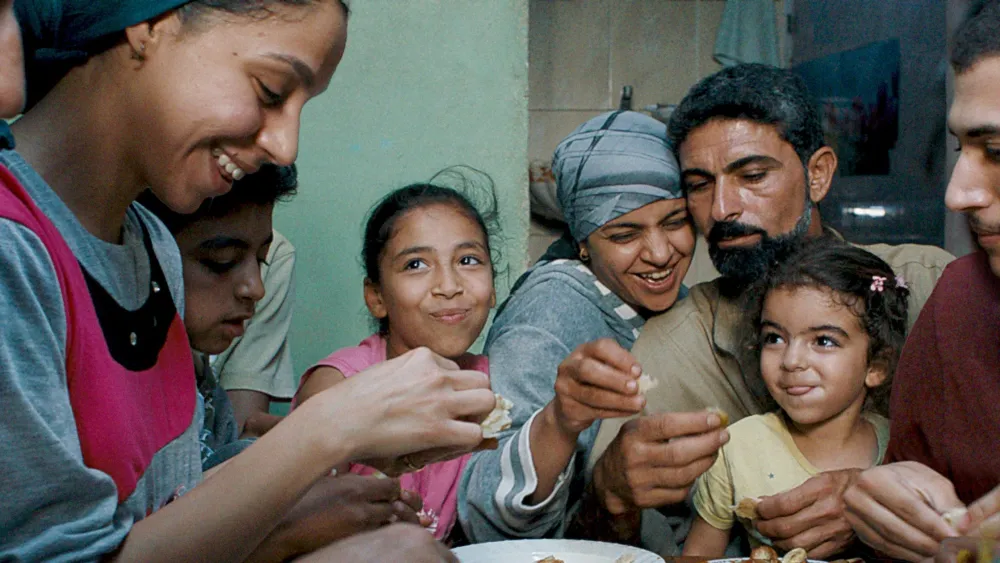
There isn’t an iota of artificiality in Ashgan El-Hamus’ impressive debut “Al Baraneya,” not an easy accomplishment given that it’s fiction looking like a documentary, with a cast almost exclusively composed of relatives. The format translates to an energized intimacy, enhanced by months of workshopping the story together with the one professional actor, Reem Amer, seamlessly inserted in the family bosom. El-Hamus’ achievement however goes beyond method thanks to a story told through moods and textures, of a young pregnant woman in the Egyptian village of Al Baraneya beginning to question the life she’s had plotted out for her. This is the kind of film that seems small only at first glance, building in impact as it plays out, lingering long after the close with images and sounds of the laughter that comes from togetherness.
Read more TikTok Creator Skyelar Chase Signs With Innovative Artists Entertainment
Al Baraneya is an agricultural town at the southern end of the Nile Delta, close in miles to Cairo but psychologically worlds away. Set on the edge of fields planted with jasmine and wheat, it looks like many villages in the area, with plain brick and concrete buildings, the noise and dust of the center belying the greenness just beyond the unregulated constructions. Though this is her extended family’s home, El-Hamus was raised in The Netherlands and her crew are all Dutch, a recipe that could have imposed a level of inauthenticity that is fortunately dodged by the director’s proximity to the cast and an avoidance of any kind of Global North pandering or poverty porn.
Despite being married, Amal (Amer) still lives with her parents and siblings while her husband Omar (Mostafa Noureldin) tries to scrape enough money together to build a house for themselves and their baby on the way. Amal’s is a raucous extended family consisting of younger siblings and cousins, presided over by father Sayed (Alsayed Mohamed El-Hamus) and mother Sara (Sara Ali El-Hadary). Before dawn Amal and the girls go into the fields to pick jasmine, which they string onto garlands and peddle at intersections in town. Everyone has a clear role in the family, with only the beloved grandma (Fatma Farahat El-Hadary) freed from the need to contribute financially. Her bed is Amal’s haven after a long day’s work, where the two can joke, watch TV, and relax in unaffected warmth.
Money is tight, the wheat harvest yields less money, and Sayed is being pestered by an outsider to sell his fields. Every offer is firmly rebuffed, and the promise of an easier life, with the possibility of moving to a large apartment near the sea in Alexandria, holds no temptation. For Sayed, it’s not a question of money but of a connection to the land, shared by his entire family: “Are we people of balconies?” asks the mother rhetorically. Life isn’t easy but it’s familiar, and breaking from tradition is an unthinkable leap into the unknown. Amal doesn’t question any of this: She’s awaiting her baby and the moment she and Omar can reproduce the kind of life of their parents and grandparents.
When the family gets a visit from cousin Rania (Salma Khattab), a beautician in Cairo who comes with gifts of clothes and creams and makeup, it opens up a different way of being an Egyptian woman. Following a fight with her mother, Amal secretly takes a bus into the city to see Rania, who offers sympathy together with a glimpse of independence — there’s a terrific scene where the two make a TikTok video in an open studio in a shopping mall, their expression of freedom, unbeholden to more conservative social norms, acting as a conduit towards questioning the life path of a young married woman in rural Cairo.
Not that El-Hamus looks down upon the choices made by the characters in Al Baraneya. The pull of family security, notwithstanding financial precarity, is palpable, and one of the film’s strengths is the way it conveys a joyous connection between the women of the family. (There’s little interaction between brothers and sisters, father and daughters.) “If you think they’re happy, you’re wrong,” says grandma to Amal as they watch a soap opera showing rich and glamorous women, and she’s right. But for Amal, a new way of thinking about her future is dawning, and with it, potential dissatisfaction with what previously had been her set role in life.
Economic difficulties, tradition resisting a changing world (not necessarily for the better), and new-found opportunities all enter into the mix in an organic way, spun out through the family’s natural interactions. Despite knowing this isn’t a documentary, it still takes some time to sink in that this is fiction, given how embedded it is within family life: It’s even more impressive that a Dutch DP, Douwe Hennink, was so accepted within their midst. Edited without a hint of didacticism, and privileging the family’s tight-knit rapport, “Al Baraneya” is a rare transnational production that doesn’t feel designed solely for European-American consumption.
Read more ‘Game of Thrones’ Creator George R.R. Martin Confirms Play ‘The Mad King’ Will Transfer to London
‘Al Baraneya’ Review: Cinema Verité Doesn’t Get More Naturalistic Than Egyptian Director Ashgan El-Hamus’ Impressive Debut
Reviewed at Venice Film Festival (Giornate degli Autori, Special Events), Sept. 3, 2026. Running time: 85 MIN.
-
Production:
(The Netherlands-Egypt-Belgium-Saudi Arabia). A BALDR Film in coproduction with Seera Films, CZAR Film, Red Sea Fund. (World sales: MAD World, Dubai.) Producer: Frank Hoeve. Co-producers: Kesmat Elsayed, Eurydice Gysel, Jacomien Nijhof. -
Crew:
Director, screenplay: Ashgan El-Hamus. Co-writer: Roelof-Jan Minneboo. Camera: Douwe Hennink. Editor: Dieter Diependaele. -
With:
With: Reem Amer, Fatma Ibrahim El-Hamus, Nadia Ahmed El-Hadary, Asmaa Ahmed El-Hadary, Farida Alsayed El-Hamus, Fatma Farahat El-Hadary, Sara Ali El-Hadary, Alsayed Mohamed El-Hamus, Safaa Ahmed Kobak, Yehia Saad El-Hamus, Salma Khattab, Mostafa Noureldin. (Arabic dialogue)