
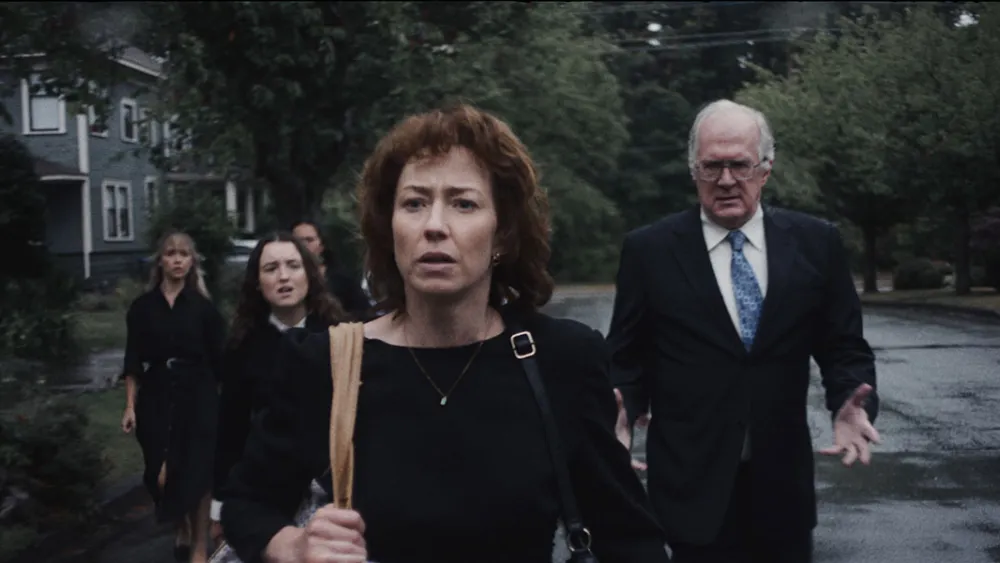
“You carry a lot of weight around, don’t you?” In Guy Nattiv’s observant, harrowing and unmistakably feminine “The Liberation,” this line marks the first time someone truly sees through fortysomething protagonist Rita Cooper. Based on Nattiv’s own grandmother (alongside various cult survivors) and played by Carrie Coon with extraordinary emotional presence and pent-up energy privately looking for an outlet, Rita is an early-1980s woman leading an ordinary life in New Jersey. Quietly depressed, a wife to Reuben (Tracy Letts, Coon’s real-life partner) and mother to Ella (Bella Ramsey) and Jo (Odessa Young), Rita holds a monotonous desk job at a bank by day, and tends to her family by night as part of her humdrum routine. Elsewhere, she agrees to be a part of a video project as a Holocaust survivor, an identity that has defined her past and continues to seep into her present in private, guilt-ridden ways.
Read more Impact of War in Iran Set to Feature in Two Venice Film Festival Dramas
She is confronted with that question at her workplace by the mysterious Ricki (Lily James), an intriguing young woman with an uneasy edge looking to deposit a surprisingly hefty sum of money. Rita shrugs it off with a throwaway remark about her middle-aged metabolism, while handling Ricki’s business. But Ricki isn’t talking about the weight women routinely pressure ourselves about. She’s played with a darkly enigmatic, unnerving quality by James in her finest work to date — a knowing, even domineering smile often curling around her lips. Her next question: “When was the last time you saw the sunset on a beach?”
Ricki is a cult leader in plainest terms, setting her predatory sights on Rita as her next recruit. As these cult stories tend to go, there is usually a magnetic male leader at the center, a sexual predator who brainwashes and preys on young women in search of direction. The scenario in “The Liberation” isn’t that at all — it actually feels several shades darker and more frightening than those clichés, as any middle-aged woman like this critic will feel in their bones.
Rita is at a point in her life when she’s settled into what she deems a less-than-ideal reality, realizing there won’t be anything more. She also feels like her body, her age and her reflection in the mirror are all collectively betraying her, another recognizable truth in her life. So what can possibly feel better and safer than the warm blanket that is female camaraderie, the allyship of fellow women who know exactly what Ricki is going through? Perhaps this is finally a chance for her to free herself from her past, from all society’s preconceived notions and expectations. If only Ricki’s intentions were pure.
Co-written by Noa Berman Herzberg, this is a deeply personal story for writer-director Nattiv, and he does unwavering justice to the shared universality of Rita’s womanly journey. Operating on two timelines that are edited with conviction and well-paced clarity by Sabine Hoffman and Yuval Orr, “The Liberation” introduces us to a Rita deeply caught in Ricki’s web at first, with her daughters Ella and Jo risking a long, perilous journey to rescue their mother from a commune somewhere in the woods.
One of the best actors working today, Coon essentially plays two different sides of Rita with astonishing range across these chronologies, portraying the past and the present of her character through distinctive markers. The domestic Rita is frazzled, hesitant, unsure of her place in the world. Dressed in muted florals and wearing a tranquil attitude on her sleeve, the commune Rita (now named Naia) is contrastingly at peace, yet alarmingly docile, eating a deficient diet of plants (sometimes of the hallucinatory kind), no longer smoking or pill-popping.
Nattiv skilfully braids together the key events that lead to Rita’s breakdown, with a breathtaking sense of tension across the flashbacks. At each turn, a heartbreaking picture comes into sharper focus, underscoring Ricki’s destructive appetite that exploits Rita’s deepest needs and fears under the guise of friendship and no-judgement sisterhood. It’s scary stuff to hear Rita recite lines straight out of today’s empty therapy-speak, delivered by Coon with a devastating sense of vulnerability.
DPs Fabian Gamper and Tudor Vladimir Panduru’s grainy lensing poetically captures these intimate faultlines and era-specific textures, staying close to Rita’s face and increasingly hazy eyes. In their hands, “The Liberation” almost looks like secretly filmed archival footage, with an early-’80s aesthetic still carrying traces of the ‘70s. Their work is matched by the production design and costuming details that favor a real, lived-in version of the decade without caricatured colors and eye-popping patterns.
The film’s absorbing final act is when Nattiv switches gears towards a more conventionally nail-biting thriller, with a diabetic Jo being put in harm’s way by the commune — it would be up to her sister and mother to save her. It’s an elegantly gripping turn in a patient and graceful film that generously laments the pain of an unfulfilled woman.
‘The Liberation’ Review: Carrie Coon Is Breathtaking as a Woman Lured by a Cult in Guy Nattiv’s Deeply Personal Film
Reviewed at Telluride Film Festival, Sept. 4, 2026. Running time: 125 MIN.
-
Production:
A Bleecker Street presentation of a Sight Unseen Pictures, Scythia Films, New Native Pictures, Spooky Pictures production. Producers: Julia Lebedev, Eddie Vaisman, Oren Moverman, Guy Nattiv, Jaime Ray Newman, Steven Schneider, Roy Lee. (World sales: Embankment Films, London.) Executive producers: Daniel Bekerman, Jordan Hart, Neil Mathieson, Leonid Lebedev, Jessica Lacy, Ben Ross, Rami Yasin, Bryan Meng, Dr. Terence Chan, Andrew Karpen, Kent Sanderson. -
Crew:
Director: Guy Nattiv. Screenplay: Nattiv, Noa Berman Herzberg. Camera: Fabian Gamper, Tudor Vladimir Panduru. Editors: Sabine Hoffman, Yuval Orr. Music: Dascha Dauenhauer. -
With:
Carrie Coon, Lily James, Bella Ramsey, Odessa Young, Tracy Letts.