
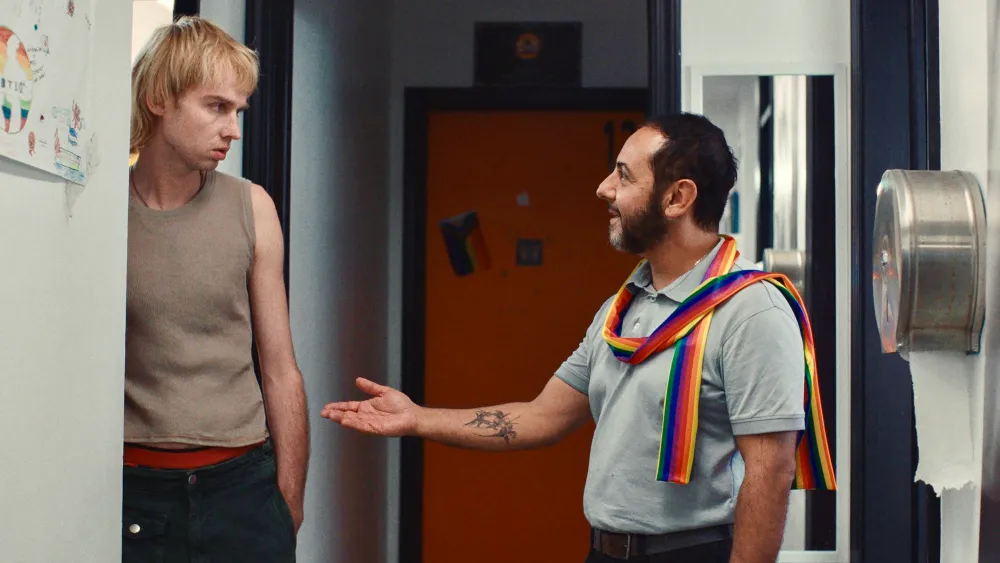
Nothing sharpens the mind like working within constraints. Made on a shoestring production grant of €200,000 ($234,000) and given three weeks to write a screenplay and outline a production schedule, ‘Tijuana, Todavía’ by Mexico’s Gabriel Gutiérrez Morales has been rewarded with a slot at the 83rd Venice Film Festival where it vies for the Queer Lion.
Read more ‘Spider-Man: Brand New Day’ Is Fastest Film to Cross $900 Million at Domestic Box Office
All in all, Gutiérrez Morales and his producer-lead Humberto Busto (“Amores Perros”) were given 10 months to develop, write, produce, shoot and complete the film by the Biennale College – Cinema, which backed it as part of its annual training program. “Not even the smallest films in Mexico are made with a budget that tiny but at the same time, all those restrictions made it a very joyful experience,” said Busto.
Not unlike David Pablo’s Queer Lion and Horizons winner last year, which represents Mexico at the 2027 Oscars, “Tijuana, Todavía” (translated to “Still, Tijuana”) takes place in northern Mexico, specifically the titular border town of Tijuana.
“Tijuana, Todavía” follows the fraught relationship between Maksim, a young queer man who has fled Russia to avoid being drafted into the war with Ukraine, and Chava, a middle-aged gay man grappling with the culture of Northern Mexican machismo.
“As a producer and performer, I feel this film arrives at a pivotal moment,” said Busto, who plays Chava. ‘Tijuana, Todavía’ speaks directly to the current situation in Russia and to the consequences of queer migration to countries like Mexico. This experience of displacement and reinvention at the border is the core identity of the film.”
Busto adds: “As queer filmmakers, we are particularly concerned by the constant threats to our community and that is why we want to counter with this film and establish a dialogue.”
He pointed to recent news that the Italian Ministry of Culture, now under a right-wing government, was not going to support the Queer Lion for the first time in its 20-year history.
Said Gutiérrez: “To add to what Humberto was saying, we felt the need to tell this story and we had the real-life background for it. But then the question became: why set a film like this at the border in Tijuana? Why make the protagonist a Russian refugee?
“The border has been part of conversations around immigration for years. But especially since Trump’s presidency, it’s often portrayed almost like a war zone. What you rarely get to see is the border from the other side. That always felt absurd to me because Tijuana is where I grew up.”
Tapping his own life experience was key. “One of the seeds for the film came when I was still living in Tijuana, shortly after I came out. I struggled to find community in person, so I had a lot of online friends. There was a certain sense of safety in being behind a screen. One of those friends was a gay man from St. Petersburg, Russia and we’ve been friends for about 10 years now.”
Given their budget constraints, the challenge in finding a Russian actor in Mexico to play Maksim was slim but as serendipity would have it, they found Petr Filimonov whose life experience closely mirrored that of Maksim. Like his fictional character, Filimonov was a refugee. He had been arrested for his opposition to the Ukraine war and being gay made him even a bigger target so he fled soon after his family secured his release. He now resides in Mexico.
“In our second interview with him, Petr was visibly emotional, with tears in his eyes. He said: ‘I’m Maksim. I’ve traveled all this way because this is a story you wrote, without even knowing me.’ And to add to their luck, he had also been studying acting for the past four years in Russia. “It was incredibly powerful to watch him and know that, even though this was fiction, his heart and his own experiences were right there in the film,” said Busto.
Reality also reflected art in the case of the Casa de Luz refugee shelter that they featured in the film. “Incredibly, the founder had a personal experience that almost mirrored the story. She fell in love with a Russian man who came to the shelter in a situation similar to the one in the film. Trump’s administration deported him to Egypt and she spent months following him through Egypt, Turkey, the Philippines and Thailand. They eventually got married and finally reunited just a few days before we started shooting. It was an extraordinary real-life parallel to the story we were telling,” Busto related.
Produced by Fosfo Producciones and distributed in Mexico by Colmena, the film also stars Miry Rodríguez, Dilan Rivera, Elliot Roy Rensky and Jorge Domínguez Cerdá.