
Andrew Haigh has built a career watching people at the precise moment their lives come apart — and finding, in the wreckage, something close to grace.
Read more Robert Pattinson Kisses Suki Waterhouse as ‘Primetime’ Rocks Venice With 7-Minute Standing Ovation
At the 53rd Telluride Film Festival, the British writer-director received the Silver Medallion, the festival’s career tribute, alongside Sandra Hüller and John Malkovich. The honor recognizes a sensibility built one film at a time rather than a single breakout. It also coincided with the world premiere of “A Long Winter,” his first feature since “All of Us Strangers” and the culmination of a project he had been chasing for nearly two decades.
While onstage before his new film bowed on the first night of the serene Colorado festival, Haigh seemed faintly astonished to be there at all. When asked when he first pictured himself as a filmmaker, he suggested that, it still hadn’t happened.”I never thought it would be possible,” he says, describing a childhood far removed from the creative industries. “It never felt like a possibility. And then, step by step, I started thinking about it more seriously and trying to make it work.”
Haigh came up as an assistant editor, a job he initially took for money but stayed in for the education.
“It was a great place to understand how films are put together, but also to work out how I wanted to put a film together — the rhythms I wanted, how I wanted to tell my stories.”
That instinct for rhythm has become central to his filmmaking work. A career reel played with crucial scenes from his potent works such as “Weekend,” “Lean on Pete” and HBO’s “Looking.” Haigh is required to fall in love with his actors before he can shoot them.
“Once I’ve fallen in love with them, you care about them, and you want to show them for their brilliance,” he said.
He keeps rehearsals light and conversation heavy, talking around a project rather than drilling it, hoping performers will offer up “those flickers of vulnerability” that most people instinctively conceal.
The preoccupation is personal. Asked about his fascination with families coming apart, Haigh traced it to his own childhood.
“My family fractured when I was very young. I was nine years old,” he said. “I’m fascinated by what people do when things crumble. Can we be resilient? Can we find a way to cope?”
That interest in intimacy dates to his first film, the 2009 docudrama “Greek Pete,” a portrait of a London escort made for a few thousand pounds. Watching his subjects navigate sex and their persistent need for connection reshaped his understanding of what his work could explore.
From “Weekend” through “45 Years,” sex in a Haigh film tends to be less about sex than about identity.
“It’s a way for you to understand yourself as much as it is connecting with somebody else,” he explains.
Two decades into his career, being “an Andrew Haigh film” has become its own shorthand — a designation that, he acknowledges, has made the notoriously difficult task of financing intimate, unhurried movies somewhat easier.
“People want to work with me now, and that’s an incredible thing,” he explained. “I never thought that would be something I’d reach.”
“A Long Winter” is where much of that history converges.
Haigh first read Colm Tóibín’s short story around its 2006 publication, before he had made a feature film, and immediately recognized something in it. He has described the story as containing “everything I wanted to make films about.”
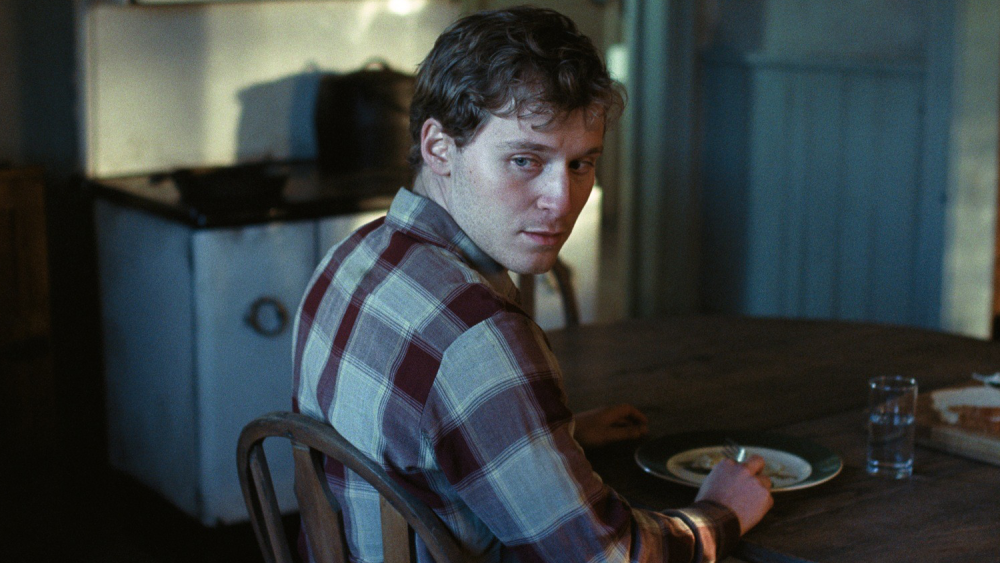
He persuaded the Irish author to grant him the rights and then spent years trying — and failing — to get the movie made.At one point, Haigh’s screenplay was set in Spain, where Tóibín’s story takes place in the Pyrenees. The finished film relocates the tale to the stark American West of the 1950s, where a family — anchored by Fred Hechinger, Caitríona Balfe, Ebon Moss-Bachrach and Kit Connor — braces for winter until the mother vanishes into a snowstorm and her son sets out to find her.
Haigh has jokingly called the film his version of “The Revenant,” a wilderness passion project nearly two decades in the making. But beneath the joke is something more personal: an “endpoint,” as he has described it, for a run of films addressed to a younger, sadder version of himself.
He also appeared ready for the reaction.”You’ll see the film and go, ‘What the fuck is he talking about?’” drawing laughter from the Telluride audience.
The film makes the question easier to answer. “A Long Winter” plays like Haigh’s response to “This Boy’s Life” by way of “The Assassination of Jesse James by the Coward Robert Ford” — a coming-of-age wound set against a mythic, pitiless frontier, patient enough to let the landscape carry much of the emotion.
Hechinger, all raw nerve and watchfulness, announces himself as a star. Balfe is haunting as a mother whose absence hollows out everything around her. Moss-Bachrach, grizzled and heartbreaking as the father, gives the film its ballast.It is not an obvious mainstream play. But then, neither is much of Haigh’s filmography.
That becomes the central awards question surrounding “A Long Winter”: Can the Academy finally catch up with a filmmaker it has spent the past decade admiring from arm’s length?
“All of Us Strangers” earned six BAFTA nominations, including best director and adapted screenplay, but was shut out of the Oscars entirely — one of the more conspicuous omissions of its year. Before that, Haigh’s closest brush with the Academy came with Charlotte Rampling’s best actress nomination for “45 Years.”
This time, the circumstances are a bit different.
“A Long Winter” comes from Mubi, a distributor whose ambitions have expanded significantly after “The Substance” broke through with five Oscar nominations, including best picture. Mubi now has both the appetite and, increasingly, the campaign infrastructure to make a film like this part of the conversation.
The clearest path may be through the screenplay and acting branches. Tóibín’s spare, psychologically loaded source material gives Haigh a natural case in adapted screenplay, while best director and, in an expanded field, best picture are not outlandish possibilities for a film launching through the Telluride-Toronto-New York festival corridor. However, difficult nonetheless. The performances provide another route.
Balfe, long admired but never quite embraced by the Academy despite coming close for “Belfast,” carries the film’s most elusive role: a woman whose presence is defined as much by her absence as by what appears onscreen. Moss-Bachrach, already an Emmy winner for “The Bear,” makes a quiet but formidable case for major film recognition. And Hechinger delivers the kind of breakthrough performance that can turn an emerging actor into an awards-season name ready for breakthrough prizes.
None of it is guaranteed but Haigh’s films have never been. His work has a familiar history of being passionately embraced by critics and audiences before finding itself left off the final list.
At 53, Haigh also suggested that the work may be entering a new phase.
The films about missing mothers, fractured families and unclaimed grief may have run their course. He described projects that would take him somewhere different, including a film about the environment and a television project set in 1980s New York.
“I’m very different than when I started making movies,” he says. “I always want the film to speak to where I’m at in my life.”