
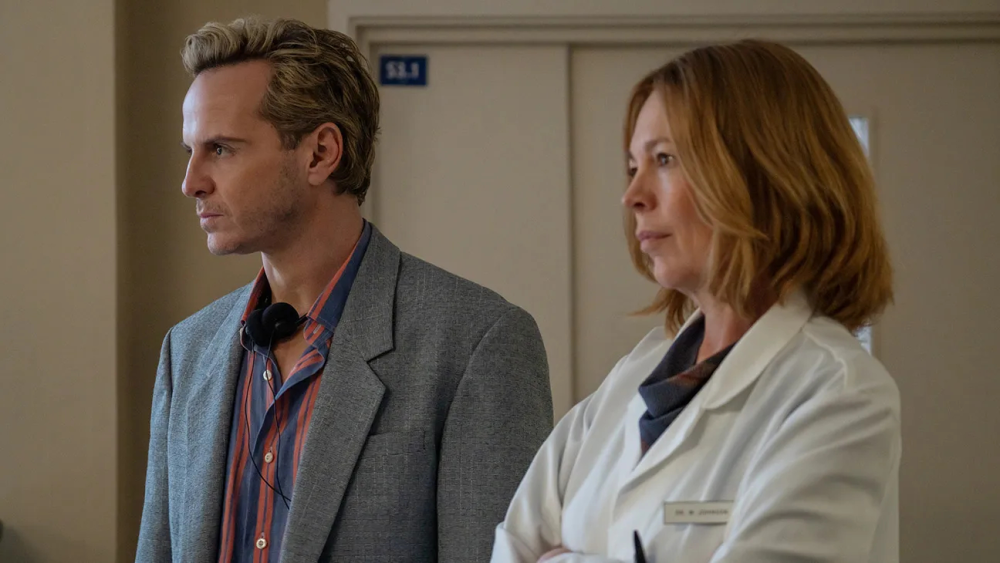
Andrew Scott is the prince of Telluride.
There are performances that feel like a reckoning, and performances that feel like a resurrection. Andrew Scott’s work in “Elsinore,” which had its world premiere Friday night at the Telluride Film Festival, is somehow both — a great actor playing a great actor as the curtain starts to fall, and refusing to let it.
Directed by Simon Stone and written by Stephen Beresford, “Elsinore” tells the true story of Ian Charleson, the Scottish “Chariots of Fire” star who spent the last year of his life playing Hamlet at London’s National Theatre as AIDS was quietly taking his life. He died in 1990 at 40. His Hamlet — hailed then as one of the finest of its generation — became a farewell disguised as a role.
The casting is too perfect to be accidental. Scott is himself a celebrated London Hamlet, here playing a man whose Hamlet was his last act of defiance. “Elsinore” is, at its heart, a love letter to actors — to the craft as vocation, to the courage of standing in the light when the body is failing. And a milestone waits inside the role. No openly gay man has ever won the Oscar for best actor, and Scott could very well become the first.
Make no mistake, this is the role of Scott’s career and it lands him toward the forefront of a best actor conversation he has been circling for years. He has never been Oscar-nominated — a fact that curdled into open disdain when the Academy passed over his shattering turn in “All of Us Strangers.” “Elsinore” is the correction: he captures Charleson’s wit, vanity, terror and grace inside the same breath and in the final stretch, he nails Hamlet’s readiness measured against a dying man’s own — the sustained high-wire work voters still see behind their eyes in January.
It’s also a role the Academy has never resisted. Voters are reliably moved by the actor staring down the barrel of death — Tom Hanks in “Philadelphia” (1993), Matthew McConaughey in “Dallas Buyers Club” (2013) and Anthony Hopkins vanishing into dementia in “The Father” (2020).
“Elsinore” hands Scott the AIDS-era variation, with the added charge of real history — a story to discover even for those who think they already know it. Charleson was a real man and a real actor, dying as he did, playing Hamlet as he did. That is not a fact that asks for votes so much as one that issues a commandment, and I dare any Academy member not to see the worth in honoring such a life through a vessel as gifted as Scott.
Then there is Olivia Colman, who has entered her “Maggie Smith” era and is plainly having the time of her life. Her supporting turn as Charleson’s doctor is all steel and mischief — grumpy one moment, gutting the next — the work of a past winner (“The Favourite”) who keeps finding registers no one knew she had. It belongs in the supporting actress conversation without an asterisk, the season’s most quotable grande dame showcase since Smith herself. Watch, too, for Billie Piper, as a casting director and Charleson’s confidant, who does the quietest and maybe the most surprising work in the film. It’s a stealth turn. Stone directed her to an Olivier Award in his radical stage “Yerma,” and their reunion could carry her into a film-awards conversation for the first time. If Focus campaigns her with nerve, she’s a supporting actress spoiler nobody is clocking just yet.
The rest of the craft work is impeccable. Stefan Gregory’s score rips — propulsive where you brace for a sonorous monologue, tender where you expect something loud. Stone directs with a theater maker’s reverence for the actor’s face; Beresford, who wrote “Pride,” has built a script funnier than any logline would suggest and gutting exactly when it must be. One curious wrinkle: the script credit reads “based on an idea by Ethan Silverman,” which raises the kind of question pundits love — a “Barbie”-style scramble over whether the Academy files it as original or adapted. The WGA has designated it original.
What ultimately matters is this: is it Scott only, or should we brace for more?
A lead performance, fully embraced, can drag a whole film up the ballot. Sandra Bullock’s “The Blind Side” was beloved enough to pull the movie into best picture — its only other nomination — and she won. “Extremely Loud & Incredibly Close” managed the same trick, riding supporting actor nominee Max von Sydow to a best picture berth; it won neither, but von Sydow was plainly the runner-up to Christopher Plummer’s winning turn in “Beginners” — itself that film’s only nomination.
Then there are the critically adored turns that stand alone. Colin Firth in Tom Ford’s “A Single Man” managed exactly one nomination — his — and lost. A year later, folded inside the 12-nomination embrace of “The King’s Speech,” he walked away with the prize. A lone acting nod is a precarious perch, and Scott will need more than that to convert his into a trophy. “Elsinore” likely needs Colman and Piper in supporting, Beresford’s screenplay on the ballot — or perhaps techs like makeup and editing — and even a best picture berth. A great performance gets you nominated; a film full of them gets you onstage.
This can be Focus Features’ specialty. No specialty distributor has been better over the last 25 years at minting best actor winners from biopics — Adrien Brody (“The Pianist”), Sean Penn (“Milk”), Matthew McConaughey (“Dallas Buyers Club”), Eddie Redmayne (“The Theory of Everything”) and Gary Oldman (“Darkest Hour”) — five men, each playing a real one, each launched off a fall-festival bow and a patient platform release. And every one of those films was a best picture nominee.
“Elsinore” follows the blueprint to the letter.
The material carries its own Oscar pedigree — and Focus is riding it. Last winter the studio won its first best actress Oscar with Jessie Buckley in “Hamnet,” the story of the family loss that gave the world “Hamlet”; a few years earlier, Kenneth Branagh, cinema’s foremost Shakespearean, took original screenplay for the Focus release “Belfast.” The Academy’s affection reaches back further, to the wins “Shakespeare in Love” minted for Gwyneth Paltrow and Judi Dench. Now, two years running, the studio has a “Hamlet” in the race. The Bard has been good to this address.
Hamlet’s final words are “the rest is silence.” “Elsinore,” and the actor at its center, make a beautiful liar of the line. On Friday night in the mountains, the rest was a room on its feet and an actor, at last, getting the reception for the role he was born to play.
Read Variety’s review of “Elsinore” here.
See all Academy Awards predictions
Variety Awards Circuit: Oscars