
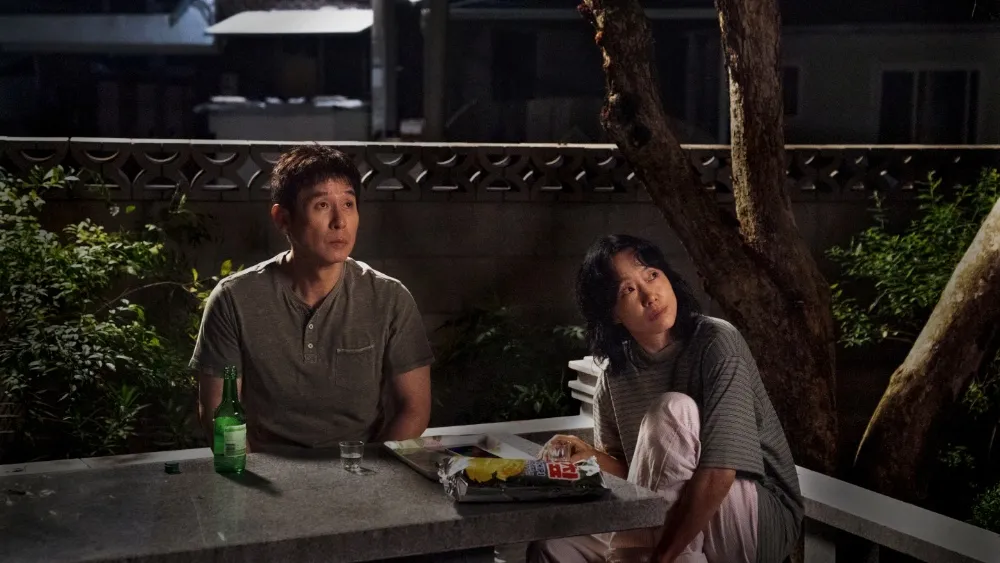
Every great love story, in Korean auteur Lee Chang-dong‘s telling, is secretly a story about love that cannot happen — class, status or fate standing in the way. His new film dares to ask the opposite question, and it took him the better part of two decades, one abandoned script about a 2009 workers’ strike and a single idea from his co-writer to find an answer worth filming.
Read more Are Russian Filmmakers Finally Coming in From the Cold?
“When we think about a love story, usually the most typical love story we think about is love that cannot come true,” Lee says about Venice competition title “Possible Love,” his first feature since 2018’s “Burning.” “So to simply put it, you could say that all of these love stories are called impossible love, so to speak.”
“Possible Love” follows Mi-ok (Jeon Do-yeon), who works at a mask factory while dealing with the fallout of her husband Ho-seok’s (Sul Kyung-gu) layoff and the strike that followed it. A funeral draws the couple into contact with Ye-ji (Cho Yeo-jeong), a filmmaker shooting a documentary about laid-off workers, and her husband Sang-woo (Zo In-sung); they are a couple whose money and detachment set them apart from Mi-ok and Ho-seok’s daily struggle. Once Mi-ok signs on to be filmed, a bond forms with Ye-ji, while something harder to name pulls her toward the unreadable Sang-woo, and the two households’ collision starts to crack open both marriages. Zo and Cho are working with Lee for the first time.
The mass layoff at the center of the film happened at a major Korean company in 2009, followed by a 70-day strike and a violent crackdown by authorities. Lee began developing a fictional treatment soon after but could not finish it. “Every time I create a film, what I need is a conviction that this story is worth telling in the format of a film,” he says, adding that he could never settle whether turning real workers’ pain into fiction, rather than documentary, would mean anything to him, to audiences or to cinema itself. So he shelved it.
The story only came back to life once his co-writer, Oh Jung-mi, suggested pairing it with the story of a filmmaker. “Because it is told adjacent to my own story as a filmmaker, I could be more honest in the storytelling,” Lee says, describing the addition as a new layer that gave him a way back in.
That doubling lets him ask a question he says has followed him since his years as a novelist, long before he started directing. “When we deal with the lives of other people, are we worthy of telling their story, and are we not only using it for our own purposes? This is something that always I had in mind,” he says, adding that the question belongs to all filmmaking, not only documentaries, and that he wanted “Possible Love” to put it to the audience as much as to himself.
He locates the film’s title in the same territory. “In our film, ‘Possible Love,’ as you can see in the title, it asks a question: what is love that is possible?” he says, noting that the love in question reaches beyond the romantic, to Ye-ji’s pull toward the people she films and to Ho-seok and Mi-ok’s marriage. On the distance between the two couples, he resists calling it simple class conflict: “Now we live at a time where class is really no longer just class,” he says, pointing to Sang-woo as someone who “deals with the amount of wealth and capital that is unfathomable by people like Mi-ok and Ho-seok.”
Lee also traces the story to the 10th commandment, “thou shalt not covet,” and to Kieślowski’s “Dekalog 10.” “The former nine [commandments] all are about human actions. However, this very last one is about the human heart,” he says, framing the film’s real question as how much resistance to coveting is even possible “in this capitalist society we live today,” and noting that Ye-ji’s desire to claim other people’s lives for her documentary is its own version of the same impulse.
Jeon, reuniting with Lee nearly 20 years after “Secret Sunshine,” found her way into Mi-ok through what they share rather than their circumstances. “I thought that the anxiety she harbors in her heart was something that I could relate to, because I also have that as well,” she says, describing Mi-ok as someone living with “a ticking time bomb in her heart.” She had read Mi-ok’s pull toward Sang-woo as desire on the page, then revised that once shooting began. “I came to think that it’s more about curiosity,” she says.
She also connected with Mi-ok’s refusal to collapse under hardship, echoing something she says has been said about her own work as an actor. “I don’t think that she is going to crumble and just be sad,” Jeon says, calling the character someone who won’t “let go of hope.” Stepping back onto Lee’s set after two decades felt easier than she expected. Where “Secret Sunshine” had been “very intense,” she says this time “I felt so comfortable and so much at ease when I stepped onto the set.” She adds that “Possible Love” arrives at a point in her career when she has grown frustrated watching commercial appeal crowd out character work in the Korean industry, and that the project is “so significant for me at this juncture.”
Sul, reuniting with Lee 24 years after “Oasis,” which won Lee the Venice Film Festival‘s best director prize in 2002, agreed to the project before reading a script. “I think just the name Lee Chang-dong means complete trust for me,” he says, adding that “Peppermint Candy,” their first film together, remains the role he still calls his most representative work. Getting back on set stirred the same nerves he felt making that film decades earlier. “I just feel like all of this is the power that director Lee holds,” he says.
Playing Ho-seok’s silence, he says, was the harder task. He describes the character as carrying rage, guilt and shame after being laid off, his pride “thrown on the ground,” with only “silence and just glances” as tools, all beneath an outwardly unbothered exterior. Asked whether he saw himself in the role, Sul calls Ho-seok “a universal Korean man,” caught between a tough exterior and a wound he never lets show. He’s less certain how much that particular tension has shifted since “Peppermint Candy”: “It has been three decades, so I do think there has been some changes,” he says, though he stops short of generalizing about Korean masculinity broadly.
Lee, asked about Korean cinema’s rise since his 1997 debut “Green Fish,” when he says international interest in Korean film was “close to none,” credits the industry’s current global standing to younger filmmakers, adding that how optimistic to be about its future “is a question not for me to discuss, but something that I do believe the younger filmmakers of today should be asking themselves.”
“Possible Love” heads next to the Toronto, Busan and London film festivals. It opens theatrically on Oct. 23 before streaming on Netflix starting Nov. 6.