
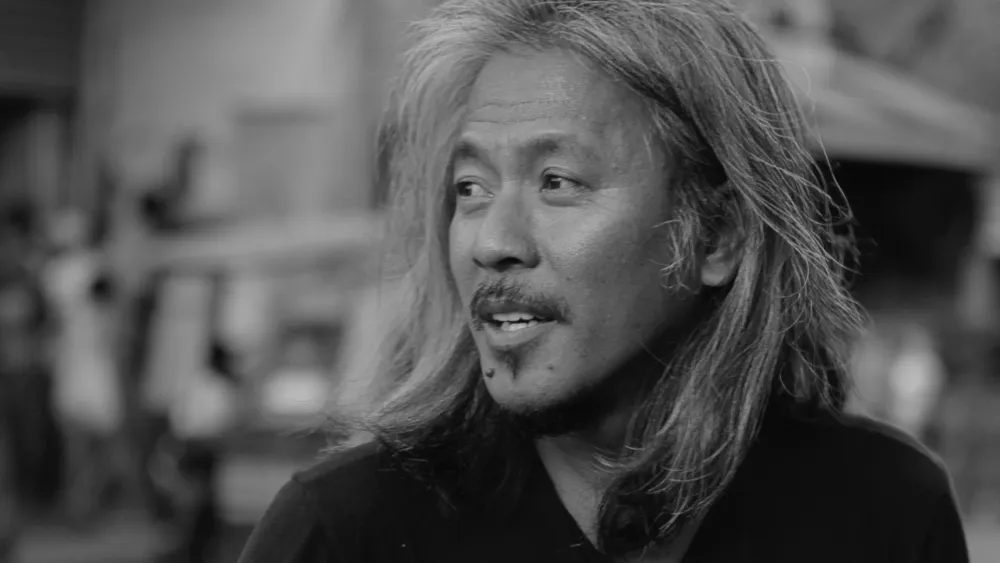
Venice Golden Lion winner Lav Diaz (“The Woman Who Left”), who returns to the Lido this week with the Venice Open selection “Let Us Through, Dear Ancestors” (Makikiraan Po), is in post-production on “An Entry Into the Sadness of a Portuguese Woman.” The Filipino auteur presented the film during the Venice Gap-Financing Market, which took place Sept. 4 – 6.
The third installment of the director’s “Hermes Trilogy,” the Lisbon-set drama follows Lieutenant Ines Horta — described as “one of the finest detectives in the city” — as she investigates a mystery with the help of Sergeant Mariana Moura. Hoping for information from Filippino Lieutenant Hermes Papauran that never arrives, she decides to leave Mariana to deal with the case, putting her life in danger in the process.
“An Entry Into the Sadness of a Portuguese Woman” is produced by Jean-Christophe Simon for Films Boutique and co-produced by Epic Media and Rosa Filmes, with the support of ARTE, Bord Cadre and Sovereign Films. It’s written and directed by Diaz and stars Monica Calle, Ana Vilela Da Costa and John Lloyd Cruz.
The film picks up the thread of Diaz’s previous features, “When the Waves Are Gone” (2020) and “Essential Truths of the Lake” (2023), both of which premiered at the Locarno Film Festival and followed the obsessive, disillusioned Lt. Papauran, billed as “arguably the greatest Filipino investigator ever,” played memorably by Cruz.
Though “Sadness” chronicles an investigation led by Portuguese Lt. Horta, the specter of the Filipino detective — described by Variety’s Peter Debruge in his “Essential Truths” review as “a good cop in a corrupt country” — still looms large.
“Although the focus of this film is now on the brilliant Portuguese investigator Ines Horta, the spirit of Lt. Hermes Papauran is still very present in it,” Diaz told Variety. “They are friends and colleagues, and they share the same idealism in the conduct of their profession. They are for truth. They are obsessed with the truth. They classify truth the way punctuation mark stops a word or ends a sentence; it must not go beyond period. It stops there.”
The director described both investigators as “deeply conflicted beings, restless and battered souls,” whose “inner turmoils are channeled in their probing of hardcore cases.” “They are both outliers in the system they’re working for as they know the dysfunctions of it, but they work around it, oftentimes, carrying their tasks on their own terms, as they don’t trust the orthodoxies of investigations,” Diaz said.
Like many detective stories that came before it, the Hermes Trilogy gnaws at existential questions as much as the simple mechanics of a classic whodunit; as the director puts it: “The great investigator, the obsessive visionary, aims for the mystery of existence.”
Would Diaz apply the same distinction to filmmakers?
“In the case of the filmmaker as a visionary, it simply has to do with a grasp of reality, that deep understanding of life. It’s never on the technical side, it’s never about money, the budget, but more on the perspective realm,” he said. “The visionary filmmaker is trying to crack the mystery of existence. Why is there sadness? Why is there passion? Why am I evil? Why did I fuck my neighbor’s wife?
“The visionary filmmaker is obsessed with the idea of responsibility — what his cinema can do for humanity’s survival,” he continued. “Ultimately, the visionary filmmaker seeks only the truth. And that’s humility.”
Ten years after winning the Golden Lion with “The Woman Who Left,” Diaz is in Venice with “Let Us Through, Dear Ancestors,” a period drama set in the late 16th century and early 17th century, when Spanish forces under Miguel Lopez de Legazpi consolidated colonial rule 44 years after Magellan first landed in the archipelago. “It is an essential part of my continuing studies and dissection of my people’s struggle, or simply trying to understand the history of the Philippines,” Diaz said.
The film arrives one year after Diaz’s “Magellan,” starring Gael García Bernal as the Portuguese explorer, premiered at the Cannes Film Festival.