
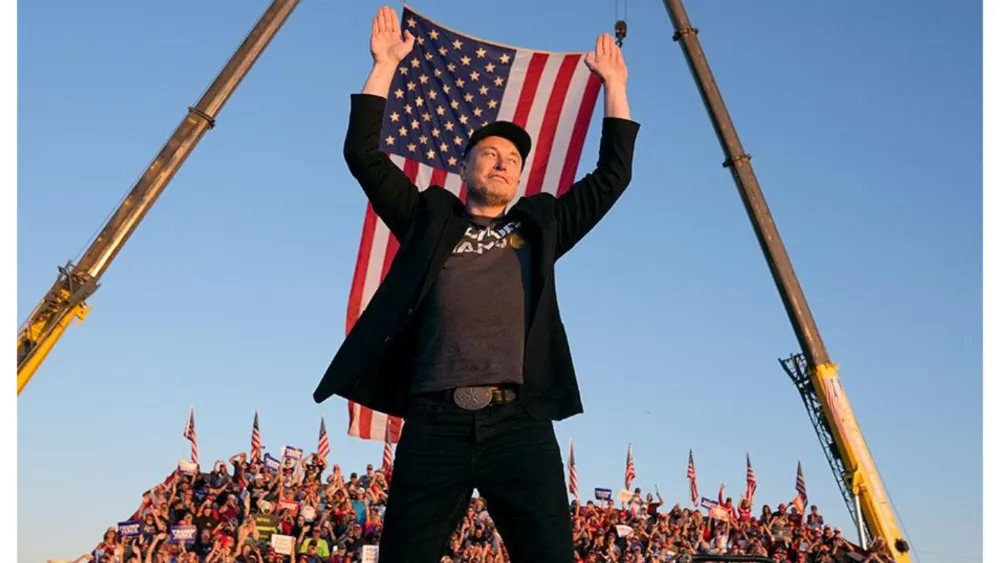
When a subject has been as exhaustively covered — and as infamous — as Elon Musk, the electric-car-entrepreneur-turned-rocket-man-turned-richest-billionaire-in-the-universe-turned-Twitter-disruptor-turned-DOGE-destroyer-turned-God-only-knows-what-he’ll-do-next, reviews of a documentary about him tend to lead by plucking out the film’s incendiary bits of investigative reportage, the ones that feel worthy of a news headline. “Musk,” Alex Gibney’s 3-hour-and-45-minute documentary about the tech bro who would be king, has a handful of those.
Read more Levan Koguashvili Brings ’90s Georgia to Venice With Comedic Drama ‘Guria’
The biggest revelation, to me, was the film’s detailed history of Musk’s attempt to put a self-driving car on the market — a technology that’s sure to be here at some point, though Musk, in his race to be first, was far too eager to announce that it had all happened. Tesla released its Autopilot driver-assist system in 2015 (and then the Full Self-Driving Beta program in 2020), marketing the new technology with ads that exaggerated the car’s powers. And so people were suckered. From the outset, there were accidents. More than 60 fatalities have been linked to Tesla’s driver-assistance systems. Talk about something that could put a dent in your image! But Musk, for the most part, succeeded in hushing up the lawsuits, the federal investigations, and the fatal crashes, which were evidence of a recklessness that should have given the whole world pause.
There are other places where Gibney colors in sides of Elon Musk you knew in a cursory way. It’s well-known that Musk has fathered many children — at least 14, though the people around him say it’s many more. He believes his progeny to be part of a larger war against population decline. The documentary, which features a highly illuminating interview with his ex Ashley St. Clair, goes into the details of how Musk, apart from his two spouses, would zero in on young women he thought would make good “breeders” and get them pregnant, dropping all interest in them after the babies were born. (They were required to sign NDAs.) The film also goes into details of his alleged drug use (ketamine, Ecstasy, psychedelic mushrooms).
Yet what makes “Musk” such a lacerating and important watch, grounded in Alex Gibney’s supremely insightful but user-friendly mastery of the documentary form, is that it takes this flamboyant and in many ways elusive figure, with his tech ambitions and cosmic dreams and malignant egomania, and puts him all together, letting us see how one chapter of his life led to the next, and how the Musk dream wasn’t always so grandiose. You can see it evolve right along with his look. In the mid-’90s, at his first company, the relatively modest Zip2 (which essentially put the yellow pages onto the Internet), he looks just like the tech geek he was inside, skinny and unthreatening, with receding hair and a rabbity grin.
But it’s not long before his Ayn Rand ambitions start to poke through. The hair fills in, the body thickens, and the smile gets elevated into a kind of aggro leer, as Musk makes himself over into his version of a tech-head Nietzschean superman. Gibney plays around a bit, creating a synthetic “interview” with Musk (who, of course, wouldn’t cooperate with him) by putting verbatim quotes of his into the mouth of an AI Elon. Late in the movie, when Musk is wreaking the havoc of DOGE, we see him killing off bureaucrats as if in a first-person-shooter video game.
From the start, Musk has three obsessions: the Internet, energy, and space exploration. He first tried to purchase old Russian ICBM rockets (minus the nukes they were built to carry) for $3 to $5 million, and Gibney shows a fitting admiration for the innovation of Musk’s space dreams. He was leading a movement that was organic: the privatization of space exploration, which resulted from the U.S. government having lost all passion for it. The thrill was gone — for NASA, and maybe for the public. But Musk rekindled that (working in cooperation with President Obama). Sending up rockets was his original and driving obsession. Musk thought of himself as an engineer-magician in the mold of Steve Jobs. With SpaceX, even Musk’s failures (i.e., the first three launches) were spectacular. But he might have gone bankrupt if the fourth launch hadn’t connected.
Read more Andy Serkis Unleashes Imagination with Venice Immersive Breakout ‘Nevatars’
In a way, you could say that the first semi-scandal of Musk’s career was the way he took over Tesla, a sports-car company co-founded by Martin Eberhard in 2003, and then erased Eberhard out of the narrative of the company. Instead, it would all be his, with Musk showcased as the sole visionary — the Henry Ford — of the electric-vehicle revolution. His genius was marketing the Tesla as less a car than a shiny new tech gizmo on wheels. Yet this required a lot of smoke and mirrors, like the Tesla battery fraud: the claim, sold in advertisements, that you could just swap a new battery into a Tesla (it would be as easy as replacing two double-AAs!), when in fact the Tesla battery weighed 1,000 pounds. What Musk was selling was pure fiction. When people started having problems with the cars, Musk established a boiler room full of scammers who took the calls and lied about how the cars could be fixed. In essence, he was gaslighting his customers. The second scandal, according to the movie, is the way he gaslit his first wife, Justine Wilson, after their first child died of SIDS-related causes.
“Musk” opens on something that’s not new (I wrote about it five years ago), namely Musk’s ardent belief in simulation theory — the notion that we are all very possibly living in a giant simulation, an idea bolstered for Musk by his love of video games, which became more and more sophisticated in their creation of simulated realities. The way he saw it: Who’s to say that we’re not all just part of a digital dream landscape, and that there isn’t some cosmic force out there playing us?
While it doesn’t spend a lot of time on this idea, “Musk” uses it make a point: that anyone who truly believes this — and thinks it’s the higher wisdom — may not be in complete possession of his marbles. It’s not that Musk is less than brilliant. It’s that it’s his very brilliance that leads him to invest in the idea that his fruitiest fantasies are reality — like the one he began to evolve out of SpaceX that said we were on the verge of colonizing Mars. There was no truth to it. But Musk, like his future frenemy Donald Trump, was starting to think that he had the power to create his own reality.
Once you start piecing together Musk’s scandals and cut corners and slipshod management, you see that he’s a creator of mirages who promises more than he delivers. There’s no question that the Tesla, as he finally designed it, is a strong and beautiful car, and that Musk’s early advocacy of electric vehicles was a positive force in the world. But his rocket program is increasingly mired in a kind of sci-fi stasis. (His fixation on Mars is right out of the cheesy ’50s.) And when Musk took over Twitter, which he had to borrow so much to buy that he wound up slashing the company to ribbons, it was a lesson in atrocious management (which he camouflaged as a testament to free speech), and he then applied that experience — as if it were a positive prototype — to his slashing of the government under Trump. He was out to make destruction look cool. Increasingly, though, his ventures began to look like they were about little more than Elon’s simulated glory.
Musk, as the documentary makes clear, is a genuine if flawed technocratic visionary, a messianic opportunist, and something of a crackpot. Around the time he was given a cameo in “Iron Man 2,” he’d begun to think of himself as a Tony Stark figure: a superhero right out the comics. He used his Starlink satellite technology to influence the war in Ukraine (not necessarily in a good way), and he became a mega-donor and collaborator of Trump’s, in no small part, to squash the federal investigation into the Tesla Auto-Drive fraud. In doing so, he demonstrated that tech fascism doesn’t need to be a form of government; it can do an end run around government to control people’s lives by reducing them to cogs. That, “Musk” argues, is the world Elon Musk has been building up to, not intentionally at first, but once he got a taste of power. The film says that what should scare us about him is how he coddles his own interests by passing them off as the world’s.
‘Musk’ Review: Alex Gibney’s Definitive Documentary Puts the Pieces of Elon Musk Together — It’s a Lacerating Portrait of Technocratic Brilliance, Power Lust and Crackpot Delusion
Reviewed at Bleecker Street Screening Room, New York (Venice Film Festival, Out of Competition), Aug. 31, 2026. Running time: 225 MIN.
-
Production:
A Bleecker Street release, in association with HBO Documentary Films, Ronan Production Group, of a Jigsaw Productions, Anonymous Content, Closer Media, Double Agent production. Producers: Zhang Xin, Joey Marra, Nick Shumaker, Jessica Grimshaw, Dana O’Keefe, Ronan Farrow, Lawrence Wright, Jessie Deeter, Erin Edeiken, Alex Gibney. Executive producers: Executive Producers: William Horberg, David Levine, Richard Perello, Yariv Milchan, Michael Heimler, Natalie Lehmann, Emily Selinger, John Friedberg, Kent Sanderson, Tyler DiNapoli. -
Crew:
Director: Ales Gibney. Screenplay: Alex Gibney, Michael J. Palmer. Camera: Benjamin Bloodwell. Editor: Michael J. Palmer. Music: Daniel Pemberton. -
With:
Elon Musk, Justine Musk, Ashley St. Clair.