
The irksome controversy over “No Other Land” upon winning both the Berlinale Documentary prize and the Academy Award was never really about the film. It was hardly the first strong documentary to call attention to Israel’s official policy of ethnic cleansing, and there were no revelations to be had. But coming just four months after the October 7th Hamas attack, tensions were high, misinformation was rife, and Israel’s decades-long conflation of anti-Zionism and anti-Semitism had burrowed deep into the Western psyche. Simplistic media pieces marveled that Palestinian and Israeli filmmakers were working together, and film festivals claiming “not to take sides” were able to hide behind their programming and have it both ways.
The distance between then and now is saturated with the blood of more than 73,000 people, though casualty figures fail to account for the deliberate infliction of trauma on those who survive. This is the space that “Naza” seeks to fill, and in its systematic, neutral-toned way of conveying information about Israel’s policy-driven perpetration of genocidal war crimes, it’s a more effective and urgent documentary than “No Other Land.” It also makes sense that it’s directed by only the Israeli half of that film’s directing team, Yuval Abraham and Rachel Szor, who have assumed the responsibility of revealing their government’s hidden activities in a way that would have been impossible had their fellow filmmakers joined them.
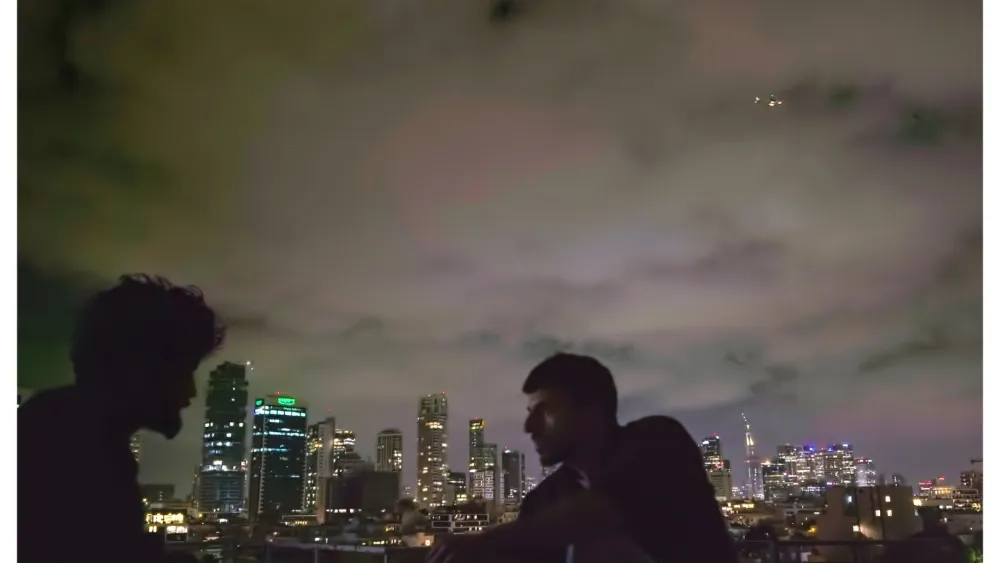
The setup is simple and remarkably effective: Over the past three years, they filmed Abraham talking to members of the Israeli military elite at night, on Tel Aviv rooftops. Each of the 24 service members is seen in obscured profile, their voices modified to make identification impossible. Asked about their duties, they describe in detail, frequently using sketchpads, how they executed their orders in Gaza. Some were involved in surveillance, several were guiding lethal drones from the safety of their Tel Aviv headquarters, and others were on the ground. All participated in erasing not just the human presence in Gaza, but the buildings themselves.
“Naza” is the army word for “collateral damage.” Rather than talk about the murder of non-combatants, the Israeli Defense Forces (IDF) use the term “naza,” obviating the need to think of dead civilians as men, women and children. This erasure of human costs is not a policy that originated with Benjamin Netanyahu: For decades, the Israeli government has stocked its jails and morgues with Arab men in order to use them as bargaining chips in prisoner exchanges. Six Israelis for 291 Syrians; one dead IDF soldier for 65 prisoners and 40 bodies; one Israeli hostage for 1,027 Palestinian prisoners. The message, disseminated not just within Israel but among the diaspora, is that one Israeli, alive or dead, is worth untold numbers of Arabs.
Understanding that this is policy is crucial for comprehending how Israeli soldiers are expected to dutifully erase entire villages without questioning orders. By saying “200 naza” rather than “200 non-combattants killed,” the dehumanization process is handily condensed to four letters. And yet, despite being miles away from the drone attacks, the soldiers directing the strikes hear everything. The IDF listens to all Gazan phones, so they know where people are and whether children are home. They know who’s in an apartment just before the missiles hit, and they hear the screams after the explosions. They even coined a phrase — “Where’s Daddy?” — to describe listening in on a child’s phone, determining when their father will be home, and then sending a missile to kill them all. As one solider matter-of-factly says about a 12-year-old, “You hack her phone, and then you kill her.”
That’s the part most difficult to comprehend: It’s easy to use the term “naza” because it’s a cold statistic, but how is it possible to listen to people in agony and still accept that this is a necessary operation? “You feel like God, because you hear everything they say,” explains one of the people interviewed. In many cases, the soldiers have had Arabic training, so they can’t hide behind incomprehension, as so often happens on Western news broadcasts that show distraught Arab women but don’t bother to subtitle what they say.
The geographic distance (Gaza is a mere 37 miles from Tel Aviv) offers another form of psychological detachment, but as one IDF member says, they didn’t need psychologists — they were fully into it. Raised on video games where the more you killed the more points you got, these soldiers just transferred those dopamine highs to real life: Strikes that were successful were fun. What’s more, they’re just following orders. “My role is technical” and “You have to trust the system” are two of the familiar lines used to disguise the moral somersaults needed to perpetrate atrocities.
It’s not as if they don’t understand the ethical implications. The same man who says it was fun also openly admits to knowing Israel is committing genocide. Presumably the reason he agreed to speak with Abraham is because he feels some iota of remorse, though that concept never comes up. Someone else expresses revulsion at seeing dogs devour bodies left to rot, but the disgust doesn’t seem to extend to the killings themselves. (Conversely, the organization Breaking the Silence, composed of former soldiers actively calling attention to Israel’s policy of ethnic cleaning, was featured in Avi Mograbi’s 2021 documentary “The First 54 Years.”)
For those still unwilling to accept the word ‘genocide’ in the context of Palestine, “Naza” makes clear that the Israeli government believes there are no innocents in Gaza, which is why snipers can so nonchalantly pick off starving people waiting at food distribution points. But genocide is not only the elimination of human lives, it’s also the deliberate destruction of property, to cover up ethnic cleansing and ensure that no one from the eliminated population will come back. Despite official Israeli denials, this too is revealed, as those involved on the ground talk about the premeditated flattening of any structure that could harbor human life.
Abraham and Szor intersperse these chilling testimonies with shots from the rooftops of the Tel Aviv skyline at night. Without seeing faces, we glimpse people in their apartments, watching TV, preparing meals, heading to sleep. The device allows the viewer a momentary space to breathe before the next wrenching description, but it also reflects on the large percentage of Israelis who also “trust the system.” Though not stated in “Naza,” this faith in the righteousness of eliminating the Palestinian people from their lands doesn’t come from the ruling Likud party, but can be found in the very DNA of Zionist philosophy.
Given the film’s extremely effective structure, it would be difficult to insert information not elicited from the rooftop conversations, though it would have been useful had the filmmakers been able to get at least one soldier to talk about the government’s fear-mongering following the horrific October 7th atrocities, with discredited tales of beheaded babies and likely exaggerating reports of sexual violence (about which Azadeh Moaveni has persuasively written in the “London Review of Books”). Will “Naza” change minds, now that it’s becoming increasingly difficult to disguise what’s happening in Gaza and the West Bank? It has more of a chance than “No Other Land,” though by giving festivals claiming to be apolitical a free pass just for programming the film, we too contribute to a campaign designed to obfuscate the reality so unflinchingly revealed here.
Read more Sky’s Defense-News App Could Help Old-School Media Launch Offense Against Creators
‘Naza’ Review: Two of the ‘No Other Land’ Filmmakers Deliver a More Devastating Exposé of Israeli Genocidal Policy, This Time in Gaza
Reviewed at Venice Film Festival (Competition), Sept. 1, 2026. Running time: 80 MIN.
-
Production:
(Documentary — U.K.) A The Guardian production with JW Films in association with Placeholder Films, Unseen Hand. (World sales: mk2, Paris.) Producers: Harry Davies, Lindsay Poulton, James Wilson. Co-producers: Ekaterina Ochagavia, Noa Yachot. Executive producers: Jonathan Glazer, Paul Lewis, Nicole Jackson, Joseph Schull, Harriet Gugenheim, Wendy Vanden Heuvel. -
Crew:
Directors: Yuval Abraham, Rachel Szor. Camera: Anonymous, Szor. Editors: Abraham, Szor, Harry Davies. -
With:
(Hebrew, English dialogue)