
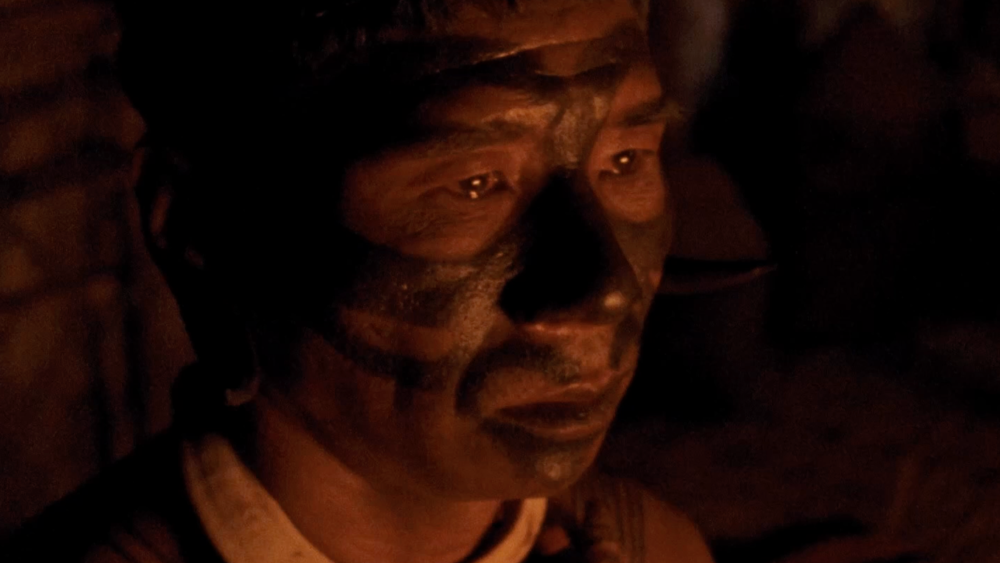
Expanding on his 2021 short film, Theja Rio’s debut feature “Angh” forces its way into the hidden crevices between indigenous identity and colonial modernity. This tension unfolds with riveting restraint in a story set in 1960s Nagaland — the eastern Indian state on the Burmese border — following the principled chief of a waning tribe, and the arrival of an American missionary. “Angh” won the top prize in the Platform competition at this year’s Toronto Film Festival, thus qualifying it for the Best International Feature Oscar.
Read more Apple TV Finally Schedules Jessica Chastain-Led Thriller ‘The Savant’
Lush, impenetrable forests play host to the tale of Anghba (Anghlong Konyak), addressed reverentially as “old chief” by his kin who have, willingly or otherwise, been excommunicated. After the death of his wife from disease, his son Amao (Sobino Rengma) — a silent boy searching for his voice — remains the only other member of his Konyak tribe. However, Amao’s curiosity about modern, western clothing and a nearby bustling community of Baptist converts threatens their existence.
Right from its opening scene, “Angh” frames the arrival of colonial missionaries as a strange, almost alien absurdity. With bow and arrow in hand, Anghba finds his hunt for a wild boar across a riverbank interrupted by a raft floating downstream, as former tribespeople surround a jovial American preacher (Douglas Henshall), much to the chieftain’s chagrin. These impositions are gradual and incredibly well-meaning, although even their medicinal intentions come laced with the word of a foreign lord and savior, whose crucifixes and tales of forgiveness are at odds with the local rituals.
Images often associated with barbarism on screen, like beheading the dead to memorialize them, are approached with an uncanny gentleness. This places the audience alongside the Konyaks, and subverts the traditional, colonial cinematic gaze in the vein of Filipino maestro Lav Diaz. The film’s cast is mostly made up of tribal non-actors, but Anghlong Konyak is its captivating center, as a man whose stubbornness against change sits alongside a lingering grief over his fading way of life.
The story of the rest of post-independent India lives far away from the film’s peripheries; Rio’s concerns, instead, are hyper-focused on a local tale of transformation and thorny resilience. To the average viewer living in a westernized society, Anghba may come off as obstinate, which feels entirely in tune with the film’s intent. However, his raging protectiveness over what might be lost — language, attire, ritual, even memory — grows more pronounced as Rio veers further into phantasmagoria by way of dreams and visions.
Together with his cinematographer Adam Pietkiewicz, the director crafts an inviting 16mm atmosphere, transforming the textural flaws of celluloid into a living fabric, where dirt, scratches and punctures may as well be insects zipping across the screen, as though this is where the medium belongs. “Angh,” in this way, feels truly alive, and at one with nature — a harmony that’s slowly interrupted as the story unfolds, en route to fiery and devastating conclusions.
With disarming simplicity, “Angh” challenges closely held notions of default filmic perspectives, offering a whole new world for us to consider through its soulful ruminations, while forcing us to reflect on the cost of our own unassuming norms. It is, in effect, a lament for things which have been lost, a quiet memorial that beats with righteous fury over how easily we let entire ways of life simply slip away — or rather, how we allow them to be snatched in the guise of progress.
‘Angh’ Review: Toronto’s Platform Award Winner Is a Lush Lament for an Indian Tribe in the 1960s
Reviewed at Toronto Film Festival (Platform), Sept. 19, 2026. Running time: 103 MIN.
-
Production:
(India) A Winter Hymns Films, Undercover Squirrel production. (World sales: Jungle Book Studio, Mumbai.) Producers: Nancy Nisa Beso, Theja Rio, Jai Vir Rodgers, Bernardo Angeletti. Executive producer: Gaurav Dhingra. -
Crew:
Director: Theja Rio. Screenplay: Rio, James Davis. Camera: Adam Pietkiewicz. Editor: Tanya Chhabria. Music: Sagar Desai. -
With:
Anghlong Konyak, Douglas Henshall, Sobino Rengma, Genpai Konyak, Amah Konyak, Wangton Konyak. (Konyak, English dialogue)