
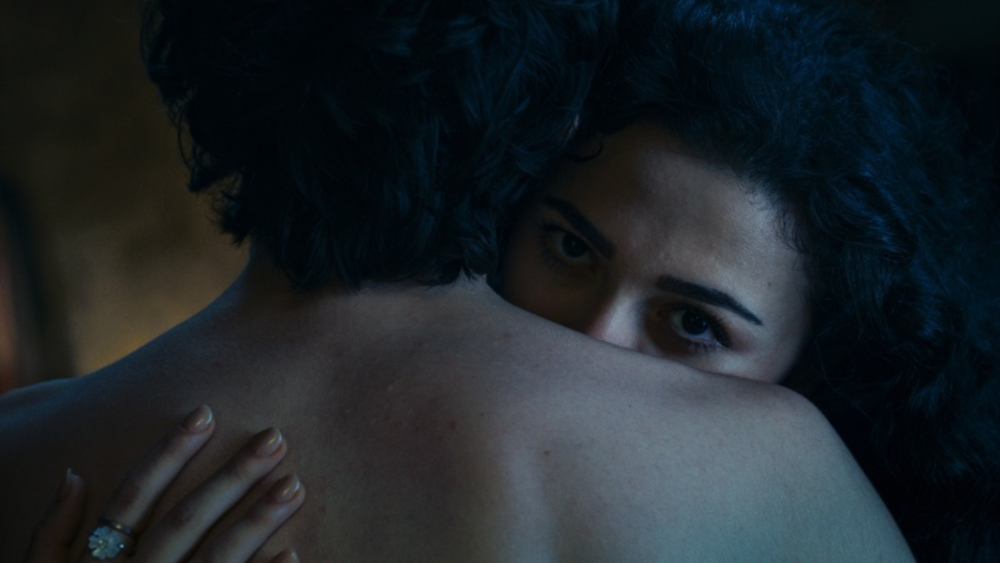
Since hitting an artistic peak with the back-to-back festival triumphs “Head-On” and “Edge of Heaven” in the mid-2000s, German-Turkish auteur Fatih Akin has darted all over the map in genre, style and form — occasionally striking commercially, as with the Diane Kruger thriller “In the Fade” and the local hip-hop biopic “Rhinegold,” without ever matching the rigor and impact of those earlier standouts. That pattern doesn’t change with his latest, the star-crossed supernatural romance “Ghost Song,” which opened this year’s San Sebastian Film Festival. The film, about two 20-year-olds carrying on their early courtship across the mortal divide, is earnest and a little clunky as it takes a simplistic inspirational approach to complex metaphysical questions. But it is accessible and attractive, shot in glistening monochrome, and could well be a youth-skewing hit for the filmmaker.
The choice to shoot in inky black-and-white, making prominent use of major German city landmarks, practically begs for comparisons to Wim Wenders’ “Wings of Desire,” another atmospheric romantic fantasy about a love spanning the mortal and ethereal realms — with Akin’s film the Hamburg-set, GenZ-focused homage to Wenders’ Berlin classic. Placing the two side by side doesn’t flatter the thinner, less lyrical new work, but it’s a marketable resemblance, while “Ghost Song” asserts its own identity with an expression of Muslim faith, as interrogated and interpreted by its young, multicultural characters. The fact that “Ghost Song” has simultaneously been adapted into a graphic novel by Akin and artist Bea Davies is a further indication of its generational targeting.
Farasha (luminous first-timer Mariam Dawoud) is a Syrian refugee who has settled and assimilated in Hamburg with her family, following an interstitial stint in Turkey. Though she chooses to wear a traditional headscarf, in other respects she lives as a modern, independent-minded woman, following in the footsteps of her late father by studying physics at university, while keeping at least one haram secret that would scandalize her mother: a butterfly tattoo on her stomach.
At a graduation party in Hamburg’s imposing Telemichel tower, she meets and immediately sparks with fellow grad Faris (Eren M. Guvercin), a tousle-haired, German-born Muslim of Turkish descent. With her very tipsy bestie Una (Carlotta von Falkenhayn), they decide to continue the party elsewhere and pile into his car; in circumstances deliberately (and somewhat luridly) parceled out over the course of the film, an accident sees the vehicle plunge into the Elbe river.
Faris wakes up in hospital to find that Farasha has drowned, and the police have questions; Farasha, meanwhile, comes to in a different way, finding that she can still walk the Earth, but no one can see or hear her. No one, that is, except her father, who informs her that for 40 days — in line with the mourning period in certain Muslim traditions — she can visit the living in their dreams. Still lovestruck and not yet fully accepting of her death, she seizes the opportunity to spend more time with Faris, cuing a strange and increasingly dangerous courtship.
“Ghost Song” rests on the idea that, in just one evening, Farasha and Faris made such a deep soul connection that even death can’t quite sever them. It’s an intensely romantic notion not really borne out by these wan characters, however individually charismatic the young actors playing them. Nor by Akin’s naïve, slightly purple writing, which keeps sentimentally reiterating the characters’ devotion to each other — mining tension from the question of which will ultimately make the biggest sacrifice for the other — but says little of any spiritual or philosophical substance. More moving is the film’s observation of Farasha’s family through this nightmare: A literal out-of-body scene in which she watches them ritually clean and prepare her corpse for burial is the film’s most layered and haunting.
Where the film veers into the superficial or kitsch, however, it can fall back on its lush mood and widescreen visual riches. Being a ghost has rarely looked quite this pretty on screen, as Tom Tykwer’s regular DP Frank Griebe — working for the first time with Akin — makes a chiaroscuro lovers’ playground of even Hamburg’s unlovelier spots, finding as much intimacy in a brutalist monument as an ordinary darkened bedroom. Iridescently illustrated title cards disrupt the stark monochrome, as do the moments leading into the closing credits — the characters’ worlds flooding into color with a crucial, life-or-death choice.
‘Ghost Song’ Review: Fatih Akin Doesn’t Find Top Form in This Supernatural Romance, but at Least It Has Beautiful Ghosts
Reviewed at San Sebastian Film Festival (Competition, opener), Sept. 25, 2026. Running time: 105 MIN.
-
Production:
(Germany) A Bombero International GmbH & Co KG production in co-production with Warner Bros. Film Prods. Germany, Rialto Film GmbH. (World sales: Beta Cinema, Munich.) Producers: Fatih Akin, Herman Weigel. Co-producers: Steffen Schier, Julia Hayungs, Margret Mackuth, Felix Wendlandt. -
Crew:
Director: Fatih Akin. Screenplay: Akin, Ruth Toma. Camera: Frank Griebe. Editor: Andrew Bird. Music: Malakoff Kowalski. -
With:
Mariam Dawoud, Eren M. Güvercin, Carlotta von Falkenhayn, Gabriel-Winner Amorim. (Arabic, German, Turkish dialogue)