
Crime repped 27% of scripted TV orders globally, first half 2026 – the single most commissioned TV genre, estimates Ampere Analysis, and a whopping 61% of the No 1 series from many of the world’s biggest players.at this October’s Mipcom trade fair ib Cannes.
So one of the global TV business’ Holy Grails is the search for original crime, shows that can stand out from a still hugely crowded market.
One candidate is from Spain, “Killing a Bear” (“Matar a un oso”), the latest big series from the largest Spanish pay-TV/SVOD operator Movistar Plus, behind Series Mania 2025 top prize winner “Querer,” International Emmy nominated “Anatomy of a Moment” and 2023 “La Mesías,” the first title to display the full on-ambitions of Javier Calvo and Javier Ambrossi, writer-directors of major Academy Award contender “La Bola Negra.”
All three series were bought by or co-produced with Arte France, building with Movistar Plus one of the most fertile TV axes in Europe for series which entertain, yes, but are also marked by high artistic ambitions and say something of the current state of Spain and Europe.
“Killing a Bear” has the narrative propulsion of Agatha Christie, but, real-fact based, is sluiced by the contractions and contentiousness of the contemporary, divided warring world.
It also marks the latest show by Jorge and Alberto Sánchez-Cabezudo, at the Studio TF1-owned Kubik, creators of the first high-profile premium series made in Spain, 2011’s “Crematorio,” produced by Mod Producciones for Canal+ España.
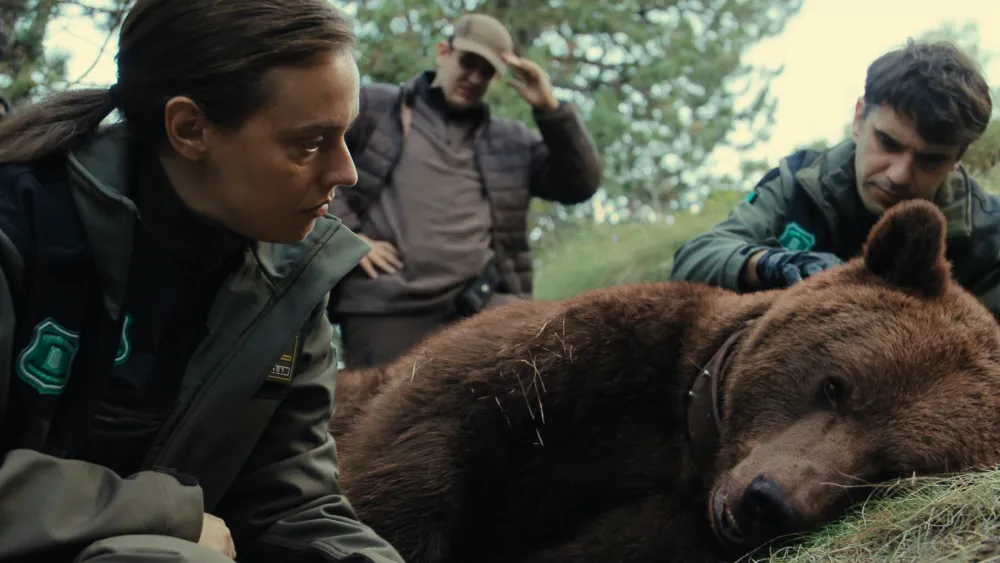
Written by the brothers and lead-directed by Jorge Sánchez-Cabezudo, in the series a murder is committed. The victim is no hated bigwig, however, as often in murder mysteries, but a Pyrenean brown bear called Cachou. Its death, poisoned by anti-freeze in April 2020 during Spain’s COVID confinement, sparks on screen and real-life the first criminal investigation in Spain and Europe for an animal’s slaughter.
In most murder dramas, suspicion is spread wide, but here its 262 inhabitants of the Val d’Aran who are members of an anti-bear internet chat room, led by the charismatic and powerful Zacaríes Farga, a high-ranking local politician from one of four families which control the Val d’Aran.
Shot in September and October last year during seven weeks of unusual sun, says Alberto Sánchez-Cabezudo, “Killing a Bear” has blue sky, but “to offset what could come across as too dark a drama.” That said, this is not a blue sky crime drama.
Locations can be stunning but aim at making a larger point, such as when Lola Barrera (Nora Navas), a judge from Barcelona, rounds a final bend in her car high-up above the Val d’Aran, the camera trucking near to a precipice to reveal a first shot of the Valley thousands of feet below, nestling between massive steep-backed mountains, its own enclosed world. “This is a valley: You can’t get in or out of here,” Farga tells Barrera when they first meet in a veiled threat, clenching his fist.
Key to the drama is the tone, Jorge Sánchez-Cabezudo said at a presentation of the “Killing a Bear” at Madrid’s Iberseries & Platino Industria earlier this month.
Read more Shane Gillis and Danny McBride Are Rival Weathermen in Absurdist, 4-Minute Kalshi Ad (EXCLUSIVE)
Farga, for example, is the Val d’Aran’s Environment Counciller, responsible for administering funds to ensure the survival of bears in the Valley after they were re-introduced into the central High Pyrenees from Slovenia in 1997 as a European Union initiative. But he’s also the adminstrator of the popular Anti-Bears chat room. In a flashback, remembered by Neus, Fargas boasts at a party about knowing one good way to kill.a bear: getting it to ingest anti-freeze. When a container of anti-freeze in spotted in Farga’s garage, he becomes a prime suspect.
Key to “Killing a Bear” was its tone, said Jorge Sñanchez-Cabezudo. “There are a lot of strange, near surrealistic situations which could tip the series into comedy, which would give a sense of not caring about the death of the bear. But if we were too dramatic, it wouldn’t have been realistic. So we attempted to maintain a naturalistic tone.”
Most murder mysteries follow the investigator. Here, every episode is told from a different POV, the camera hugging that character: First, Neus Amat, a Rural Police Officer and daughter of a local farmer in Pallars Sobirá who can see both sides of the conflict over Cachou; then in Ep. 2, from Barrera’s, a no-nonsense judgewho admits to loving the landscapes but “hating” its people. “They’re like stuck in the last century,” she tells her daughter. It’s Barrera who instigates a criminal investigation, wire-tapping suspects.
The victim, however, is a killer. Cachou get his own Episode 3 – combining shots of a real bear and digital effects from Ollín VFX – where like any adolescent he tries out his own power attacking and killing two horses and sheep, becoming the Valley’s public enemy No. 1.
“’Killing a Bear’ trapped us: It is a thriller with a very good story and strong auteurist voices, and such strong characters, which is a perfect mix for us,” Movistar Plus executive producer Susana Herreras said at Iberseries.
The series is prefaced by a prologue set in 1932, shot in a 4:3 box format, in which Fargas’ grandfather shoots a bear that has killed some of his sheep. He is received in his village as a hero. Arriving from Barcelona, the local landlord, however, confiscates Fagas’ America rifle, given to him by his father. Clients pay him good money to hunt bears, the landlord argues.
For grandson Zacaríes Fargas, killing bears is part of the Val d’Aran’s ancestral way of life, a legacy he honors.
“We’re living in a world of constant present time. Social networks have got rid of history and our memory,” Alexandre Piel, Arte France’s co-head of fiction said at the Iberseries round table. “By having episodes which intertwine characters, you come to understand them, their sense of identity and where they come from in a far more nuanced manner,” he added.
“’Killing a Bear’ is born from the necessity of understanding the world’s current polarization and the fable of bear Cachou seemed to us to be the best way to sum it up,” says Jorge Sánchez-Cabezudo.