
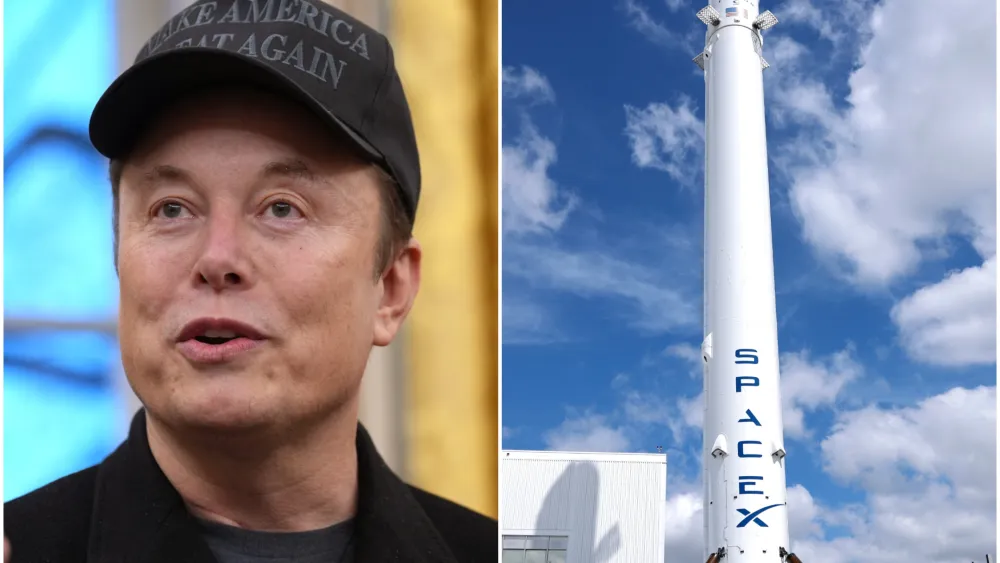
Elon Musk’s SpaceX — rocket manufacturer, satellite internet service provider, AI firm and owner of X (aka Twitter) all rolled into one — has officially set a record for the biggest IPO in history with its initial stock pricing.
SpaceX on Thursday confirmed the pricing of its IPO of 555.6 million shares of its Class A common stock, at a public offering price of $135.00/share. That gives it a valuation of around $1.77 billion; the company raised about $75 billion from the IPO. Shares of the company, which is officially “Space Exploration Technologies Corp.,” are expected to begin trading Friday on Nasdaq Global Select Market and Nasdaq Texas under the symbol “SPCX,” it said.
Even so, leading up to the IPO, analysts have identified concerns with SpaceX’s lofty valuation given its current financials.
In a June 8 report, research firm Morningstar put a fair-value estimate of $63/share on SpaceX. Even that assumes favorable outcomes of two unproven technologies: a rapidly reusable Starship upper stage and commercially scalable and competitive orbital AI data centers. “We expect neither of these technological questions to be answered before 2028, even in the most optimistic scenario,” Morningstar analysts led by Nicholas Owens wrote.
Meanwhile, whereas SpaceX claimed Starlink’s global addressable market was a whopping $1.6 trillion, Morningstar estimates it at less than 10% of that: $129 billion globally. The analysts project 7.5x revenue growth for Starlink to $85 billion by 2035, supported by “niche broadband, enterprise use cases, and carrier partnerships.”
SpaceX’s IPO valuation was substantially higher than previous high-profile tech IPOs — roughly 94 times revenue, the analysts pointed out (compared with, for example, Meta at 22x and Amazon at 18x). The IPO valuation implied that the company’s 2035 earnings before interest and taxes would have to grow 75-fold from 2025 levels.
In 2025, the company’s xAI segment — which includes X — posted a $6.36 billion operating loss (vs. a $1.56 billion loss a year earlier) on $3.2 billion in revenue (up 22%). For the first three months of 2026, capital expenditures for the AI business came in at $7.7 billion. That represents a significant acceleration from $12.7 billion in capex for full-year 2025.
X, which is what Musk renamed Twitter after his debt-laden $44 billion deal for the social network, generated about $1.8 billion in ad revenue in 2025, per SpaceX’s IPO filing — less than half of the $4.5 billion in ad sales Twitter reported in 2021. As of the end of March, X had about 550 million monthly active users; of those, only 4.4 million were paying subscribers.