
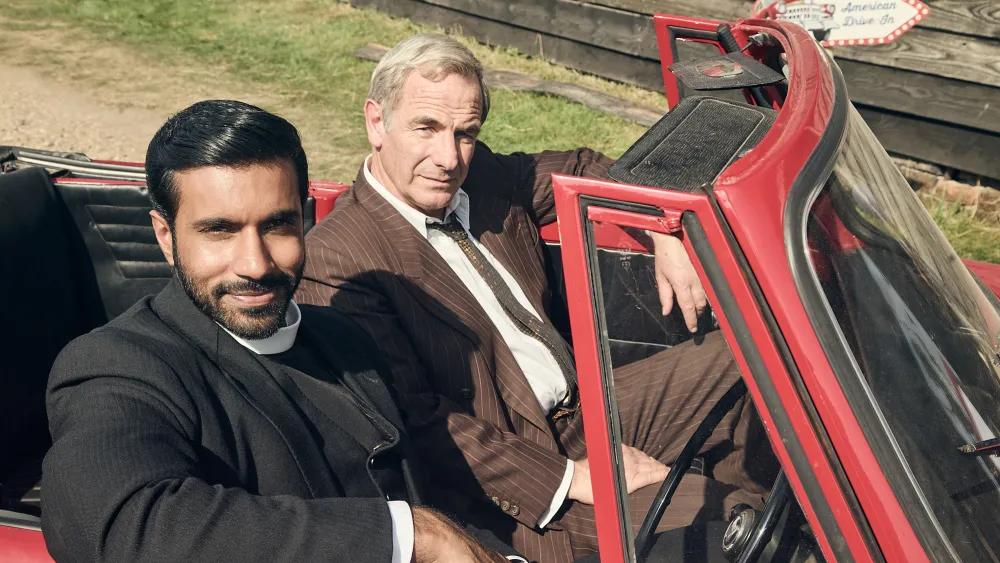
“Grantchester” begins its final season on June 14, with crime-solving vicars who seem to face far too many murders for one small British village. Variety spoke with the core cast members about staying with the same sharply written, witty and emotional show for 11 seasons, spanning the prim 1950s to the swinging ‘60s. It may be known as “Granny Chester” for its soothing country scenery and delicate balance of humor, crime and pathos, but that doesn’t stop the show from confronting a host of serious issues.
The show — which premiered in 2014 and will end with the 11th season — kicks off not that long after World War II. Britain is still deeply traditional, and a village like Grantchester is barely affected by the events of the outside world. Men are the stoic providers, women are mothers or prospective brides and vicars are basically saintly, even if they do like a wee tipple now and then. But as the series progresses into the 1960s, the good folk of Grantchester confront societal upheaval on a whole new level. James Muncie, the author of the book series “Grantchester” is based on, calls it “a social history of Britain.”
Vicars attracted to other men, non-white vicars, civil rights struggles, sex workers, rock ‘n’ roll and more — now, it’s all part of life for the residents of this Cambridge-area village. Against a backdrop of bucolic village fairs and secret romances, the characters are the constants — grouchy police officer Geordie (Robson Green), who begrudgingly becomes more tolerant; Tessa Peake-Jones’ Mrs. Maguire (later Chapman), the housekeeper who spreads her wings as she too embraces a changing society; Leonard Finch (Al Weaver), the fledgling minister who goes through massive life changes as he attempts to come to terms with his sexuality in a repressed era; and of course the three central vicars.
The trio of vicars starts with James Norton as Sidney Chambers, the doe-eyed clergyman with a taste for cool jazz and clever women. The series, which runs on ITV in Britain and PBS “Masterpiece” in the U.S., continues with Will Davenport (Tom Brittney), the affable clergyman hiding a difficult past, and then Archie (Rishi Nair), the handsome but conflicted vicar of Indian heritage who felt he was destined to join the church after being abandoned on the doorstep of a chapel. All three vicars show a passion not just for ministering to their flock but for helping Geordie solve an unending series of murders and crimes of passion in the sleepy village of Grantchester and the worldly nearby city of Cambridge.
The funny thing about chatting at length with all the principals of “Grantchester” is how little of the conversation revolves around gruesome stabbings or diabolical poisonings. Perhaps that’s because solving the crime isn’t entirely the raison d’être behind “Grantchester.” Nearly every murder is solved by the end of the episode, but despite the unusual twist of having the village vicar team up with the police, the real action comes from the relationships among the characters. It turns out the pursuit of justice is secondary to the quest for creating an intentional family, even if some of the family members are harder to get along with than others.
The show’s creator Daisy Coulam, Green, Nair, Weaver and Peake-Jones looked back at the high points of being on the same show for so long — and what’s in store for the final season.
Creator Daisy Coulam on how it started
Longtime television writer Daisy Coulam went on to create “Deadwater Fell” after launching “Grantchester” with producers including Emma Kingsman-Lloyd. But “Grantchester” is her longest stint on a show to date.
I read James Runcie’s book, the first one, on a train journey, and I could just picture it. The characters were so vivid, and the two central characters, Geordie and Sidney, were so clear to me. He’d set it out very cleverly in six chapters. It was like six episodes, bang. I made more of the love story that he had in there, and I made Leonard a regular. I got to spin a bigger web.
I think people assume it’s going to be cozy and not ask difficult questions, and we always try to ask difficult questions, and make it a bit spikier.
How they got cast
Rishi Nair played a lawyer in hundreds of episodes of soap opera “Hollyoaks” before taking on a character that came as a surprise to many of the Grantchester villagers: a vicar of South Asian heritage.
Rishi Nair: I got a self-tape from my agent at the time, and it was obviously for “Grantchester.” I didn’t know it was actually for the lead. Maybe that was kind of a blessing in disguise, because it didn’t put so much pressure on it being the lead character.
Between my first and second audition, I started to watch a bit of “Grantchester.” I watched about 10 minutes of it and I thought “I shouldn’t be watching this.” I turned it off and decided to just go with my instincts of who I thought the character was, and have the trust in the directors and the producers to guide me and steer me.
There’s something about Robson Green that says, “problem solver”: He’s played two doctors, in “Wire in the Blood” and “Reckless,” and solves more crimes in the upcoming “The Northumbria Mysteries.” But before he was cast in “Grantchester,” he was facing a bit of a crisis.
Robson Green: I was never meant to be in this show. I was doing another show and an actor I was working with in Thailand had an accident. And as a result, the show I was in had to cancel. It was an important time for me, because I was struggling economically. I went to my agent and said, “I’ll do anything. I’ll do an advert that would embarrass my artistic career and creative career. I just need the money.” He sent me two dramas. One was called “Cucumbers,” written by the wonderful Russell T Davies, and the other was “Grantchester.” I read “Grantchester” first, and as I got to the 11th page, I went, “This is really lovely.” It has an underbelly of something uncomfortable and serious and edgy. And it’s got a wonderful hybrid of pathos and levity.
Within six hours in Thailand, on Skype, I read for Geordie Keating. Then I got on an airplane, very, very quickly. Get off there, go to costume, put on the brown suit — a complete plagiarism of Peter Falk out of “Columbo.” Very early on I realized that this was something that had longevity in terms of its relationships, and characters an audience would care about and engage with.
I never knew that I would wear that same brown suit in every scene, in every episode for 11 years, and finally, in Season 11, you see me in a different costume.
Before “Grantchester,” Tessa Peake-Jones was known for the comedy series “Only Fools and Horses.” The news of her role in “Grantchester” came during a time of crisis, but she calls it her “parting gift” to her late mother.
Tessa Peake-Jones: My agent phoned me, and I knew nothing about “Grantchester.” It was with an offer to play Mrs. Chapman. My mum was very poorly, and I’d been told she got about 24 hours to live. And my agent rang and said, “You sound odd.” And I said, “Well, I’ve just come back from visiting my mom in the hospice.” And she said, “Well, sit down, because I can’t make that better. But there is some good news.” My mum died the next day. My mum had been very influential in my entire career. It was like she’d left me this parting gift. So when I started the program, I was dealing with that side of my life, but I was also very excited, because none of us knew how it was going to work out. We just knew we felt it was a really interesting drama. We hoped the public would like it. And here we are, 11 years later!
When I first read the scripts, I just thought, “For once, I’m being cast as somebody very grumpy and very unlike myself.” She never smiles — I’ve come to cherish all those things about Mrs. Chapman. So it felt to me like a really exciting adventure to play her.
Al Weaver, a frequent British television actor, plays Leonard Finch, a curate who moves to Grantchester to assist James Norton’s vicar character Sidney Chambers. Weaver’s character has a dramatic arc that includes coming to terms with his homosexuality, a stint in prison, and later, a committed relationship.
Al Weaver: I remember Leonard was described as having this mustache, and he was quite an oddball. I don’t think he really knew what he was at the time. He was just confused and kind of an outsider. He was very passionate about the church, and very kind of scatty and nervous. As the show grew and progressed, and we really explored his character, he became aware of that, and what society thought about it. It’s great to play, because it can be quite theatrical. It was all a case of finding that level.
He’s obsessed with books. He’s not good with people. All those things kind of dictate where you go with it. I remember they cut my hair and put it on this mustache, and I just thought, I’m going to get fired. I was like, this is ridiculous.
They took me down to set where Robson and James were filming. I hadn’t filmed yet, and I walked in and Emma and Harry [Bradbeer] were like, “Oh my God. We love it.” Then I put the suit on, so every time I do that, as soon as I do the hair and put the costume on, it just all works.
Always revolving around a murder, the show has incorporated dramatic moments from weddings to births to prison and prejudice. Here, cast members look back at a few favorite moments over the years.
Robson Green: In Season 2, me and James Norton had to swim in the river Cam. I’m sure you’ve seen James Norton with his shirt off. He’s a physical god, an Athenian temple. I couldn’t compete, but I try, so I spent half the rehearsal process and half the prep doing 100 press ups every morning, trying to compete with the physique of James Norton and failing. He tried to push me in the river just before we were filming, thinking it would be funny. I turned in a certain way, and he ended up in the water, but he slipped really awkwardly and we thought he broke his leg. So we hadn’t even started filming, and “I was thinking, Oh my God, I’ve just broken the leg of the most popular actor in Britain.”
I think the season that really stood out for me was 6 — and 7 was the jailing of Leonard, which was really edgy.
Rishi Nair: When you film TV, you shoot out of order, but actually, my very first scene on screen was the first scene that I filmed, and it was me punching Robson in the face, which was super intimidating. I remember walking onto set thinking, please don’t punch Robson in the face for real, because that’s not going to be a good start to this. But I really enjoyed that.
And then in Season 10, the orphanage, I really enjoyed that as well, because it was quite a rogue episode. It was kind of different from what “Grantchester” normally is. It was a little bit horror-esque. I love horror movies, so when I was reading this in the script, I was thinking, “This is amazing — this is so different.”
On solving murders
Daisy Coulam: The more you interrogate the premise, the more nothing stands up. You’ve got a vicar in an interview room — none of this would happen. Suspend your disbelief a little bit, and once you do, it’s quite easy to think that there’s a murder every week that a vicar happens upon.
What is it that makes a vicar a good detective? They both solve mysteries in a way; that’s the heart of what they do. Asking big questions about the human condition. As Robson always says, people talk to the vicar because they don’t talk to policemen. Sometimes he has to make the point that Robson is questioning people too hard. He needs to have a gentler approach with them.
Robson Green: You can call it a detective show because of the 78 murders, but I haven’t solved any of them. Geordie Keating does not solve the crime. He accuses people of committing the crime. It’s always the vicar who solves the crime.
Nobody realizes that they kind of solve it together, but the person who works it out in the end, who gets the light bulb moment, is always the vicar. So I begged them in the final season, could I solve one? And I do. I’m not going to tell the episode, but I solve one on my own.
The core characters
Each character came into their own during the series, sometimes in emotionally painful ways. Over 11 seasons, they portrayed an entire social history of mid-century Britain while always staying true to their chosen family, the cast explained.
Geordie Keating, Grantchester’s detective inspector:
Robson Green: This is a man who’s a product of World War II, who was a prisoner of war in Burma. So he’s gone through an incredibly traumatic event in his life. He fought a war for the freedom of British people and British values. He is very much working class, and views people who travel through life with entitled ease as the enemy. If you watched Seasons 1, 2 or 3, I would refer to the character Leonard as a pansy, and that is a really derogatory term for homosexuals of its time.
So that aspect of him being stuck with his values was very apparent in the first three seasons, but throughout the series, the notion of family comes with it. Not just his wife, Cathy, and his four children, but the family of “Grantchester” is important — and that he slowly realizes that each of them depend on one another. He was quite intolerant to start with. I think that’s what made him grumpy. He thought that people who do bad things in their life will always do bad things in their life. So that journey from being an embittered, grumpy, individual turns into something incredibly progressive, beautiful and quite life-affirming.
Daisy Coulam: Geordie is a product of his time, sort of the old England. He does have some questionable views, but I think that’s realistic, and he has evolved as a character. His friendship with the vicars has given him a different perspective on life. It always comes down to that friendship. I’m so obsessed with getting them to say they love each other. Emma’s like, “No, they wouldn’t have said that.” But I’m like, “Come on, it is a love story, really.”
Mrs. Maguire and later Chapman, the vicars’ housekeeper
Tessa Peake-Jones: All the relationships on the show have been absolutely joyful. You will hear this from everybody you talk to. It’s like a proper family. But I think for her and Leonard, I don’t think she was at all sure about it. He had a mustache in the first couple of episodes, and that she just did not like. Then, of course, she’s had to come to terms with the fact that he was a homosexual, and because of her religion, because of her lack of experience, she really didn’t know what that meant.
She’s opened her mind. Before she got married, she was Mrs. Maguire. We used to call ourselves Leonard and Maguire. And we said, can’t we have a spinoff series? Because they get on so well. He’s like her son. I think she’s still very sad about the fact that he’s not a vicar anymore. And she’s very happy that he’s with Daniel. She feels that he’s got Leonard’s best interests at heart. Al Weaver, in real life, was a student that I mentored when he was at Guildhall drama school. So I always say, and he gets very bored with it, that I’ve taught him everything he knows.
We all were very aware that in the first season, they were still coming out from the Second World War. Mrs. Chapman’s husband had gone to war and never came back. We used to talk about the fact that rationing would still be in place, and not knowing if you’re going to live or die, and air raids — all that stuff.
At the beginning of this series, I think she was probably quite racist too. Now, of course, having Alphy as the vicar has opened her mind. If you’d looked at her in Season 1, she’d have found that very hard, but because of these younger people around her — young people get your minds open more. She’s learning from all of them, and particularly Alphy, about a whole culture that she had no idea about.
Daisy Coulam: As the world is broadening for women, it’s getting bigger and bigger for Mrs. C. Her life was very small, and now she’s a working woman, and she has money, and Jack has money, and she’s kind of gone up in the world. But she still loves nothing more than to boss her boys around and wear her apron, and tell everyone off. Mrs. C is a very easy character to write, actually, because she’s just very grumpy and what’s amazing is that Tessa is a softy, she’s the kindest lady you’ll ever meet, the smiliest, and then she puts on the face, and you’re like, “Oh, Mrs. C!”
Leonard Finch, the curate (vicar’s assistant)
Al Weaver: His mother had died early. And his father was a drunk and not a nice person. There was a really lovely actor named Rory Fleck Byrne, whose character was having a secret affair with another male character. That story was kind of the catalyst for Leonard. As he became aware of those feelings in himself, he hated himself. The church said, God is against it, and it’s a sin. But James’ character, Sidney, was always welcoming of him. There was an episode where he tried to commit suicide and kind of failed, and he was just like, I can’t even do this. And Sidney’s like, “God loves you. You’re not that.” So there’s all these beautiful messages coming from within the show.
Read more Cannes Winner ‘Minotaur’ Takes Top Prize at Sydney Film Festival
I remember my late grandma, she used to watch the show, and she loved it. And she said, “We all knew those people, those men who were really good friends, or maybe they were roommates and shared a house, but it was never talked about. We knew, but we never talked about it.” It was so sad, because they just couldn’t be themselves.
Everything changes. Attitudes change. You see it with women at work, and Cathy and Tessa opening a fashion shop. Women are really starting to find their voice. It’s still that patriarchal society, but women are finding the courage to stand up to these things now.
That’s one of the great things the show’s done over the years. It reflects society, good and bad. Hope is always a big one, hope and courage. If I had the same courage as Leonard, I think my life would be different. I think it would get more things done — he just doesn’t let things stop him, even though he’s scared.
Daisy Coulam: Leonard’s big story has always been about his sexuality, and trying to play that in a real way, because quite a lot of these characters are desperate and lonely, and then they find their place in this world. For him, he couldn’t express who he was. He almost got married to a woman, and he met this guy, Daniel. It’s about identity and becoming yourself for all the characters, but especially for Leonard, who we’ve put through the wringer quite a lot. But he will be happy, I promise.
Every year, we think, maybe we’ll do something jolly for him, but actually you just think he’s such a good actor, you want to give him the push into the edges.
Alphy Kotteram, the third vicar
Rishi Nair: He comes into the village, and he’s very distinctive and different to everyone else, and Season 9 is kind of him trying to find his feet. We see that he suffers a lot of prejudice and racism. It would have been a dishonor to history, really, if you had someone like me come into Grantchester in 1961, which is a very English town even today — so you can imagine back then what it would be like, and that no one would bat an eyelid at him and think he looks different, or treat him differently.
He tells people this story about his family, and he’s a very positive, strait-laced, glass half-full person. In Season 10, we start with him being very comfortable, and he has his new Grantchester family. Then we start to unravel a bit more of his history and his upbringing, and we realize that actually what Alphy has told everyone isn’t entirely true, and the big secret that he had is that he doesn’t have a family. He’s an orphan. A foundling that was left as a baby on the church steps, and that’s how he got into the church. He has abandonment issues, but also it affects him in his relationships. Geordie has a nickname for him, the Reverend Love Them and Leave Them, meaning he’s playing the field and seeing other women. And I think what that stems from is actually he’s too scared to commit and fall in love with someone, because of the fear of them leaving him and being abandoned.
In Season 10, we see him trying to combat that with going back to the foundling home and finding a letter from his mum that she had left him all these years ago. And him having to go back and unravel his past, which is something he’s never done before.
On the racism of that time:
Rishi Nair: You also draw on some of your own personal experiences — even in today’s age of growing up in a Western society, and the certain prejudices, and certain moments in your life, that you’ve kind of felt that discrimination, or felt ostracized. It’s a very particular feeling when you experience that. Alphy is a really great character, in the sense that anytime he faces this kind of adversity, he doesn’t get too down. He expects it, and he finds it a challenge to prove people wrong. When he comes to Grantchester, he knows that when he walks into a pub, everyone’s going to stop drinking, turn their heads, and look at this guy like he’s an alien. But Alphy comes in and thinks by the end of the year, once I’ve been here for a while and people get to know me for who I am, they won’t be doing that anymore. And hopefully, they’ll want to have a drink with me.
Mrs. C is such a lovely character, and you can see that sometimes when people are talking about issues like racism, it’s not always from a bad place. It’s not always from someone thinking, “I’m going to be really nasty and racist to this person.” It’s sometimes just ignorance, and I think with Mrs. C, we see that in her character. It’s ignorance, and actually that can very easily be fixed. As the season progresses, the first thing that she says is “a swarthy gentleman has entered the vicarage and broken in,” and it’s just me entering my house. Then by the end of the season, you see Mrs. C and Alphy’s relationship, and that’s such a beautiful journey that both of them go on together.
Cathy (Kacey Ainsworth), Geordie’s wife who opens a dress shop with Mrs. C:
Daisy Coulam: We wanted to focus more on the women’s stories, because everything is so much more difficult for them. You’re either a mother or you stayed at home, and Cathy is pushing that boundary and saying, “No, I want to go out and work.” So we get her in Season 10 into her own shop, and it’s about empowerment and womanhood. Kacey [Ainsworth] actually wrote an episode in Season 9, which is something I love about this show, that if somebody’s like, “Can I try this?,” I was like, “Yeah, have a go.”
On having three different vicars:
Daisy Coulam: It’s really terrifying. Robson and James got on really well, and that on-screen chemistry was their friendship. You think, can you get that again? Is that possible? And then Tom came in and stepped up to the plate, and then Rishi stepped up. You have to find a vicar character that can fit into that world, but isn’t exactly the same as the last one, so you kind of have to keep reinventing the wheel. I saw James the other day, actually — and he really misses it still.
Robson Green: When James Norton auditioned, he was asked, “What can you bring to this inquisitive, curious member of the clergy set in Cambridge?” He said, “I have a first in theology from Cambridge.” Isn’t that a great comeback?
He’s got a first in theology, and all I brought to my audition was a long mac [raincoat] and a magnifying glass. That relationship was based on sinners confessing their sins to this vicar. That became a very handy tool for a detective, and so that’s how they solved the crimes together. He was breaking the law of confidence within the church.
I wanted James’ life, with women falling at his feet, and he wanted my life — a family and togetherness and something solid and secure.
Tom, who played Will, was very much a father and son relationship. He just wanted validation and approval and recognition from Geordie within that relationship.
And Rishi — we were two just street-wise working class people from similar backgrounds, in terms of how we’ve lived our lives. Obviously, he’s got this deep secret that comes out in Season 10. He really didn’t have a family, but suddenly realizes that Geordie, Cathy, Mrs. C, Leonard, and everyone else are part of his family.
When Rishi did the chemistry test with me, the first thing we talked about was football. He’s a Man United supporter. I’m a Newcastle United supporter, and he knew more about my team than I did about my team. So even before we went in to talk in front of camera, there was a relationship evolving within minutes, and you kind of knew instinctively that he was going to be the one.
Tessa Peake-Jones: A lot of my friends are very envious, not only of the job I do, working so much, but also of these lovely, gorgeous young actors that are playing the vicars.
James Norton kicked us off, and that was lovely. When he left, we all thought, “Well, how is this going to work, a new vicar?” Especially from Robson’s point of view, Geordie, because that relationship of vicar and detective had become so strong. But Tom came in, offering a completely different personality with his own pluses, minuses and foibles.
It’s gone from a bicycle with James Norton to a motorbike with Tom Brittney, and now the beautiful Triumph red car with Alphy. Tom was a delight to be with. He took over a directing role too.
And then, when he went, we thought, what on Earth? How will we do it again? I don’t know how they do it in the audition process, but here came Rishi Nair, and he has absolutely taken it in a completely different way. All three are delightful, but in completely different ways.
On shooting during COVID:
Tessa Peake-Jones: All our work was canceled in March of 2020. We were all so depressed that when we came back together again at the end of that year, it was difficult. You had the masks, you had the plastic, everything was very, very challenging. You couldn’t have more than two people in a room. Some scenes were outdoors in the freezing cold, pretending it was the summer.
But you looked around at everyone, and you thought, “We are in this terrible time where people are dying, and here we are working.” And hopefully the public are going to enjoy this, and it might take them out of themselves for a bit, when the world was so awful. So even then, it was joyous because we’d none of us spoken to anyone, so to get back in a room where you can actually talk, to just come together as a group, was wonderful. I’ll always look back on that time and be very grateful that it enabled us to get back to work, however difficult that might have been.
Daisy Coulam: I think the hardest time for us was when it was COVID. We’d got our scripts ready, we were going to shoot, and then everything locked down. It was like, how do you shoot a show when you can’t get people in the same room? That was Season 6, and we were one of the first shows up and running. The actors had the best time, because they’d been isolated for so long, and then suddenly they were thrown into a holiday camp. If you watch that holiday camp episode, you’ll realize a lot of it is outside, no one’s standing near each other.
We call it the Battle of Grantchester. We all got dog tags.
On the show ending, and missing the family:
Robson Green: I’ve always made sure that we’re genuine friends off camera as well. And if that doesn’t work, that’s going to be very, very difficult to pull off in front of the lens.
I’ve done thousands of hours of television. This has been one experience without ego. And that is why it’s made it so enjoyable, and made me, every morning, get up and go, “I’m looking forward to going to work today.” I’m in denial that it’s coming to an end. It’s been an emotional and beautiful journey that has been great on so many levels. And it’s not goodbye, because we forged so many friendships.
The last two episodes, they go out with a bang. I’m just going to defy anyone not to openly weep in the last two episodes.
Daisy Coulam: It’s been a big part of my life, starting with getting the green light when my husband and I were on our honeymoon in Costa Rica. It feels like the world has changed. That was always what the series was about. It was about taking it from the ‘50s to the ‘60s, and how the world changed, and if you look around now, it has completely changed for us from when we started.
We’ve gone through COVID. It’s a quarter of my lifetime I’ve spent on this show, and I’m quite scared about letting go, actually.
The cast was so tightly knit that most of the actors — and Coulam — have matching “G” tattoos.
Daisy Coulam: So far there’s me, Emma, Tom who plays Will, Al, Kacey — Robson chickened out. There were a few dropouts, but I think they’ll come in this time.
On meeting fans in the wild:
Robson Green: I’ve done a lot of fishing series for the Discovery Channel. I was in Alaska, and we were going to do a section on husky racing. A group of Americans around the Kenai Peninsula pulls up. “Oh, my God, it’s Geordie, oh, my God.” I went, “Hello. I’m Robson.” And they went, “Hey, Geordie, say ‘Christ on a bike.’” And this wasn’t just an isolated incident. Three coaches of Americans came this year. They thought they were just going to get photographs of the set, because they were on a “Grantchester” tour, but we were filming. They were in Grantchester heaven. We’re very open and happy to talk with the crowds, but all of them are going, “Hey, Geordie, do this with the pint.” And it’s just like, is that what they’ve taken away from a character? He’s a raging alcoholic, and he says “Christ on a bike” a lot.
Tessa Peake-Jones: I was once on a bus in Oxford and someone came up to me. She was American, a huge fan of the show, and she said, “I’m sorry, but how do they make you look so awful?” And I said, “Well, I don’t wear any makeup, and I’ve got a wig on.” And she said, “But you look so different. I mean, they make you look so ugly!” The wig does a lot.
Daisy Coulam: We had a lovely letter from a man whose mother had a limb difference. And he sent us a picture of her, and said he was so pleased to have a character like Miss Scott, who is living her life and working and falling in love — because he said his mother was very ashamed of her body difference. So you have these little moments where it means something to somebody. I had a chat with an American guy in the church once, about homosexuality, and how he was brought up in a very religious community, and gayness was frowned upon, and he felt a kinship with the character Leonard, so much so that he felt he had to come over here.
On what makes “Grantchester” work so well:
Robson Green: You’ve got actors who have to have that kind of nuance within their armory. The comedy and the pathos and the edge and the emotion comes from truth.
You always know when you have a Daisy Coulam episode, it’s the economy of thought and structure, and the way she creates arcs within the relationships is just beautiful and seamless. Her writing is so easy to learn because it’s well written. Bad writing is so difficult to learn.
On whether they would ever return for a possible reunion special:
Rishi Nair: I personally think that we should do “Grantchester, the Movie,” and have all the characters come to the U.S. and experience the U.S.
Al Weaver: I don’t think anyone would be averse to doing a Christmas special, if we ever got asked. That would be lovely. That would be fun to see everyone come back.
On the upcoming Season 11:
Rishi Nair: Alphy meets his mum, and this is a woman that abandoned him as a baby, so it’s not going to be so straightforward. It’s very painful for him. I think in Season 11, you see Alphy really crumble in a sense.
Daisy Coulam: We’ve gone very Agatha Christie on one episode. I’m not going to give it away, but it’s a very contained episode, almost real time. We like to challenge ourselves and do something different, because you just want to test the format a little bit and poke it. We’ve also got a “Conclave”-esque episode.
Al Weaver: The great thing we’re doing this year is thinking, “What are the things that we’ve not done or explored?” One of them was a child, which is impossible in this time for Leonard. That wasn’t a possibility for two men to have a child, but they found a way to involve that within this last season.