
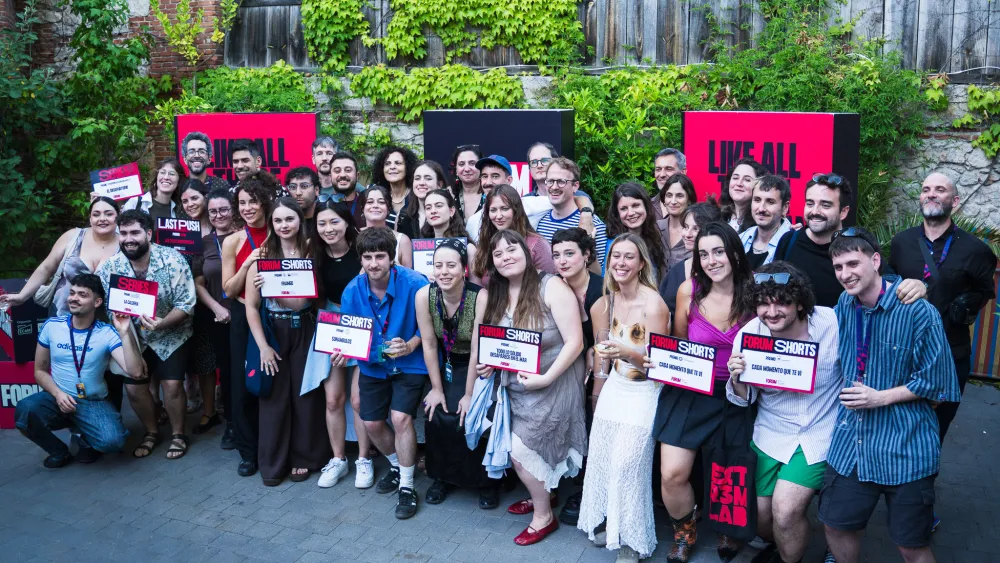
Madrid’s ECAM Forum wrapped its third edition Thursday, June 11, with María Aparicio’s “Undefined Things II” (“Las cosas indefinidas II”) taking the Last Push Award and Pauline Julier and Nicolas Chapoulier’s “The Indies” (“Les Indes”) scoring a special jury mention, closing a three-day event that again positioned the Spanish capital as a strategic meeting point for indie cinema in Europe and Latin America.
Read more Korea’s Showbox Teams With ReelShort to Co-Produce Microdramas
The prizes confirmed the forum’s role as a showcase for projects already carrying strong auteur and international credentials. Aparicio returns to the world of her award-winning “Undefined Things,” now following Eva through Madrid, the Reina Sofía Museum and a story that opens onto questions of labor, memory and displacement. “The Indies,” produced by Switzerland’s Alina Film with Spain’s Lastor Media, brought one of the more ambitious European co-production packages in Last Push: a 17th-century historical drama moving between France and Spain as an old order collapses and another struggles to emerge.
Films to Come spread its awards across projects with strong festival and industry potential. Víctor Diago’s queer fantasy-horror “The Unmoving Hands” (“Las manos quietas”) won the Filmin Award, Ángel Filguera’s “Handen” took the IFFR Rotterdam Award and Víctor Iriarte’s Spain-France sci-fi drama “Snow Country” received the Screen International Award. Enrique Buleo’s “Palomita Errante,” a tragicomedy about a character unable to find her place in a world full of prefabricated answers, emerged as the section’s most awarded title, winning both the Madrid Film Office and Equipo SOPA prizes.
Buleo’s project arrived at ECAM Forum after winning the ECAM Forum Award at Abycine Lanza, while Iriarte, whose “Foremost by Night” premiered at Venice’s Giornate degli Autori in 2023, follows that career step with “Snow Country,” produced by Spain’s Inicia Films and Palmeras Salvajes and France’s 4A4 Production.
The Les Arcs Award went to producer May Odeh of Mayana Films for Suha Arraf’s “Chentian,” a Palestinian-German drama about two sisters, land confiscation, desire and survival under occupation. In ECAM Series Market, “La caldera,” by Laura López Fuertes, Jaime Pérez Fernández and Juan Sánchez Gómez, won the Series Mania Forum Award, while “El observatorio,” by Laura Roqué, Eloy Zamora and Luis Sorolla, received the Serializados Award.
A Forum Built Around Industry Questions
Held at Matadero Madrid, ECAM Forum 2026 drew close to 800 accredited participants, including festival programmers, sales agents, distributors, producers, fund representatives and institutional players. Across the lineup, questions of identity, memory, displacement and contemporary uncertainty fed into the forum’s core industry question: how indie cinema can finance itself, travel internationally and preserve singular voices.
That question came into sharp focus at FINDE, the forum’s financing strand. Opening the session, ECAM director Gonzalo Salazar-Simpson framed the event as a relationship-building mechanism, saying the important thing was “not so much what happens here, but what starts here,” and urging Spanish producers to engage differently with potential investors.
Carlos Antón, representing the Madrid Audiovisual Cluster, EGEDA and Crea SGR, described FINDE as a practical attempt to bring private finance closer to audiovisual projects “in a much more dynamic, professional and international way.” Crea SGR, he said, now finances more than €400 million ($465 million) a year in Spanish audiovisual and cultural projects.
The producer’s view came with a warning. Morena Films general manager Pilar Benito said post-pandemic production costs have risen 20%-25%, while some public support has not kept pace. Fiscal incentives, she argued, are now central to Spanish production, but indie producers still lack “funds that make real equity investments, at risk” — financing able to close the final stretch of a budget without forcing cuts to salaries, producer fees or IP.
Other FINDE speakers focused on the mechanics of alternative finance. Jesús Martínez, founder and adviser of venture capital fund Moby Dick, said “the basic and fundamental guarantee is the story,” while Javier Villaseca, of SEGO Creative, and Antonio Manso, of BE&JING, pointed to a more diversified market in which producers combine instruments according to each project’s scale, timing and risk profile.
Filmmakers Push Back Against Speed
That concern with scale and control carried into The State of Things, where Rodrigo Sorogoyen, Alauda Ruiz de Azúa and Sandra Romero discussed faster production rhythms, changing audience habits and marketing and casting as areas where creative control is negotiated.
The conversation brought together three directors operating at different points of Spain’s film and TV landscape: Sorogoyen, Oscar-nominated for the short “Mother” and a Goya winner for “The Realm” and “The Beasts;” Ruiz de Azúa, Goya-winning director of “Lullaby” and creator-director of Movistar Plus+’s “Querer;” and Romero, whose feature debut “Por donde pasa el silencio” premiered in San Sebastián’s New Directors.
Faced with a climate of hyperconnectivity and acceleration, Ruiz de Azúa described her instinct as one of withdrawal: giving recent projects the time she felt they needed. She also suggested that spectators increasingly move between two sensibilities — one shaped by quick consumption, another still open to more complex cinematic experiences.
Read more U.K. to Ban Social Media for Children Under 16
Sorogoyen’s diagnosis was blunter. He said he viewed the speed of the current cultural system “very negatively,” arguing that faster consumption tends to push the industry toward faster manufacture. Still, the conversation did not present filmmakers as powerless: privilege, time and the ability to choose projects were framed as ways of resisting that pressure.
The exchange also cut into spectators and platforms. Ruiz de Azúa said she thinks about viewers but rejected the idea of writing for an abstract “average spectator.” For Sorogoyen, sacrificing one’s gaze in order to be understood by everyone is “bread for today and hunger for tomorrow.”
Marketing surfaced as another area where filmmakers negotiate how their work reaches the public. Sorogoyen acknowledged that cinema is both art and industry, while Ruiz de Azúa noted that posters, trailers and positioning shape how a film “exists in the market,” even if such conversations usually become concrete once the film has been shot or edited.
Casting, however, emerged as a more decisive question of creative control. Sorogoyen said he uses casting to discover whether he and an actor “communicate in the same way.” Ruiz de Azúa described it as going “to meet someone,” watching how different performers incarnate different versions of the same character. What emerged was a practical map of creative control: industrial pressure may shape a film’s path, but casting, time and freedom to choose collaborators remain decisive.
Indie Cinema Goes Global
The forum’s international dimension was reinforced by two masterclasses, one with Brazilian producer Rodrigo Teixeira and another with Argentine-Swiss filmmaker Milagros Mumenthaler.
Teixeira, founder of RT Features and producer of Walter Salles’ Oscar-winning Brazilian drama “I’m Still Here,” Luca Guadagnino’s “Call Me by Your Name,” Robert Eggers’ “The Witch” and “The Lighthouse,” Noah Baumbach’s “Frances Ha” and James Gray’s “Paper Tiger,” used his ECAM Forum appearance to argue that indie film production is now fundamentally global.
“No independent cinema is self-sufficient in any country in the world,” Teixeira said in Madrid, pointing to Michael Almereyda’s Don DeLillo adaptation “Zero K,” shot entirely in São Paulo with an international cast, as evidence of a new production map. “The landscape of cinema is much more international than Hollywood right now,” he added.
Mumenthaler, the Locarno Golden Leopard-winning director of “Back to Stay,” gave the forum’s reflective strand a more intimate register. Presented with Filmadrid, her masterclass moved through houses, bodies, sound and memory — the materials that have shaped her cinema from “Back to Stay” to “The Currents” — while also opening a window onto her next project, a male-led “rom-drama” centered on a young man.
A Madrid Meeting Point Comes of Age
By the final day, ECAM’s team was reading the third edition as a consolidation year. Alba Wystraëte, general manager of Fundación ECAM, said the challenge had been to consolidate the forum in national and international calendars while “growing without overflowing” and reinforcing the profile of its speakers and participants.
For ECAM Forum coordinator Alberto Valverde, the event grew out of a simple industry need: “Spain needed a close, friendly meeting point” capable of bringing international festivals, sales agents, producers and distributors to Madrid around a tightly curated project selection. This year’s response, he said, had been “overwhelmingly good,” confirming “an edition that has already matured.”
The third edition suggested the forum’s practical use: a Madrid meeting point where indie projects are tested, financing models are debated and international alliances begin to take shape.
Read more Korea Box Office: ‘Colony’ Passes 5 Million Admissions Milestone in Continued Reign