
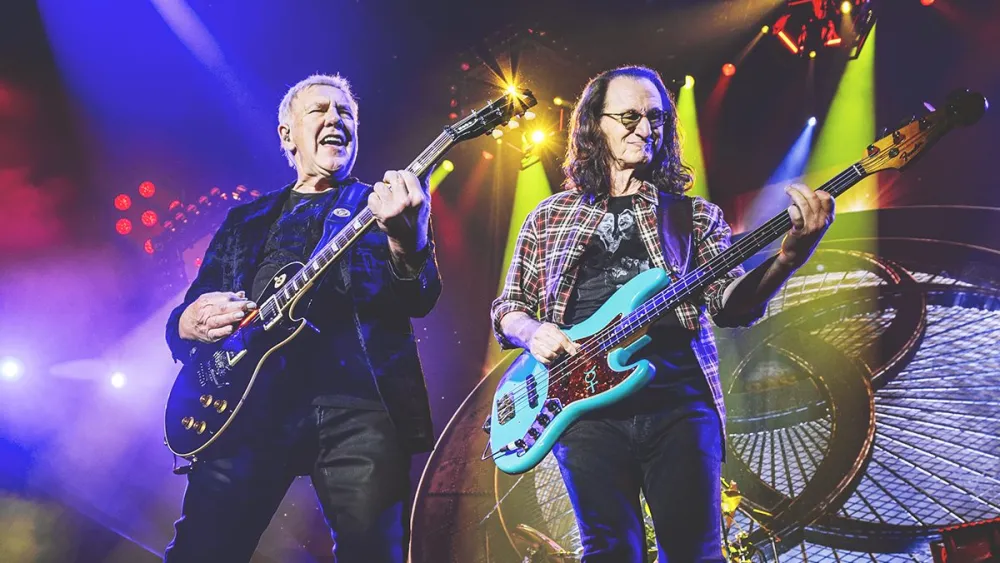
Step (or fly) aside, Geese. Circle back later, Turnstile. Take five and go flaccid, Viagra Boys. There can only be one rock band that is unquestionably and certifiably the cool kids’ choice in 2026, and whatever indie cred the rest of you may carry, this town ain’t big enough for you and Rush.
The reconstituted version of the recently dormant group just wrapped up a sold-out, tour-opening four-night stand at the Kia Forum that was a triumphantly climactic week in Rush’s unexpected reentry as a cultural and musical force in the 2020s. Two heroes walked into the Forum — Geddy Lee and Alex Lifeson — and three walked out, as new drummer Anika Nilles may now be able to claim the title of the woman who’s most popular among American men at this particular moment. (And, sure, that newfound veneration extends to some women, too; Rush’s popularity is not as completely lopsided on the gender front as has been joked about for decades.)
But what was most clear going down to Inglewood tour was just what a wide swath Rush fandom cuts in 2026. Some fans may claim that is as it’s always been, but it seems fair to say a tide has shifted. As a snobby 1970s kid, I would have considered myself not dweeb enough for Rush; going to the Forum fiftysomething years later, it was more about doubting I was hip enough.
Fortunately, it’s a fandom that accepts all comers. And after only admiring from a safe distance for quite a long time, I qualify an actual convert, now, after Saturday night’s staggering performace, one of the most invigorating displays of visceral prowess I can recall from across untold decades of concertgoing. Being happily beaten into submission through an almost unflaggingly thrilling three-hour show, I found myself silently repeating the obvious question:
Where have I been all Rush’s life?
I throw in the proviso of “almost” because my newbie fandom did meet its match in just one stretch in the second half, a full performance of the “2112” album that in portions lived up to the stereotype I’d harbored in my teen years of Rush representing ponderous prog. But nearly every other minute of the show had me on the edge of my seat, or would have if I hadn’t been standing. I was in a kind of awe at how much of the set veered toward something that felt closer to speed-metal than Marillion, albeit a combination of speed-metal and Fun WIth Time Signatures, which as it turns out is right up my gonzo-jazz-anarchist alley. (“Rocking in 7/8 with Geddy Lee,” wrote Aimee Mann, posting an Instagram video of herself doing just that, after the last of four successive guest appearances with the band.) In the end, I’ve realized that the bar for entry for the Rush cult is much lower than I’d spent too many years assuming. All that is really required is a love for furious guitar playing, furious bass playing, or furious drumming, which is really rather a lot of entrance points. As for Geddy’s voice, I had always assumed it must be an acquired taste… and ladies and gentlemen, I am here to announce that, after a mere 50 years, I’ve acquired it.
And, like all 15,000 people inside the Forum each of those nights, and millions more watching the widely disseminated video clips of the opening “Fifty Something” tour dates, I was madly, platonically in love with Anika Nilles — who may immediately go down as the most rapturously accepted fill-in for a legendary, departed musician in rock ‘n’ roll’s history of high-risk substitutions. We can hope that Lee and Lifeson did not develop too much jealousy over her fills getting the biggest cheers of the night. (Every time she went all the way around the toms in a tune like “Tom Sawyer,” the audience erupted like they were watching motocross flips being performed in front of the White House.)
Having rhapsodized a bit, I should say that it is important for a music critic to admit or at least know when he is licked. And as someone who is learning to love Rush late in life, I’m ill-qualified to offer the analysis a more devoted fandom deserves. That’s why, before I knew exactly how I’d react to the show, I came to the Forum determined to talk with long-term fans about what is at the roots of their Rush love, and why seeing Lee and Lifeson reunite after seeming to call it quits in the wake of Neil Peart‘s death is such a joyous occasion. I especially wanted to query some musicians I ran into, before and after the concert and in the Forum Club during the band’s well-earned intermission.
“It’s one of those bands that’s been around so long, they’re not one thing anymore,” said Brian Kehew, the noted producer, musician and Beatles historian. “Kind of like Paul McCartney, Elton, Sting, Madonna, the Who, they have different periods, and so it’s not just a ’70s rock band. To me, seeing a band that’s lived way past their fashionable date into other generations is pretty cool.”
Kehew told a story I heard from others during the night, of having latched on at a certain period that wasn’t necessarily the band’s most classic, after an initial dismissal. “I heard about them in the first year they were out — I met a kid from Toronto and he said, ‘I love Rush,’ and we made fun of them. I didn’t like it yet. There was something about the mixture of things I didn’t get, even though I liked progressive rock and hard rock. It took the ’80s era where they got some more keyboards in, which as controversial — I got into them then and then went backwards… They’re one of those acts like Bowie or Madonna that just kept changing, and I don’t know of any single person that likes every period. But tonight they’ll play an amazing setlist from different periods, and everybody will be happy.”
Nearby, I spotted another musician of renown, Jason Falkner, who had a similar entry point to Kehew’s. “I think it was at around 12 years old I had ‘Moving Pictures.’ The only Rush I knew before that were the smattering of things I heard on the radio, but I was so young, so ‘Moving Pictures’ was my real introduction to Rush, and I loved it because it seemed kind of in line with the kind of new wave stuff a little bit, as far as Rush goes. Obviously Rush’s musicianship and writing is not that at all. It’s their own thing, and it’s far more advanced than most new wave things could ever dream to be. But that was was my introduction, and then obviously I went backwards over the decades.”
Falkner thinks of them in underdog terms, despite the best available evidence that they are superstars. “I mean, this is probably by far the biggest underground band in the world, and I love them for that. because I love underground music and I always have. … It’s certainly not for everybody, but it’s for a lot more people than I would’ve thought, and it just keeps growing, you know? This band’s popularity and success to me is unreal, because really when you boil it down, what they’re doing musically, it’s so almost niche. But there’s all these people losing their minds over this — it’s a cool thing to witness.”
Another singer/songwriter, Mark Lane, was seeing his fourth Rush show in a row Saturday night, though he’d initially only bought tickets for one, then found himself unable to stop. He’d also been at the final Rush show before Peart retired, then died — a concert that also happened to be here at the Forum, in 2015. “At the time it wasn’t like, ‘This is officially the last show,’ but more like, ‘Hey, guys, they might not be doing this again anytime soon.’ Unfortunately Neil passed away a couple years later, which was very devastating, especially for those guys. I would’ve never honestly predicted this would happen. They just look so happy to be doing this, and I think it’s the kind of energy that the world needs right now, personally.”
Lane added, “There were people who thought they were uncool, and now, like, every fucking person in L.A. wants to be them. It isn’t about being right. It’s nice though, right? I’ve unapologetically loved this band, when people were like, ‘Oh, really? That’s kind of dorky.’ I actually took a strange sense of pride in that because they’re not a trendy band. And now they are. I don’t spend a lot of time on social media, but I opened up Facebook the other day and my entire fucking feed was just people posting about these shows…
Read more Knicks NBA Championship Game Draws 24.5 Million Viewers for Most-Watched Finals in Almost 30 Years
“They’re obviously not a punk-rock band in the classic sense of the word,” he noted — but they are to Lane. “The album ‘2112’ was the album where, if they didn’t have some kind of success with that, that was gonna be it, basically. And instead of trying to go in the studio and make a pop record, they made this totally unconventional science fiction kind of record — and by some happenstance, that sold a lot of records, and it allowed them to continue doing what they were doing on their own terms. … Aside from the fact that they’re so unique musically, what I really like about them is, I like them as human beings, and they’re not pretentious, but kind of just ordinary guys who’ve been friends since they were in high school — you just want to root for them.”
Matt Laug, a veteran studio and touring drummer who currently drums for AC/DC, was knocked out by the new addition in the spotlight. “Anika crushed it,” he said after the show. “A band can rehearse till the cows come home. But when you start doing shows, that’s when the band really starts getting good. So imagine this band in a year and a half. Not that tonight wasn’t killer.
“Of course, when you lose a member of your band like Neil Peart, you think, ‘Well, that’s irreplaceable. They’re done.’ But when I heard Anika got the gig, I was like, ‘Oh, yeah, right choice.’ It was just so beautiful to see the support of the fans here tonight anytime she did a fill, with the place was going nuts. The fans of this band have accepted her and are fully supporting her, which is unbelievably cool — me included.”
Not everyone’s fandom goes back to the ’70s or ’80s. Also hanging with the musician-fans was Lindsey Lemke, a guitarist in her early 40s who says, “I got into them kind of late in life. Rhere’s a Marc Maron standup where he talks about catching up on music and goes to the record store. And he walks out with a couple Captain Beefheart records, and this guy sitting on the sidewalk is like, ‘Catching up, huh?’ And he’s like, ‘I’m only doing that.’ That’s exactly what I’m doing. And it was during the pandemic that I finally got to exploring Rush. It was so mind-blowing how it just grabbed me instantly, and very quickly I learned a big chunk of the catalog of the music. They just suddenly became one of my favorite bands. I’m very grateful for it, because I feel like the older we get, the magic gets lost. I don’t know if that’s the era or time period that we live in. But I’m grateful that these things did wait so I can appreciate it at a time when I feel things are duller.”
Lemke had the lament of the younger-generation fan who comes in after a band’s expirration point. “Neil had already passed away, and they declared that they weren’t doing any more music at that point. So this is very exciting. … It’s it’s interestin,g because I’m more of a heartfelt kind of music person, as opposed to most of the bands that have really loud, complicated guitar riffs and complicated drum hits. I’ve had music collaborators who can’t stand Rush at all for that reason — for the complicated drumming, for the cerebral aspect of the music — but there’s a lot of feeling behind it too, and that’s why I think I do attach to it. I love that there’s a combination of both those things — the really skilled level of musicianship and complexity in their music, as well as their ability to get you to just feel.”
Lemke might as well have been my spirit animal on this particular night, as I allowed myself to undergo the Rush conversion experience in even more of a late-dawning, Pentecostal-level fell swoop than she did. It doesn’t hurt that my guard had been let down over the last few decades by just how willing the members of Rush had been to take the piss out of themselves, if they ever had the piss in them. There was a good taste of that in the Forum shows with an introductory film somewhat in the style of Monty Python, an extended piece that had Lee and Lifeson playing themselves in extreme old-age makeup, along with a “South Park” clip of “Lil’ Rush” and Paul Rudd and Segel reviving the Rush-fanatic characters they’ve played on film and even in past Rush tour videos. For those of us who don’t necessarily lean toward math-rock, per se, and would never pass a prog SAT, the irreverence is a welcome reminder that no arithmetic skills will be required to dive into this music.
And I am also a natural sucker for a band that mixes up its setlists, having a snooty disposition that figures that every rock group should aspire to be a jazz combo, or just emulate the Dead, in that way. Ironically, I came in at exactly the right entry point for that. As I learned later from reading the forums, Rush had the sets entirely locked in for touring in Peart’s day, but whether it’s because Lee and Lifeson never felt the same way or just have loosened up on things with a new drummer in tow now, the sets have been substantially different each night, with some surprises thrown in. I paid attention when Lee described a song as “one we haven’t played in about 4,000 years,” knowing that bands can overstate this sort of thing to make a crowd feel special. But I got to the setlist.fm site and saw it noted as “‘A Farewell to Kings’: first time since 1979,” I let out the same little whoop that everyone else had minutes earlier, even though I wouldn’t have known it as anything other than a nightly staple without the online cheat sheet.
I was fascinated by Rush’s experiments with conventionality, in a few more mainstream FM-sounding songs along the way, like “Far Cry,” which immediately followed the “2112” play-through with a reminder that they could play it straight. Or the encore numbers, “Finding My Way” and “Working Man,” which harked back to an early-to-mid-’70s moment when Rush apparently aspired to not much more than being a boogie band. (Thank God they soon set their sights above Foghat, but they would have been a fine arena-sized bar band if they’d kept at that, I’m sure.) I relished the fact that Aimee Mann showed up for her fourth and no doubt final tour performance of “Time Stand Still.” I got a huge kick out of learning that Rush apparently had a vaguely Police soundalike period, with “Distant Early Warning” and “New World Man” standing in for a time when they evoked another polyrhythmic power trio, but were maybe just a little more willing to be thrilling.
The singlular standout moment for me — the one that locked me in early in the show as a fan — might have been “Freewill,” which had Lee and Lifeson soloing furiously and simultaneously, with nearly equal freneticism from Nilles, who was practically soloing all night as it was. And as they came out of this thrilling instrumental passage, Lee, who is no baritone to begin with, started singing in an even higher register than usual, as if what everyone had just heard needed to be signified as semi-orgasmic in some tangible vocal way.
But there was no highlight quite like the constant highlight that was Nilles’ playing — a performance so rigorously muscular and accomplished that Pete Hegseth could see this show and leave publicly advocating for an all-female armed forces.
What’s worth pointing out is how much Peart is still a part of these shows, not just in the multiple video homages and in the way Nilles pays homage to his playing, but in the lyrics that pepper the entire three hours. “Spending so much time watching Neil grow as a lyricist was quite something,” Lee said, in one of his few lengthy spoken asides during the show. “His subject matter ranged from so many different things, from fantasy to semi-autobiographical themes… from worldly things to some things that go straight to your heart, and love. Let’s not forget that.” When, in one of the final song selections, Lee sang, “The measure of a life is a measure of love and respect / So hard to earn, so easily burned / In the fullness of time / A garden to nurture and protect,” it was… yes, a mouthful, but also a hell of a mission statement for a band that has made a fateful decision to soldier on after a loss.
A nice job of seed-planting, there, on Peart’s part, appreciated even by those of us experiencing Rush flowering for the first time, against just about all odds.
Read more ‘Rocky Horror Picture Show’ Set to Screen at Sphere Las Vegas in 2027
\