
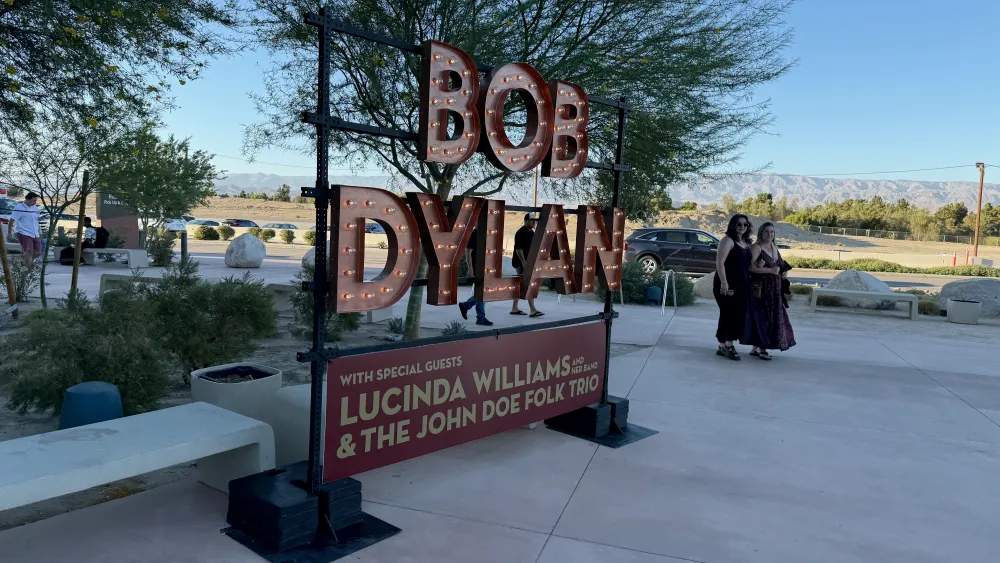
“I’ve Made Up My Mind to Give Myself to You,” Bob Dylan sings every night on his recently begun “Long Hot Summer ’26” tour, keeping a song from his most recent album, 2020’s “Rough and Rowdy Ways,” in play as a staple of his setlist. It’s a beautiful affirmation, as one of the purest love songs in his recent catalog, and an outlier in that regard. But it does raise a question: Can you make up your mind to give yourself to Bob Dylan?
Read more ‘House of the Dragon’ Season 3 Cast Guide: Who’s Who in Westeros and What Happened in Season 2?
It’s a question to keep in mind because this outing, like a lot of the touring that preceded it, does ask you to meet him halfway, without a lot of hand-holding, and certainly no verbal assurances, as he remains as mute between songs as ever. Bluntly put, this is a fantastic show that he’s taken on the road, but appreciating it as such perhaps may require a willingness to surrender to a vibe. With dim lighting, a setlist featuring a lot more deep cuts than world-famous classics, and a hooded central figure who seems to grow more mysterious right before our eyes, the mood is somewhere between “the after-hours roadhouse of your dreams” and “eternity’s waiting room.”
Saturday night, I caught up with the tour at the Acrisure Arena in Palm Desert, California, the third of four stops he is making in Southern California (none of which are actually in L.A. County, because that’s Dylan for you). I spotted a few quiet walkouts in my section of the floor halfway or two-thirds of the way through his Tight Ninety, from folks who were presumably realizing that this was not for them. I also intuited that more attendees around me than not were fully in their bliss. They had made up their minds to… well, you know… and their faith was rewarded with as rich of an experience, in its fashion, as any of the more easily encapsulated performances Dylan has done in his long day.
But I did have to chuckle on the way in, checking out the merch stand for “Long Hot Summer ’26” tour, gear and seeing a T-shirt that sported scrawled lyrics from “The Times They Are A-Changin’.” No shame in buying a shirt with a verse from one of the most significant songs of the 20th century, as long as you don’t imagine that might count as a promise you’ll hear it in the show. He’s only done it on a regular tour date one time since 2009; statistically, the odds that he’d perform that, or any of his protest-era tunes, are not that much greater than the chances that he’d bust out “Wiggle Wiggle.”
What you are guaranteed to get is a still-solid selection of songs from “Rough and Rowdy Ways”; even though the five-year tour that stayed on the road under that album’s formally ended on May 1, picking up under a new banner just over a month later, it’s not so different, given his fondness (and a lot of ours, as well) for that late-period milestone work. You will also get three or four pretty obscure covers, depending on the night — of songs made not-quite-famous by Bo Diddley, Bobby “Blue” Bland, Jerry Lee Lewis and maybe (although not on this night) Eddie Cochran. And, of course, you will get that familar bugaboo: a few songs that should be recognizable but arguably are not, to the casual listener who complains later on Threads that “he didn’t play a single hit!” and doesn’t realize they sat through “All Along the Watchtower.” To be fair, he is not out to radicalize every song from his back pages: “Every Grain of Sand” closed Saturday’s show (as it has a few of these dates so far) in extremely detectable fashion, if you happen to know the tune, regarded by manhy as the best one he ever wrote.
If a show this left-of-center is really not your speed, you don’t have to worry that you’re a rube. You’re in good company on the wide scale of philosophies about what is seemly for a classc rocker’s performances. Paul McCartney made headlines earlier this month when he did a podcast interview where he seemed to be taking a mild shot at Dylan’s choice to emphasize obscurities (something that a lot of Paul’s most hardcore fans wish he would drift more toward, if maybe not as far as Bob has gone).
“I think we could do songs [most people] don’t know and have a lot of ‘black holes’… But they’ve paid a lot of money… In fact, talking about Mr Dylan, I’ve been to see a couple of Bob’s shows, and honestly, I couldn’t tell what song he was doing. Now, that’s a bit much, because I know his stuff. And I get it if he doesn’t want to do ‘Mr. Tambourine Man’ – maybe he’s fed up with it. But I would like to hear it. And I paid.” (The idea that McCartney has to pay for a ticket struck some observers as fanciful, but — rare among major performers — there are no press comps for any Dylan show, so who knows? Maybe the policy applies further up the ladder.)
The beauty is, what either of these major dudes will tell you (or in Dylan’s case, not explain at all) is not wrong for them. Paul wants to put on a show every night that will always come off as the concert of a lifetime, something that any younger, first-time comer will hold onto to tell the grandkids about, if they don’t already have any yet. Dylan, meanwhile, offers a performance you’re more likely to discuss with your higher power, or your therapist… or maybe your experience of it is so personal you’re just gonna keep that shit to yourself. But encompassing and definitive are not words that likely figure into his concert-philosophy vocabulary. No matter how big the venue (Acrisure Arena is probably by far the largest on the current tour), Dylan wants you to think you’ve stepped into a bar, or an ethereal version of one. If you saw his 2021 pay-per-view special, “Shadow Kingdom,” that is probably his vision of the perfect gig, and even when he plays a rare arena show in the Palm Springs era, he’s looking to recreate that same mix of down-and-dirty familiarity and other-worldliness, but with 500 times as large an audience and no smoking.
There’s a wonderful midpoint Dylan has discovered in his contemporary shows between intensity and coolness. Six decades ago, when he went electric and was greeted by a heckler shouting “Judas!,” Dylan turned to his band members and instructed, “Play fucking loud.” Nowadays, if I imagine him giving any orders at all, it might be more along the lines of: Play fucking soft. A lot of the show has a low-to-medium simmer that feels appropriate for an firebrand of 85 whose pilot light is going strong but who isn’t worried about acting like a 30-year-old rocker, either.
The band is finely tuned, in that way, with one new addition to the mix: the well-known jazz guitarist Julian Lage, who came in to replace years-long stalwart Doug Lancio some time between the June 14 show in Berkeley and the June 17 gig in Santa Barbara. Temporary fill-in or permanent replacement? There’s just as much official word on that out of Dylan or his camp as you’d expect, but it sure looks like a personnel change. How that is playing out in terms of stylistic difference will have to be weighed by bootleg-favoring Dylanologists who are more attuned to the subtleties of band interplay. Palm Desert marked only Lage’s third night as lead guitarist, and during the opening “Watching the River Flow,” the group seemed a bit tentative, like they were still working something out… although with Dylan’s fluid approach to arrangements, it’s somtimes difficult to discern if you’re the one still working it out. But, by a few numbers in, Lage’s brief solo leads seemed to become more assertive and distinctive, as he jelled perfectly with bassist Tony Garnuer, drummer Anton Fig, acoustic guitarist Bob Britt and, of course, Dylan standing at the electric piano.
The man of the hour is now positioned center stage, instead of off to the right as he often was during “Rough and Rowdy Ways” tours. Which doesn’t mean that he’s any more eager to stand out. Singing “Man in the Long Black Coat,” he is the man in the short black hoodie, keeping as much of his head under wraps as he can, even though there are no big screens for closeups and audience members are respecting the no-phones policy. (Yondr pouches were supposed to be employed on this tour, but apparently everyone’s just trusting the honor system instead.) In other tour stops these last few years, when he was wearing what looked like formal Western-wear on stage, Dylan would occasionally come out from behind his keyboard and adopt a faintly triumphant stance, soaking in applause. Now that we are into the full-time hoodie years, he’s staying behind the piano till the very end, and still no more lit up than anyone else. I saw a mother accompanying her pre-teen daughter up to the front row, and it was easy to imagine the girl asking, maybe five or six songs in, “Mommy, which one is Bob Dylan?”
But if he is visually retreating more than we already thought possible, he is not retreating as a vocalist. He is still a marvel to aurally behold as one of the modern era’s great singers. (We don’t have to relitigate this issue, do we?) It’s almost as if all his experience as a boxing hobbyist filters into his vocal performances, as he bobs and weaves, turning the constant rewriting of every line’s cadences or melodies into an improvisation that always pays off. When he sings or reads lyrics you know have to be quite different than the way he did them the night before, it’s never clear if he’s doing that because he’s finding different meanings and emphases in the words, or because he just gets off on using his voice as a sort of polyrhythmic percussion instrument. But he is singing with surprising clarity — or at least surprising if you’ve become accustomed to complaints that he doesn’t — and, as a listener, it’s rewarding to either focus on his intonations or just dig the way he matches and counters the rest of the band. To be able to still hear him do this, live, is one of the greatest pleasures and miracles you could have in 2026.
Highlights from the classic material include “Watchtower,” which has more or less the same new arrangement he brought out for it performing on the Outlaw Tour with Willie Nelson — yes, pretty different from the original, but almost more commercial-sounding now, oddly enough. If you’re looking for a completely new surprise for the ’26 season, get a whiff of this tour’s version of “When I Paint My Masterpiece,” which is now being done as something close to a samba. It’s delightful.
The emphasis here is not on dynamics — this band just seems to roll from one moment to the next, entertainingly — but there are exceptions to that. The crowd goes wild when Dylan busts out his harmonica, which for the the moment is just for solos in two songs near the end, “Under the Red Sky” and “Goodbye Jimmy Reed.” But the band does indeed Play Fucking Loud, or louder, in a couple of instances. “Crossing the Rubicon” has the group turning it up for a couple of bits of mid-song riffing that nearly amount to jump-scares. And “Goodbye Jimmy Reed,” the penultimate song, actually veers into pure rock ‘n’ roll territory in a way much of the rest of the set hasn’t, ramping up into something that feels cathartic, before “Every Grain of Sand” winds things up on a respectful spiritual.
(Note: Dylan has been switching out the last two numbers in different shows, sometimes doing a cover of Eddie Cochran’s “Nervous Breakdown” as the rocker for that next-to-last slot, followed by “I Shall Be Released” as the more spiritual closer. This show also found him trading in “Watching the River Flow” as the opener in place of “To Be Alone With You.” There are some other songs that have dipped in and out of the set once or thrice in the previous nine shows on this tour — “You Ain’t Goin’ Nowhere,” “Rainy Day Women #12 and #35,” “Love Sick,” the very obscure “Baby, Won’t You Be My Baby” — and it’s unclear whether he’s still just experimenting with the list or plans to keep pulling surprises. But after how locked in most of the “Rough and Rowdy Ways” tour became, a little suspense for setlist trainspotters at each show is a welcome thing.)
Coming into one of Dylan’s shows now, it’s hard not to have at least in the back of your mind the comments he made about aging in the New York Times just over a week ago, in that piece where entertainers in their 80s were asked, how does it feel?, with a nod to Trump turning 80. (Thankfully, Dylan just ignored the Trump part of the Times’ questionnaire.) “You don’t chase the parade anymore,” he said, addressing his advanced age. “You’re an old king from some vanished country. You’re harder to program. You’re not rushing to become anything and you’re not haunted by things that you did. You’re haunted by how little of it really mattered in the way you thought it would.” If he’s not going to avoid the “king” language, we don’t have to, either: Part of whatever price you’re paying for a ticket is a fee to feel like you’re in the presence of royalty… royalty that’s long since past the point of giving too many effs about commercial expectations or the contrivances of show business.
And also in the presence of a spirit. The stage couldn’t be lit more like a seance, and as we go through those initial motions of squinting and trying to figure out which of the guys on stage is Dylan, a New Testament verse may come to mind: “For now we see through a glass, darkly…” Dylan sings about “Tryin’ to Get to Heaven,” yet he and his band almost look like they’ve already been to the other side and just popped back in through that huge yellow curtain to offer warnings and assurances about the time we have left on this mortal coil. Watching him now, he seems both earthy and spooky. We wouldn’t want him any other way.
Most of the tour’s SoCal appearances have had two opening acts, Lucinda Williams and the John Doe Folk Trio, and there are no skips in that triple-bill. They each got their own color-coding for the rear curtain: red for Doe, violet for Williams. As great as the ongoing X reunion has been, Doe makes for a perfectly fine solo frontman — fronting a trio that’s as close to rockabilly as the promised folk — and on top of original classics like “See How We Are,” the audience got things they wouldn’t at an X show. Namely, Austin neighbor Jimmie Dale Gilmore’s “Tonight I Think I’m Gonna Go Downtown” and Arlen/Harburg’s “Somewhere Over the Rainbow.” Is it too late in Doe’s history to suddenly remember and say: What a voice on that guy.
No small shakes in that department, also, was Williams, who opened with one of rock’s great childhood memory songs, “Car Wheels on a Gravel Road,” and ended with an anthem of innocence lost, Neil Young’s “Rockin’ in the Free World.” Well after her band members had shuffled off stage, Williams remained, thanking the audience for its warmth and no doubt savoring the reception not so many years after a stroke put her performing future in doubt. Gratitude on a stage has rarely seemed more palpable than in Williams basking in the glow of the arena roar; here is someone who, in the spirit of Dylan and the actual words of Doe, has been beyond and back.
Setlist for Bob Dylan at the Acrisure Arena, Palm Desert, California, June 20, 2026:
Watching the River Flow
Man in the Long Black Coat
All Along the Watchtower
Tryin’ to Get to Heaven
False Prophet
I Can Tell (cover)
Black Rider
Share Your Love With Me (cover)
When I Paint My Masterpiece
I’ll Make It All Up to You (cover)
Crossing the Rubicon
Soon After Midnight
Under the Red Sky
I’ve Made Up My Mind to Give Myself to You
Goodbye Jimmy Reed
Every Grain of Sand
Read more Concertgoer Falls to His Death During Goose Show at Madison Square Garden