
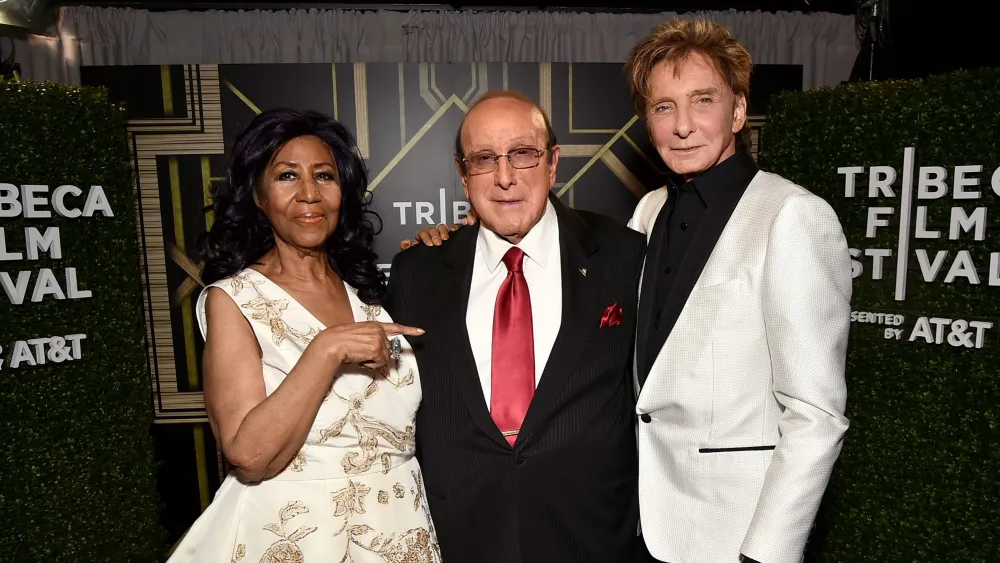
When a public figure is prominent and dominant for as long as Clive Davis — the legendary music executive who died yesterday at 94 — it’s easy to take them for granted, especially when they’re as vocal, as adept at self-promotion, and as outspokenly confident as he was.
Read more Lin-Manuel Miranda Bringing ‘Warriors’ Musical to Broadway in Spring 2027
Most of his contemporaries, fellow titans who helped create the modern record business like Ahmet Ertegun, Berry Gordy, Mo Ostin and Chris Blackwell, had long since dropped into the background or effectively retired by the time they reached their seventies. But even as Clive’s direct involvement in releasing music tapered off over the past decade, he was still hosting and overseeing his legendary annual Pre-Grammy Gala — which everyone has always called “The Clive Party,” still the hottest ticket in the industry — and keeping up a very active social and speaking schedule. Along with overseeing the Gala during this year’s Grammy Week, he also presented an award to Sharon Osbourne at Billboard’s Power 100 event, did his usual round of Pre-Grammy interviews, and probably a lot more. Just six weeks ago, he hosted a one-on-one conversation with his son Fred Davis, partner at the Raine Group and one of the music industry’s top investment bankers, at a conference in New York. The man had celebrated his 94th birthday only a few days earlier.
His image was as carefully sculpted and maintained as any superstar’s — as tailored as his crisp suits, with their brightly colored ties and (always) perfectly matching pocket squares. His words were just as precisely curated, so much that it often became repetitive: During speeches or interviews, once he’d start reeling off artists who were highlights of his career — “Whitney Houston, Aretha Franklin, Janis Joplin, Bruce Springsteen, Billy Joel, Barry Manilow” — or saying, without providing any details, that the array of talent and attendees that he and his son Doug and co-producer Stacy Carr had lined up for that year’s Clive Party was going to “knock your socks off,” you’d just settle in, like waiting for your grandfather or uncle to finish one of his stories that you’d already heard countless times.
The familiar image of Clive Davis as the dominant industry kingpin obsessed with hits above all else was partially his own creation, and while it gave him power, it actually did him a disservice. Pundits often compare him unfavorably with the likes of Ertegun, Gordy and Ostin, portraying them as innovators, which they indisputably were. But so was Clive. Sure, his record companies made millions from the big, sweeping ballads that were his trademark — “All by Myself,” “The Greatest Love of All,” “Don’t Cry Out Loud,” “I’ll Never Love This Way Again,” multiple Barry Manilow songs — along with easy listening titans like Kenny G, and one-hit wonders like the disastrous Millli Vanilli.
But during the ‘70s and ‘80s, he released multiple albums by Patti Smith, Lou Reed, Iggy Pop, the Kinks and even the jazz musician-poet Gil-Scott Heron. During the ‘90s, his label distributed era-defining albums by Notorious B.I.G., Outkast and TLC, via deals he’d struck with young Black entrepreneurs Sean “Diddy” Combs, L.A. Reid and Babyface. He had no musical training or background, but he went to the wall breaking conventions, arguing that “Bridge Over Troubled Water” — a five-minute ballad that is just voice and piano for its first half — was a smash single, and that “I Will Always Love You” should open with 45 seconds of Whitney singing a capella. They’re two of the most iconic hit singles of all time.
I interviewed Clive at least fifteen times, read both of his autobiographies and countless articles, went to the premiere of the 2017 HBO documentary “Soundtrack of Our Lives,” and heard him speak — and speak and speak — at many, many events over the decades. The fun was in trying to get him off-message, to lure him out of the same-old with a question or angle or topic that was off the beaten track. It wasn’t easy.
The first time was in 2011, for a Billboard video celebrating his longtime colleague and competitor Seymour Stein, founder of Sire Records. The videographer and I were summoned to the top floor of the imposing old Sony building at 550 Madison, which one writer described as “Post-Modern Thug.” We sat in a conference room with a stunning view of the Midtown skyline before we heard heels clacking slowly down the echoing hall — Clive apparently had the entire floor to himself — taking seemingly several minutes to reach us, before his assistant materialized and said “Mr. Davis will be with you shortly” and then clacked back, like a character from “Citizen Kane.”
Clive had asked for questions in advance and had his answers written on index cards that he produced from the breast pocket of his beautifully tailored suit jacket, each one a vivid, perfectly timed, five-sentence-or-so anecdote about Stein and his career and their friendship. I tried asking a couple of follow-up questions but he demurred, saying “I haven’t prepared for that.”
But he warmed up as we got to know each other better over the years, especially after Variety published a remarkable, 6,000-word article on him for his 90th birthday in 2022, culled from interviews with 25 executives who had worked for him, reaching back to his first major role, as president of Columbia Records in the 1960s. He liked it so much that at his 90th birthday party in New York, he shook my hand and held it, in a way that will be familiar to people who knew him, locking on my eyes as he said he’d “Thoroughly, thoroughly enjoyed it — thoroughly.” As well he should have: All of the quotes were glowing, filled with gratitude and admiration, marveling at his energy, consideration, politeness and attention to detail as well as his toughness — and these were mostly former employees talking, who had little to gain from praising him except a good seat at the party (which was always a consideration). Of course, nobody was likely to slam him in an article for his 90th birthday, but only a couple of people declined our request for quotes.
Read more ‘I Will Find You’ Nabs 24 Million Views in 4 Days, Netflix’s Biggest New Series Debut of 2026
Working on that article gave me a far greater appreciation, not so much for what he’d accomplished — we’d heard that song countless times — as for the lives he’d influenced and enhanced, the way he treated people, and his willingness to hear others’ opinions, especially young people. True confidence, true self-belief, is a willingness to admit that there could be a different or better way than the one you’re favoring.
“He wasn’t asking our opinion to form his opinion — he already had his opinion,” said former Arista EVP of A&R Pete Ganbarg in the 90th birthday article. “But we were representing the audience, and he wanted to know what the audience thought.”
And he believed in his artists as fervently as any fan. During our annual pre-party interview during Grammy Week this year — the last time I spoke with him — I asked Clive if, in the early days of Springsteen’s career, he saw the potential for the future Boss to become the towering and outspoken cultural figure he’s become, especially at the height of ICE’s crimes in Minneapolis this past winter.
“My prominent feeling was not that he would turn into a political figure,” he replied, “but that I somehow had to distinguish him from Bob Dylan, and that I could not help contribute to the opinions of your colleagues,” he smiled, meaning fellow journalists, “by calling him ‘the next Dylan,’ or ‘another Bob Dylan.’
“I remember vividly scheduling a nationwide call of the Columbia [Records] personnel — sales, marketing, press — and I read the lyrics of each song on the album, [focusing on] the symbolism and the writing,” he continued. “It was so different from Dylan, so unique to Bruce, and so special that it would avoid comparisons because he is such a definitive, unique poet as he is. So I would say that my primary goal was to make sure that the focus was on him as the next Poet Laureate of America, in his own right.”
Sure, he had the benefit of a half-century’s hindsight, and many people would beg to differ, especially those who didn’t experience that level of support or open-mindedness — or constructive criticism, because he famously initially rejected that album and asked Springsteen to write two more radio-friendly songs before he would release it. The music business is not for the faint of heart, and Clive played it as rough-and-tumble as anyone — in a crisp suit and without raising his voice, no less.
“You may not love every minute of the process,” Ganbarg said. “But when you come out on the other side, you’re much better at your job. I would not be here if it were not for Clive. If I had never met him, my life would be so much poorer in so many ways.”
Clive wasn’t always right, but he usually was — and he didn’t hesitate to remind the world that he was. Music, and especially the music industry, would not be what it is today without him.
Read more USA’s ‘The Rainmaker’ Adds Richard Kind, Kevin Ryan and Asher DeLand in Season 2 (EXCLUSIVE)