
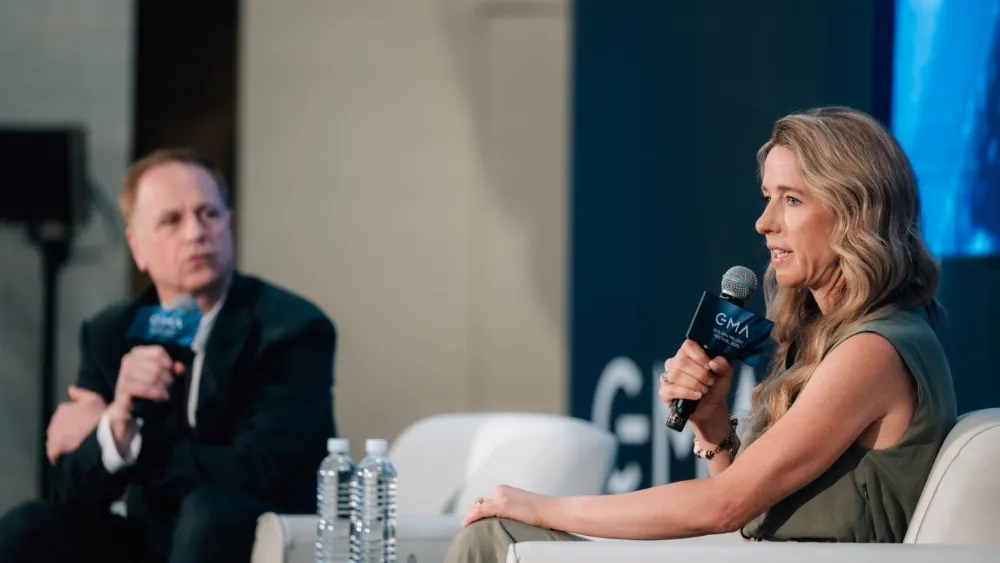
Music supervision is far more than picking great songs. That was the central message from Brittany Whyte – whose credits span “The Handmaid’s Tale,” “Riverdale” and “The Hunger Games: Catching Fire” – at the 2026 Golden Melody Festival in Taiwan.
Read more How Jolin Tsai’s ‘Pleasure’ Finally Came Together, According to the British Producer Who Made It
The session, titled “The Art of Music Supervision: From Selection to Storytelling,” was moderated by Mark Frieser, CEO of Sync Summit, a conference that brings together music industry professionals, and drew on Whyte’s extensive career. Her message was clear from the outset: music supervision is the art of making music serve a story.
Whyte’s path into music supervision was, by her own admission, accidental, thanks to her role as a “record detective” for Steve Jones of the Sex Pistols on his radio show “Jonesy’s Jukebox.” After a stint in A&R at Atlantic Records, she joined Chop Shop Music Supervision in 2007, working on “Twilight,” “The Perks of Being a Wallflower,” “The Hunger Games: Catching Fire,” and “Gossip Girl.” In 2023, she founded Whyte Room Music Supervision.
Using “Riverdale” as a case study, Whyte outlined how music supervision is shaped as much by early creative alignment as by song selection itself. She described establishing the series’ mood with the show’s creative team from the outset, defining a moody, cinematic world loosely inspired by Lana Del Rey’s aesthetic. From an initial pool of nearly 300 tracks, she distilled the options down to a shortlist of 15, refining choices in constant dialogue with editors to ensure each cue serves the emotional rhythm of the scene.
Budget, she added, is a constant creative constraint – and not always a negative one. Recognizable songs can actually distract viewers in dialogue-heavy scenes, making lesser-known tracks or production music library selections the smarter creative call.
Read more Korea’s Lotte Cinema-Megabox Merger Collapses as JoongAng Group’s Financial Crisis Deepens
The legal dimension of the job is equally demanding. Licensing calls for meticulous attention to ownership splits, territorial rights, and expiration dates. A character whistling a few bars of a song can trigger copyright clearance requirements. Overlooking regional restrictions on a globally distributed series, Whyte warned, can result in a show being pulled from streaming sites entirely.
On artificial intelligence, Whyte was measured. AI can help organize copyright data and generate reference playlists – useful tools in the early stages of a project. But she and Frieser agreed that it remains far from replacing the creative judgment at the heart of music supervision, and both flagged ongoing legal and ethical concerns around the copyrighted material used to train some AI music models.
Whyte closed by encouraging aspiring supervisors to trust their instincts, seek out student productions for hands-on experience, and invest in building professional relationships. She also expressed hope for the development of dedicated music supervision programs in Taiwan, noting that the craft is now impossible for the global industry to overlook.