
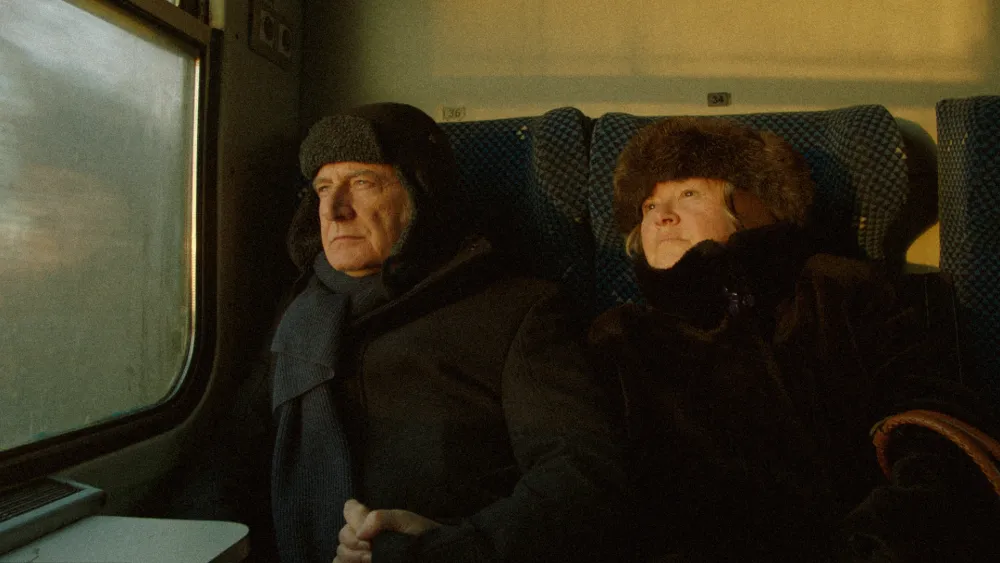
Acclaimed Bulgarian directing duo Kristina Grozeva and Petar Valchanov return to the Karlovy Vary Film Festival competition with “Black Money for White Nights.” They won the Crystal Globe in 2019 with ‘The Father,” which repped Bulgaria in the foreign-language film Oscar race.
Read more Ateez Lands Third No. 1 on Albums Chart With ‘Golden Hour : Part.5’
An indictment of modern Bulgarian corruption and moral decay set in 2022, “Black Money for White Nights” centers on Marina, a nurse, and Gosha, a railway agent, a couple in their late 60s who have spent years collecting small bribes in order to have enough money for a vacation to Russia to experience the fabled White Nights of summer — Marina’s dream. But their plans start to break down when the travel agent they used vanishes with their money, and Russia invades Ukraine. There’s no trip, and they realize that no authority — police or government or even an underworld fixer — can help. Everything is lies.
The filmmakers wanted to examine the people whose emotional loyalty to Russia is so strong that their moral compass becomes distorted, “even when reality changed dramatically in 2022, these people kept protecting the story they’ve chosen to believe after the propaganda, and that was the starting point. We were interested in what happens inside these people,” says Grozeva.
She adds, that “we didn’t want to make our characters political clichés or stereotypes. We wanted to build a real human being — contradictory, vulnerable, capable of tenderness and love, and at the same time capable of lies, deception, manipulations, and so on.”
And while there are worries that a certain segment of the population “romanticizes” the Soviet-era past, “we are happy that we are now part of Europe, and so we believe that the nightmare times in the past, during the communist period, with the censorship, and everything else, will be not repeated again,” says Valchanov.
The film embraces an almost documentary feel that gives it a palpable sense of urgency. Valchanov notes that they shot in real places, in real locations for a lot of the film, using documentary techniques and elements. “We tried to combine scene with long shots, for example, with scenes very dynamic rhythm of editing, following the emotion of the characters,” he says.
“We worked with great cinematographer Alexander Stanishev, who was very focused on this,” he says, with Grozeva noting that their style for this film exploited a sense of urgency and tension.
Societal intuitions all come under the glare of their lens: the healthcare system, public transportation, police, the government, the church, even family.
“Well, I think it’s kind of our reality. We didn’t come up with anything. All of the things are true. They happened to us or happened to some of our friends or neighbors, but yes, unfortunately, this is our reality,” says Grozeva.
The characters are a product of their environment, and it was crucial for the filmmakers to show that corruption also destroys personal relationships. But Marina has an epiphany and turns over a new leaf, refusing bribes and bucking the system — this adds a glimmer of hope to the film.
“We tried to open space for them to start again, and that’s why we try to build kind of, how to say, a tragic happy ending,” says Grozeva.
As the credits roll, we hear Marina and Gosha continue the last scene of the film. “We wanted after end credits for the film to continues in the minds of the audience, that’s why we tried to break the frame during the end credits. They continue to act, and this is maybe the most powerful thing, if it’s a shift, if we can make people to continue the film…” says Grozeva, with Valchanov finishing her thought: “to screen the film in their minds.”
They want the audience to mull on the couple’s future, “maybe some people will give them a chance to change, maybe others not,” she says, adding that it’s a way to send the audience off into a discussion of the film and its ideas.
“Black Money for White Nights” is produced by Abraxas Film in co-production with Graal Films, Bulgarian National Television, Hellenic Broadcasting Corp., ERT and the Greek Film Center, with support from Bulgarian National Film Center and Eurimages.
Cercamon is handling international sales.