
The free and open internet faces threats from companies propagating walled gardens designed to control your data and the rise of black-box AI systems. To preserve the vitality of the digital commons, individuals must take action to support the principles behind open-source code.
That’s the message from “Code for the People,” a short documentary film funded by Automattic, the company behind WordPress, Tumblr, WooCommerce and other internet tools and services. The film, directed by award-winning filmmaker Bao Nguyen, in part tells the story of how CEO Matt Mullenweg founded what became Automattic, a company rooted in the philosophy of open-source software. But it’s also a manifesto about the need to protect the open internet in the face of commercial interests that run counter to that ideal: Essentially, “Code for the People” is a recruitment video urging netizens to take part in the movement.
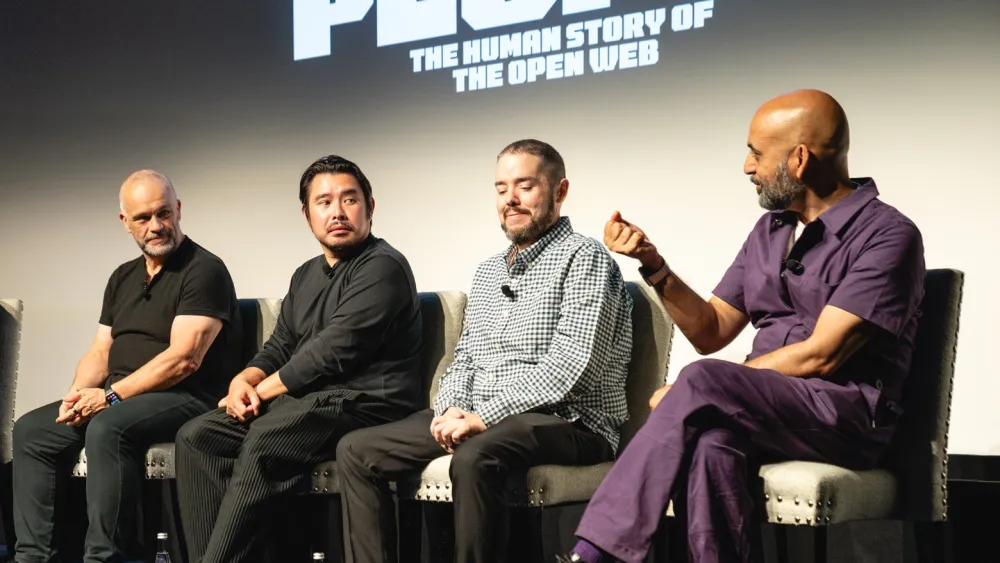
The New York premiere of “Code for the People” was held July 1 at the Crosby Street Hotel. Following the screening, Variety moderated a conversation in partnership with Automattic Inc. about the film. (Watch the full panel discussion above.) “Code for the People: The Human Story of the Open Web,” which runs about 20 minutes, will be released for free online July 9 at codeforthepeople.com.
In addition to Bao Nguyen, speakers who participated in the Q&A were Paolo Belcastro, artistic director of the Domains Maisons at Automattic, who works at the intersection of product and operations; Anil Dash, a prominent technologist, writer and ethical-tech advocate who serves on the board of the Electronic Frontier Foundation; and Eric Binnion, payments engineering lead at Automattic.
Nguyen, whose work includes “BTS: The Return,” the Sundance-premiered “Be Water” and Netflix hit doc “The Greatest Night in Pop,” said he wanted “Code for the People” to deliver an inspirational message that everyday people would connect with.
“I’m not a technologist. I’m a storyteller,” Nguyen said. “I didn’t know a lot. And so I was hoping that this film could both be sort of this emotional human story of why we are connected to tech, what are our first curiosities to tech and computers and the internet, and also this bigger philosophy of open source and sort of deconstructing that for a layperson who might not know how much open source surrounds us in everything we do.”
He added: “A lot of films about tech can be very dystopian, and I wanted to make a film that was more ‘protopian,’ that gave sort of practical ideas of of how we can move forward and learn from, you know, what values we have as human beings and bring that into how we practice our use of technology.”
Nguyen recalled that at one point, he had a cut of “Code for the People” that was around three hours — “which is way too long,” he said. “I think at the end of the day, it was trying to make something that is digestible for people who are having to talk about these really dense matters.”
During the Q&A, moderated by Variety‘s Todd Spangler, Dash said that even people who aren’t immersed in technical details have a grasp of the value of paying for tools that are based on open-source code — because they are fearful of being locked into a closed software stack.
According to Dash, there are users who say, “‘I would rather pay you the full price for your open-source product than pay those scumbags who make the commercial product because they’re going to extort me or I feel like I’m trapped by them.’ And so I think that’s part of it… just shifting the balance of power to the people that they feel that they trust.”
Belcastro spoke about why a for-profit company like Automattic is committed to the open-source model. “You cannot convince people to use open-source software because it gives them freedom or because it gives them ownership,” he said. “At the end of the day, people are looking for convenience, people are looking for a great user experience. And so investing in the product is what allows us to provide a better user experience to those users.”
“Now, it is true that when we do invest back into the product, we also give to every one of our competitors,” Belcastro continued. “But the idea of open source is that we all do that…. And we all together rise to give a user experience that is compelling enough that people then end up also benefiting from the freedom and the ownership that we promote.”
“Code for the People” touches on the fact that big AI companies like OpenAI operate closed systems even though they’ve built large language models using data scraped from the web. “The big AI tools do not practice consent about what they do to the web and what they do to creators and what they do to the rest of the world,” said Dash.
Dash believes open-source AI models will continue to develop and get better — and provide new alternatives. “Thinking about there being one option in a technology category is so broken-brained. It’s like thinking there should be one restaurant, right? Like you shouldn’t have just McDonald’s. There should be lots of little mom-and-pop restaurants and all different kinds of cuisines, right?” he said. “And the same is true in technology. … There should be lots and lots of little AIs for all different topics.”
Meanwhile, Belcastro discussed the idea of being a “landowner” on the internet, noting that even though Automattic provides free resources to let users set up an online presence, users can control their digital destiny independently by owning their own domain name. “And so having your own domain, again, is a way to say, ‘This is my little piece of this internet land. I own it, and nobody can get away from me,’” he said.
Automattic’s Binnion told the audience at the “Code for the People” screening, “I would challenge all of you, if you don’t already have a domain, to go buy a domain and start a ‘link in bio’ [landing page]. You can do it on wordpress.com in probably five minutes. And like that’s now your space on the open web.”
Pictured top (l. to r.): Paolo Belcastro, Bao Nguyen, Eric Binnion, Anil Dash