
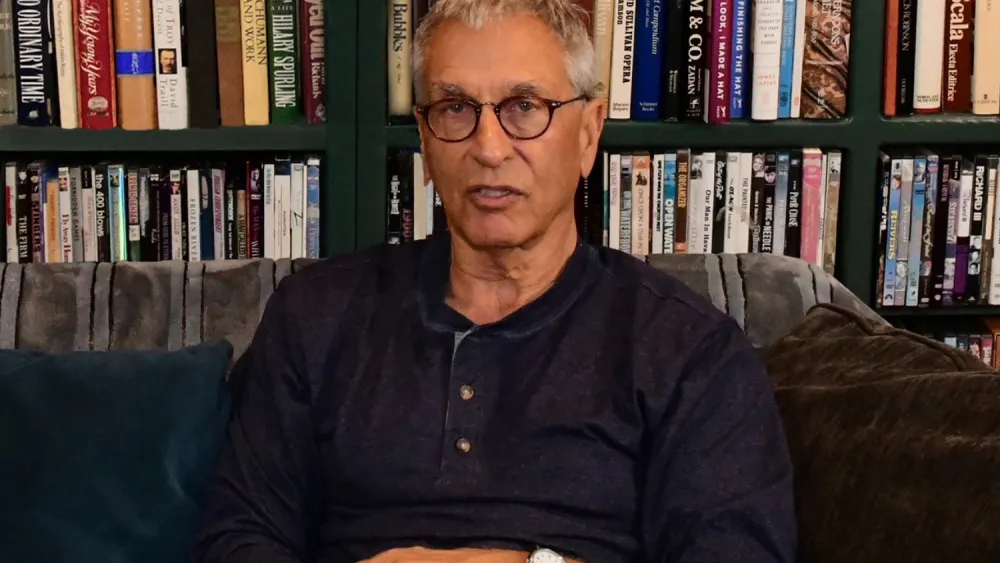
In the build-up to the Italian Global Series Festival‘s sneak-peeking “Star Trek: Strange New Worlds” Season 4 and celebration of “Star Trek” at 60, Nicholas Meyer spoke to Variety about his time with the franchise, famously having directed “Star Trek II: The Wrath of Khan,” as well as the current landscape of television, having co-created Netflix series “Medici – Masters of Florence,” and more.
Italian Global Series is celebrating 60 years of Star Trek. That made me wonder about your perspective on the evolution of the series from when you directed the films through to now.
I can’t speak very much about the evolution because I haven’t paid much attention. When I first was invited to participate in the second movie, it was because the first movie, which was a runaway production, cost $45 million in 1979 and it still made money, and so they were going to make another movie, but they weren’t going to spend any $45 million, nothing like it. And they brought in Harvee Bennett, he was a wonderful man, a television producer who made “Rich Man Poor Man,””The Six Million Dollar Man” and “The Bionic Woman.”
What were the expectations?
They said, “Can you make a movie better than the first movie for half the money? And [Bennett] said, “I can make five movies for it.” And by the way, our budget was like $11.2 [million]. And then they went looking for a writer and they had script after script after they had five drafts of script. I had seen “Star Trek” on TV, and I didn’t get it at all.
I missed everything that was interesting about the show, the idea that people of different races and genders and cultures could come together to do something good that blew right by me.
I just thought the costumes were dopey or something, so I didn’t know what it was, and but I liked Harve Bennett a lot. He said draft five is coming in. Three weeks later, I’d had a little epiphany in the meantime, I knew that this show reminded me of something that I did like. At 13, an impressionable age, I discovered the adventures of Captain Horatio Hornblower. Did you ever read the Hornblower novels?
I’m afraid I have not.
It’s obviously supposed to be Lord Nelson, but it’s a captain in the Royal Navy during the Napoleonic Wars, and he has many adventures, and he has a girl in every port. When you’re 13, this sounded pretty good, and I thought, ‘wait a minute, Kirk is Hornblower in outer space. I know how to do that.’
At this festival there’s been a lot of talk about the growing overlap between cinema and television: as someone who has worked in both mediums, how have you observed said changes?
Well, we’re in the midst of a whole technological overlap, which also coincides thanks to very short attention spans. Even film students in film schools say they they can’t sit through a full movie. So everything is becoming a 32nd vertical, vertical dramas, and all financed out of China, as I understand it. Little three minutes. Some years ago, maybe 1,015 years ago, Jeffrey Katzenberg had this idea called Quibi, collected a lot of money to invest in short episodes that would be on your phone, and he was like 1,012 years early. It didn’t work, but it works now, and this is what’s happening.
And any differences which still remain between film and TV?
The other distinction that I make between television and film – putting aside the whole phone digression – is that I believe in theater. I believe in the idea of committing to an experience, opera, play, ballet, movie, doesn’t matter where you commit yourself, you have to drive to the place or walk to the place, you have to buy the ticket and you have to feed the meter or whatever, and you are going to sit with a bunch of people that you don’t know and they don’t know you and you are going to have a collective experience, which is simultaneously utterly personal.
You are going to laugh or cry with a bunch of strangers, but it is going to be a communal journey of some kind. And if it’s good, it’ll stay with you forever. And what I worry about with television and things on your phone, is we’ve lost this collective experience, and I think that bringing people together, and I’m not just talking about sports, I’m talking about art, and why I think theater, in all its forms, is important for human beings as a species, and I think we forfeit all of this at our peril.
Do you feel there is a kind of marked difference in how series might be structured or written?
It depends whether it’s a single event, whether it’s a limited series, or it’s an ongoing series. The ongoing series, you know, in theory is not unlike, you know, Charles Dickens’ novels or Alexandre Dumas that were published in instalments, and in that format you have time to develop and work out characters. If you look at “Breaking Bad,” and just follow Walter White’s devolution. In the same way that you know serialized novels, that was like an interesting thing. With the attention span competition, it becomes, I think, increasingly difficult to find ways to hook an audience and keep them involved, and there is a lot of formulaic diktats. We need episodes to end with cliffhangers? That’s always been true. That’s been true from “The Odyssey” on, but now there’s more and more things, do’s and don’ts. There are both restrictions that are competitive restrictions, and cultural restrictions, so it’s harder and harder for the salmon to get upstream.