
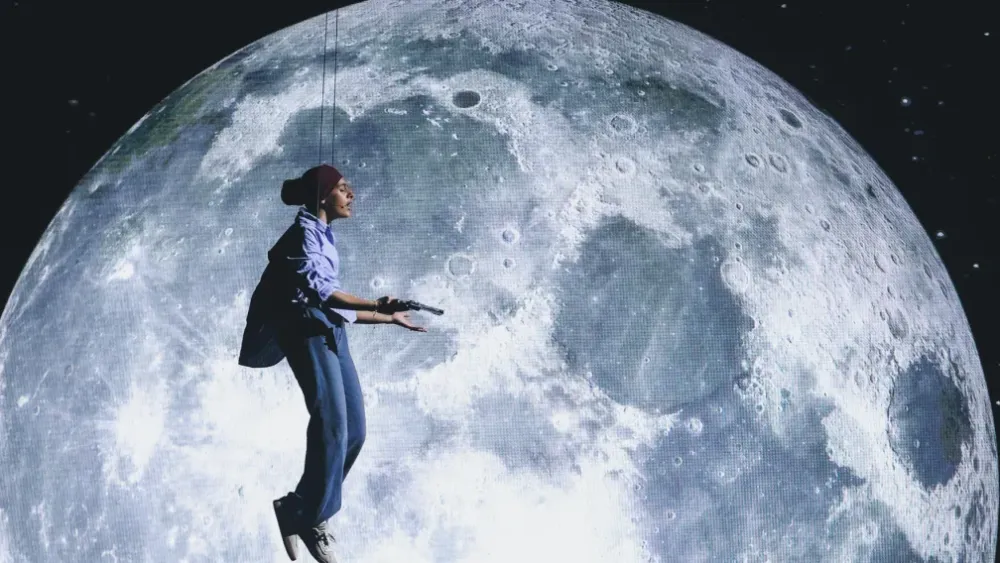
Mathieu Kassovitz’s landmark 1995 film “La Haine” is heading to television in a new form, with French broadcaster France Télévisions set to air the stage adaptation “La Haine, sur scène – Jusqu’ici rien n’a changé” as part of its 2026-2027 slate.
Read more Neon, Oscar-Winning Studio Behind ‘Anora’ and ‘Longlegs,’ Sells Stake to Department M
The adaptation was among the titles unveiled in Paris during France Télévisions’ annual press conference presenting its upcoming programming, which spans French fiction, live performance, international drama and a robust current-affairs and political lineup in the run-up to France’s 2027 presidential election.
Closing the presentation, France Télévisions president Delphine Ernotte-Cunci framed the new season as an expression of the broadcaster’s wider public-service mission at a time of social fragmentation, political polarization and rapidly evolving viewing habits.
“With 500 films available free of charge every year, an unrivaled offering of live performances and close ties with 200 partner music and cultural events, France Télévisions remains the media group that carries freedom of creation furthest across all territories,” Ernotte-Cunci said.
“The values of public service broadcasting are not a legacy that we protect. They are forward-looking ideas that we embrace,” she continued, arguing that audiences increasingly looked to France Télévisions to provide shared national experiences.
“In a society marked by loneliness, watching together means sharing the same place at the same moment. It is an irreplaceable experience,” Ernotte-Cunci said.
Originally released on May 31, 1995, “La Haine” became one of the defining films of modern French cinema, denouncing police violence through the story of three young men (Vincent Cassel, Hubert Koundé and Saïd Taghmaoui) who get caught in riots unfolding in the Paris suburbs. More than three decades later, the black-and-white drama remains strikingly relevant for its exploration of racism at a time when the far right party Rassemblement National is considered a frontrunner in the next presidential election.
Presenting the new slate, Anne Holmes, France Télévisions’ editorial director of creation, said the broadcaster’s creation division looked to introduce audiences to new works and support talent by building bridges between fiction, live performance, music and festivals.
France Télévisions also unveiled “Triple Peine,” a timely drama written and directed by Noémie Kocher that follows an actress who accuses a renowned filmmaker of sexual harassment years before the #MeToo movement.
Set across several periods, the film begins in Paris in 2024, as Mara prepares to testify before France’s National Assembly and finally speak publicly about her case. It then flashes back to 2000, when she lands a leading role in a film by a prominent director, and to 2001, when she files a sexual-harassment complaint and finds herself drawn into a violent legal and personal battle. Produced by Storia Television, a Mediawan company, in co-production with Rita Productions, “Triple Peine” stars Fleur Geffrier, Olivier Gourmet, Justin Blanckaert, Mélanie Robert, Lola Créton and Julie Moulier.
Among the broadcaster’s upcoming action series is “Stunts,” a four-part thriller from UGC-owned Next Episode. The series follows Ada, an impulsive police officer and former urban-acrobatics expert who investigates a gang of stunt performers specializing in stealing luxury cargo from trucks travelling at high speed. After the gang accidentally kills Ada’s twin brother, who is also a police officer, she infiltrates the stunt school where the thieves train without informing her superiors. Created and directed by Erwan Marinopoulos and co-written with Céleste Balin, “Stunts” stars Jeanne Goursaud, Sabrina Ouazani, Anne Parillaud, Yann Gaël and Vincent Heneine.
France Télévisions also announced “L’Autre Fille,” a six-part supernatural drama centered on Emma, a 16-year-old hockey prodigy preparing to leave her remote Alpine village and join a prestigious team in Zurich. Her plans are derailed when a mysterious fluid begins flowing from her navel and transforms into a perfect but uncontrollable duplicate of herself. As Emma attempts to conceal the double’s unpredictable appearances, she must also uncover who is responsible for her mutant power.
The series was written by David Elkaïm, Anne Feinsilber and Vincent Poymiro, in collaboration with Emmanuelle Fournier-Lorentz and Pascaline Sordet, and directed by Sophie Jarvis and Feinsilber. Lilith Grasmug stars alongside Shirine Boutella, Luna Desmeules and Yannick Choirat.
France Télévisions also unveiled “Code Rouge,” the six-part thriller from U.K. producer Bad Wolf. Created and written by Peter A. Dowling and directed by Kieron Hawkes, the series follows Dr. Mathew Nolan, a British citizen who narrowly survives an attempted murder while attending a seminar in China. Arrested upon his return to the U.K., he is immediately sent back to Beijing under the supervision of London police officer Hana Li. The return flight becomes increasingly dangerous as repeated attempts are made on Nolan’s life over the course of the eight-hour journey. The cast includes Jing Lusi, Richard Armitage, Lesley Sharp, Jemma Moore, Dan Li, Cash Holland and Tai Yin Chan.
Speaking about the broadcaster’s international acquisitions strategy, Manuel Alduy, France Télévisions’ editorial director of cinema and international series, said the group was prioritizing a distinctive editorial identity over volume.
“We are not trying to accumulate international series,” Alduy said. “We are looking for shows that bring genuine editorial differentiation and extend the public service mission. They meet the same criteria as our films: singularity, emotion or reassurance.”
Alduy added that France Télévisions’ streaming platform could not simply line up titles, but needed to create viewing pathways, build collections, establish connections between films and series and guide audiences toward new discoveries through formats adapted to digital viewing habits.
“In the continuous noise of streaming flows, certain works still move forward like persistent lights,” he said. “Our role is to make them visible and clear a path for them toward the public.”
Alongside its entertainment slate, France Télévisions outlined an extensive political and current-affairs offering, with new programs ans expanded investigations.
Philippe Corbé, France Télévisions’ news director, said the public broadcaster wanted to provide a shared democratic space during the presidential campaign rather than tell voters what to think.
“Our role is not to tell French people what they should think, but to give them the means to choose,” Corbé said. “That means bringing debate to life, questioning political programs, confronting ideas, giving facts their full place, but also hearing the questions, doubts, anger and expectations of the French people.”
France 2 will revive its cult political interview program “L’Heure de vérité” on primetime, hosted by Caroline Roux alongside a panel of political pundits.
France Télévisions is also ramping up its investigative programming and will increase its efforts to reach younger news consumers through social media and digital-first programming. “En tension,” presented by the YouTuber HugoDécrypte, will unveil reports focused on young people around the world, while Élise Lucet will continue “Dérush,” her interview series featuring prominent figures from social platforms.
The broadcaster said its news content had generated more than 5 billion video views on social platforms during the season, with its news accounts reaching more than 25 million followers.
Corbé said the broadcaster’s editorial priorities would remain grounded in reporting and fact-checking amid growing distrust, disinformation and political polarization.
“The facts before commentary. The field before the studio. Information before opinion,” he said. “The difference of public service lies in a promise: to address all French people. Public service belongs to no camp. It belongs to no party. It belongs to the French people,” he continued.
The expansive slate comes as France Télévisions faces mounting financial pressure and uncertainty over its future state funding.
Ernotte-Cunci said the group had already absorbed €110 million in funding cuts over the past two years. She argued that the unpredictable nature of the cuts had made it difficult to plan ahead and had forced the broadcaster to make painful programming decisions.
France Télévisions had made more than €80 million in programming-related savings for the new season, including sports expenditure, with approximately €20 million affecting creative programming.
She added that the broadcaster already expected to make at least another €20 million in savings in 2027.
Despite the financial headwinds, she argued that the fundamental role of France Télévisions would endure even as its platforms and distribution models continued to evolve.
“The screens will change, and viewing habits will too — probably much faster than we imagine,” Ernotte-Cunci said. “But what French people fundamentally expect from us has not changed.”
Read more Taylor Swift Paid NYC More Than $160,000 for Wedding Weekend Permit, Including Police Overtime