
SPOILER ALERT: This story contains key plot details, including the ending, for “Elle,” now streaming on Amazon’s Prime Video.
Read more Byron Allen Donates $100,000 to Nolan Wells Family’s GoFundMe as Tyler Perry Covers Funeral Costs
Where most showrunners spend the days before their series’ debut worrying whether audiences will tune in, and whether they’ll ultimately get renewed, “Elle” bosses Laura Kittrell and Caroline Dries had a different problem: navigating the press without spoiling the already-shot Season 2.
In January, Amazon renewed the “Legally Blonde” prequel series, which follows Elle Woods in high school, that transformative period before the plucky co-ed applied for Harvard Law School and solved her first case by tapping into the fundamentals of perm maintenance. And the studio’s confidence was rewarded: Amazon reports that “Elle” was the most-viewed show on Prime Video in its first week of release.
“It has been quite a time,” Kittrell who created the show, said, joining Dries over Zoom on the eve of “Elle’s” July 1 debut. “Amazon wouldn’t want it any other way,” Dries joked.
“We are very lucky,” Kittrell added. “The two weeks leading up to the premiere, all our cast were in a panic, like, ‘Can we watch Season 1 again? We have no memory of what’s new, what’s old, what’s a spoiler, what’s not.’”
Indeed, there are plenty of twists and turns in Season 1. The Prime Video show takes audiences back to 1995, when Elle’s (newcomer Lexi Minetree) world gets flipped upside down as her family unexpectedly moves from Bel-Air to Seattle after her plastic surgeon father, Wyatt (Tom Everett Scott) botches a procedure. Much like her first days at Harvard, the peppy, pink-attired Elle struggles to fit in — this time, with the grunge-obsessed kids in the Pacific Northwest. The first season’s eight episodes — titled with quotes from the Reese Witherspoon-starring 2001 movie, like “Whoever Said Orange Is The New Pink Was Seriously Disturbed” — follow as Elle navigates her newfound friendships and crushes, while also uncovering a conspiracy over the misappropriation of school funds.
That’s where James Van Der Beek comes in.
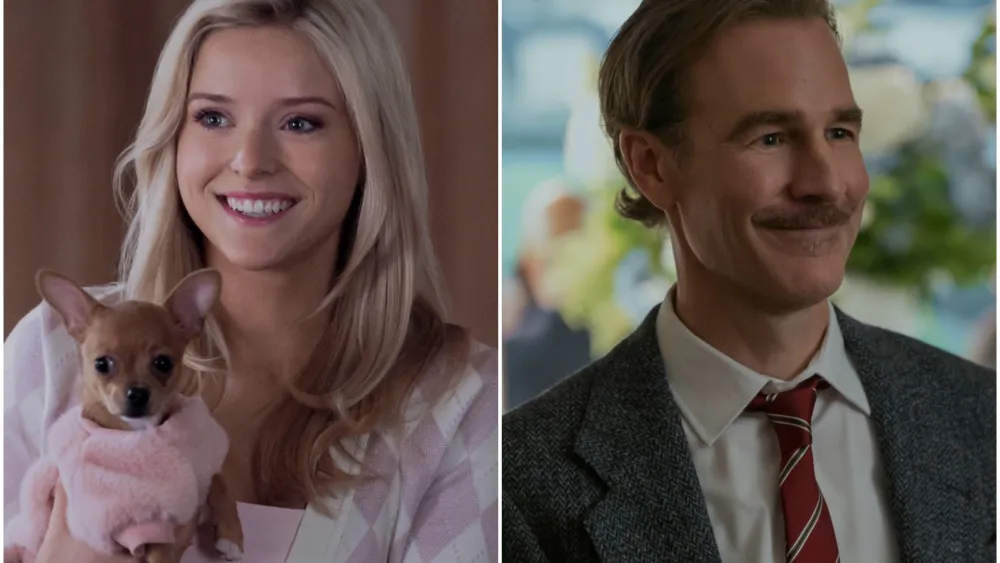
The late TV star, whose name is synonymous with the millennial teen drama, “Dawson’s Creek,” joined “Elle” to play school superintendent and mayoral candidate Dean Wilson. Elle’s mother Eva (June Diane Raphael) — whose life is also thrown into chaos by the move — finds purpose in aiding in Wilson’s campaign, but it all turns out to be for naught when Elle reveals that he was the ringleader of the whole scheme.
“We were so flattered that he wanted to do this show to begin with,” Dries said of Van Der Beek. “Laura and I are such big fans of his, so just getting to work with someone who was a hero when I was growing up was a treat. And getting to watch him take a character and elevate it was so exciting as a writer.”
“Elle” executive producer Jason Moore had worked with the actor on four episodes of “Dawson’s Creek.’ “When his name was up on the audition, it was great. Since he turns out to be a bad guy, I was like ‘What fun for him,” Moore recently told Variety.
And the gig ultimately gave Van Der Beek, who was in treatment for Stage 3 colorectal cancer while filming, as much as he contributed to the crew behind the show. “It really is a time where I don’t feel my pain,” Moore says Van Der Beek told him about performing. “Focusing on work, I really actually am completely distracted, not only when the camera rolls, but just when I’m around all those people. As he got sick, he got really wanted to hold people close and bring people together. He was always really good at that.”
The role was to be the actor’s final performance. Van Der Beek died on February 11, 2026, at age 48. His work on the show was commemorated with a special dedication.
Read on as Kittrell and Dries break down more about the making of “Elle” Season 1 — from how Lexi Minetree channeled Witherspoon’s Elle Woods, the show’s ‘90s musical homages and “Breakfast Club” episode, and how Van Der Beek rewrote his character’s ending.
Lexi is an incredible find. It’s almost uncanny how much she has the mannerisms of Elle down — she practically transforms into Reese Witherspoon at times. What was the moment when you thought, “Oh, wow! This person is the reincarnation of Elle Woods.”
LAURA KITTRELL: It was day one. There are Elle-isms that we’ve given her that are intentional. Like, “Can you say this one thing from the movie?” and she nails those. It was one of the things I was the most stressed about going into making the show: “Oh my God, how are we going to be able to find this person?” And it’s one of the bigger questions people have before they watch: “Is she going to be able to do it?” It’s amazing now that people have started seeing it. I feel like 30 seconds in, people are like, “Oh, she’s got it, it’s fine,” and then you don’t worry about it anymore. That was the experience that we had on day one on set. It was just like, “Oh yeah, we’re good, we don’t have to worry about that part. Great!”
What was your favorite Elle-isms that she nailed?
CAROLINE DRIES: The way she smiles and the way she walks. That is really where it’s uncanny. Also, her typing. That was a detail that Lexi had noticed in watching the movie a million times: Elle has a very specific way of typing on a computer. They didn’t take a typing tutorial in high school back then.
KITTRELL: I was gonna say the typing, because it’s so Elle Woods. But it’s also so Lexi. Like that’s the level of detail she’s picking up. Like, “I watched the two seconds that she types, she does this, and so that’s how the character types.” She has a “Yes!” that is very of the movie.
This isn’t the “Yes” you’re referencing, but she also cheers in the “The Breakfast Club” episode. That movie is oft-referenced in teen movies and shows. What was it like to create an episode that pays homage to that classic?
KITTRELL: It’s funny, it is both paying homage to “The Breakfast Club” and to all of the teen things that have done “Breakfast Club” before. But I can’t think of another example where the kids know that they’re doing a “Breakfast Club.” That was something that we always got a kick out of — them seeing the poster and going, “We are doing ‘Breakfast Club’ today,” and acknowledging that that’s the episode that they’re in. We got to a point in the season where we needed them to do a bit of a caper and needed a way for them to get into the school. “The Breakfast Club” came naturally as what gets them all there on a Saturday.
Read more Myanmar-Set ‘Fruit Gathering’ Wins at Karlovy Vary: ‘Harrowing Drama of Obsession and Queer Desire’
We are a very pop culture reference-heavy show. When I was working on “Insecure,” there was a big debate in the writers’ room, where Issa [Rae] put a reference in a script, and half the room understood, and half didn’t. She was like, “For the people who understand what this is, they’re gonna love it, and the people who don’t understand, they’re either gonna look it up after and have a new thing that they’re interested in, or it’s gonna be two seconds, and they’re not gonna care, and we’re gonna move on.” She was always like, “I want the characters to be talking about the things that they would be talking about if the audience wasn’t watching.” I always think about that with pop culture references, and I also think about the shows I watched when I was a teenager that made me learn about different movies or music, and could serve as a gateway. I hope that there are some teenagers now who watch our show and then seek out “The Breakfast Club” afterwards.
That is the interesting thing about this show being a ’90s-set prequel. There are a lot of references, but you have to balance them, so it’s not always in your face. What was the trickiest reference to pull off?
KITTRELL: The trickiest one, tonally — like, “Can we make jokes that are this dark?” — was in the pilot. Elle is wearing a Nirvana shirt, and Kimberly says to her, “You wearing that shirt is the second worst thing to ever happen to Nirvana,” which is a very dark joke. And if you get what that joke means, you think it’s quite funny. But that was a comedy litmus test of “Are we able to make jokes like this?” And the answer was yes.
Caroline, what is your favorite?
KITTRELL: I know what yours is: Marlena.
DRIES: Marlena, for sure. That’s what made me want to work on the show. When I read the script, they lock you in a room and take your phone. I got to page five, and she’s referencing Marlena’s possession [a major storyline on “Days of Our Lives” from 1994 to 1995], and I’m like, “Oh, if you need any references about this, I’ll just tell you what happened.” What we really wanted was not just to talk about it, but for the audience to really see what it looked like for a character on daytime TV to be possessed in the ’90s. We just ate it up as fans of “Days of Our Lives,” and that was just normal TV that you would watch when you got home from school. So yeah, that is by far my favorite.
No Doubt’s “Tragic Kingdom” was a particularly important part of 1995 for me. So that “Just a Girl” karaoke moment is pretty special. You have so many different ’90s songs — songs that people perform and needle drops. Tell me about paying homage to the sound of the ’90s.
KITTRELL: We had a pop culture timeline that our assistant put together that we referenced in the writers’ room a lot, and a lot of times it was us breaking an episode or outlining something and going, “Oh, we need something for this moment; [then] looking at the timeline and going, what could it be?” My memory of “Just a Girl” was the reverse of that: us looking at the timeline of everything and going, “Oh my God, ‘Tragic Kingdom’ came out in 1995. How can we work this into the show?” When we got to this episode where Liz was going to teach Elle not to care what other people thought about her, we had the idea of her doing karaoke and putting herself out there and doing something potentially embarrassing. It was like, well, that’s the perfect “Tragic Kingdom” moment.
Not to mention that you get a little “That Thing You Do” Easter egg with Tom Everett Scott singing.
DRIES: Totally. The “Wonderwall” mash-up, our writer [Asmita Paranjape] had that in the script, and we’re like, “These songs don’t match.” But Sammi Cohen, who directed that episode, went and did all this editing, like, “If we go in on this note and then do this note, it’s gonna match.” And sure enough, it was amazing.
The joy of our show is that Elle’s musical tastes are sort of this Bel Air, pop, ‘90s Mariah Carey, Ace of Base, and then you have the Seattle grunge, which is obviously its own thing, and they just flow together perfectly. It was fun that we didn’t have to stick with a specific genre.
I heard there’s a story about how Mariah Carey’s “Fantasy” ended up in the show, too.
KITTRELL: We had a group text with Jason Moore [who directed the first two episodes] that was constantly us pitching songs to each other — usually at like midnight. “Fantasy” was one of the first things that we pitched for that opening. We tried an Ace of Base song at some point, like we tried things just to try them, but it always kept coming back to “Fantasy.” Thematically, it was the most appropriate, and it immediately puts you in [time]. We almost don’t need the chyron that says “Bel-Air 1995” because we’re starting with that song.
You’re immediately transported. You have so many references to the ’90s, but then cast who is the epitome of the decade: the late James Van Der Beek. At the premiere, you shared how you gave him something to enjoy despite how sick he was becoming. What did it mean to you to have him on set and as a character who is key to the season one arc?
DRIES: We were so flattered that he wanted to do this show to begin with. Laura and I are such big fans of his, so just getting to work with someone who was a hero when I was growing up was a treat. And getting to watch him take a character and elevate it was so exciting as a writer. We’re still pinching ourselves that we got the opportunity to work with him, and having him on set was such a surprise, because to us, he’s such a star. He treated everyone with so much kindness and was so gracious. He loved showing his daughters craft services and saying, “Here’s where the writers sit. That person’s the director.” I don’t know that they had ever experienced anything like that before, so I was thrilled for him that he got to take his daughters. It was cool, and it made people like Laura and me realize we should be very grateful that we get to work our dream jobs every day.
Let’s talk about the twist. Was it particularly delicious to make him a bad guy?
KITTRELL: Yes, it was. I’m thrilled that people get to see how funny he is, and that he gets to be a little bad in a way I don’t think I’ve ever seen him do outside of “Rules of Attraction,” which is an incredible performance from him. But it was a different flavor on him that I am excited for people to get to see.
Even though Dean Wilson gets arrested, the ending leaves the possibility for him to return. Was that a bit of hopeful positioning, if James were to have been able to be a part of Season 2?
DRIES: We wanted to wrap up the school conspiracy story for Season 1. To say, “Elle solved her case.” So, we were pretty sure that that storyline and that character would end in Season 1. But it was important to James that, even as the character was leaving, he could have a moment with Eva [June Diane Raphael] to sort of explain himself, and to say at the end of the day, he actually is a good guy, he was just misguided and overwhelmed by circumstance. That was James’s idea to write that in; he called me on the weekend and was like, “Hey, can we add a little extra beat to give him an ending?” I love that was his instinct, because, of course, I was like, “Yeah, he should be, ‘Gotcha!.” And James was like, “Or maybe he’s like, ‘This is what I was working with. I had to do this. I’m sorry. I made a mistake.” I was like, “That’s better.”
June Diane Raphael is incredible in this show. I love the parallel of Elle’s coming-of-age arc with her mother’s. It’s interesting to watch this in my 30s and flash back to my younger years, but also connect with an older character. How did you conceive that idea?
KITTRELL: It was always baked into the DNA of the show that the people who saw the movie when they were teenagers had a character closer to their own age who was going through their own journey. So that was always the intention of Eva. I would love to think that I have my shit figured out more than I did when I was 16 years old, and in many ways I do not, so that felt pretty natural. In the pilot, this very disruptive thing is happening in both of their lives, and when something like that happens, you have to look around and go, “What is the life that I’ve made that’s getting disrupted? And how can I respond to this big change?” So, it felt like a natural place to take this woman who, just as much as Elle, had lived in a bubble her entire life and never had to really challenge herself in any way. We thought, “What does that look like as a teenager?” but “What does that also look like as an adult woman?”
It’s fun to see Elle’s friends, like Liz and Kimberly, come of age with her, too. “Legally Blonde” didn’t have much queer representation, but in this series, we get to see two young women restart their love story. Why was their arc important?
KITTRELL: I came out when I was in high school, around the time that I saw “Legally Blonde” for the first time. There were TV shows that were really important to me that really helped me come out, and so now it’s very important to me to have in our show, about teenagers, that representation, because I know how important it was to me. I have such a distinct memory of this very small moment in the movie where Vivian [Selma Blair] uses a slur about Enid [Meredith Scott Lynn], and Elle says, “I would never use that word.” Even tiny moments like that in pop culture, I would just grab onto as like, “It might be OK out there,” and I might be safe to enter the world as an openly gay teenager now. The gift that had been given to me in that tiny way by the movie made me really want that to be in the show. And it becomes more important to the foundation of the show as it goes on.
DRIES: What I like about the way the dynamic between Liz and Kimberly works on our show is that Liz did not exist in my ’90s queer story. There wasn’t a girl who was super comfortable [with her sexuality] and who had a great relationship with her mom about it. And it doesn’t seem to faze her that she’s kind of a loner outsider. I was much more of a Kimberly, so I really related to the aspiration of being a Liz, and then the reality of being a Kimberly. So it was easy to write those characters, and it was also important for us to have an existing story that happened before Elle showed up at the high school. All of these characters had lives, and then Elle entered their life.
What is your overall plan for the show? Will you go all the way through college or fast-forward so Reese can make a cameo?
KITTRELL: We’re going as long as Amazon will let us go, is really the answer. But we’ve intentionally moved very slowly throughout her high school experience. There’s a version of Season 1 that was her entire junior year, and it is only a semester for a reason. We’re trying to take our time.
This interview has been edited and condensed.