
The needle drop as we know it was born in 1969, with the instantly iconic use of “Born to Be Wild” in “Easy Rider.” There were precedents, of course. The first use of a rock ‘n’ roll song in a movie was “Rock Around the Clock” played over the opening credits of “The Blackboard Jungle” (1955), and by any measure the godfather of the needle drop was Kenneth Anger, whose 28-minute-long 1963 bikers-and-drugs-and-Jesus-and-leather-queers-gone-pop “Scorpio Rising” — in my estimation, one of the 10 greatest films ever made — invented the ecstatic juxtapositions that inspired the premier cinematic poet of the needle drop, Martin Scorsese. Which filmmakers have given us the greatest needle drops? The answer is Scorsese (the aesthetic son of Kenneth Anger), Tarantino (the son of Scorsese), Paul Thomas Anderson (the son of Tarantino), and, from a very different track, the Michael Mann of “Manhunter” (a movie I’ll write about next week, when it’s released for its 40th anniversary).
I zip through this history because there’s a needle drop in “Motor City,” the startlingly high-wire new crime thriller (it’s got love, violence, suspense — but no dialogue), that earns comparison to the work of all those other directors. And so I want to be clear that we aren’t simply talking about an ordinary needle drop but, rather, the visionary hypnotic kind.
Set in Detroit in 1977, the film introduces us to John Miller (Alan Ritchson), an ex-con and Vietnam veteran who is burly and blockish enough to look like he’s halfway between Bruce Banner and the Hulk. But in his G.I. Joe haircut, he’s trying to walk the straight and narrow. We have seen that he’s in love with Sophia (Shailene Woodley), his live-in girlfriend, who he gets down on one knee to propose to (an offer she gratefully accepts). And we’ve witnessed a rather strange crime in which his vintage green ’70s muscle car was stolen…and then returned to him. By this point, we like Miller and Sophia well enough to want to see them happy.
Then the familiar, deliberate plucking of an acoustic guitar comes on the soundtrack, and we recognize the intro to “The Chain,” the great Fleetwood Mac song from 1977. In a scene that unfolds in slow motion, a canister of tear gas is tossed into the couple’s home, tearing through their veil of domestic bliss. Police detectives burst in and demand to see Miller, who from what we can tell has done nothing wrong (in fact, he’s just completed his parole requirement). Outside, the cops, led by a dry sinister officer in a long black leather coat, order him to get on the ground, face down; Sophia comes out of the house and is placed in the back of a car, staring at all this through the glass. As the cops open the trunk of Miller’s car and fish out kilos of drugs, our mounting horror and dread is echoed, but oh so ironically, by “The Chain,” which is playing throughout all of this. The song is a slow build, one that finally explodes into that gorgeously melancholy up-tempo climax (“Cha-a-a-ain…keep us together!…Runnin’ in the shadow!”), and it elevates the fear and trauma of what we’re watching into the purest opera.
Staging a great needle drop isn’t the same thing as directing a great movie. But Potsy Ponciroli, the director of “Motor City” (which opens July 24), has an operatic temperament in a large way. He has made a stylized crime drama that’s full of pop music, and also full of naturalistic sound, so that it looks and feels more or less real, only the characters don’t converse. (They say an occasional throwaway word here or there.) Even when two of them are just seated in the booth of a diner, what passes between them is suggested by looks, gestures, and our ability to read the situation. The reason this works is that we’ve seen enough thrillers to be able to color in the essence of the dialogue ourselves; we don’t need to hear the words. And without them, we plug into the sheer presence of the actors. At times, “Motor City” is like a silent movie directed by Scorsese. It draws us in because it’s got a glittering underworld-opera surface, but also because the audience needs to use its noodle a bit to participate in the film’s telling.
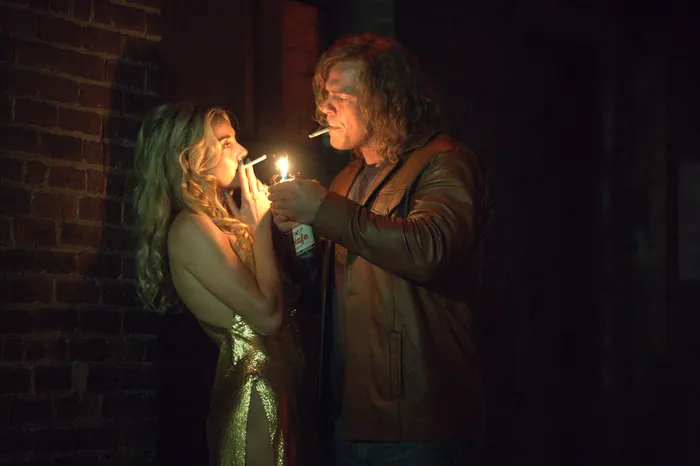
“Motor City” offers up Detroit as a gritty and squalid place, a crumbling purgatory with a period rock vibe (posters of Styx and Zappa) that’s the perfect setting for crime drama. The sound of David Bowie’s “Cat People (Putting Out Fire),” heard in a revamped version (at this point, the song is a reference to a reference to a needle drop), sets the tone of dread-soaked rapture, and a flashback to what happens in the alleyway just outside a scuzzy club gives us all the drama we need. That’s where Sophia, hanging out of her dress like a ’70s “floozy,” first meets Miller, who resembles a party boy carved out of marble. The twist is that she’s already attached to Reynolds (Ben Foster), who looks like a dweeb — but is, in fact, an extremely wealthy and powerful drug kingpin. Miller wound up taking Sophia right out from under Reynolds’ controlling gaze. The cops come to Miller’s house because Reynolds, out for revenge, has set him up.
A headline, glimpsed in a newspaper box, tells us that Miller has received a 25-year sentence for possession of narcotics. That’s what happens when you steal an underworld boss’s girlfriend. And now Reynolds has taken Sophia back. He comes to visit Miller in prison, giving him a photograph of himself and Sophia (they’re married now), with an inscription scrawled on the back: “You should have seen the honeymoon.” Ponciroli stages a powerful sequence, set to Donna Summer’s “I Feel Love,” that’s all about Miller’s jealous fantasies, and “Motor City” keeps tightening the screws of sadism and vengeance. It’s also got a diligent cop and a few canny twists, like one that hinges on a wedding ring. Written by Chad St. John, it’s a grungy piece of primal pop that recalls everything from “Drive” to David Lynch to the primitive low-budget ingenuity of “Dragged Across Concrete.”
I was a fan of Ponciroli’s sneaky, stylish 2021 Western, “Old Henry,” starring Tim Blake Nelson as a varmint who wasn’t to be messed with. But “Motor City,” while it’s a less perfect film, demonstrates that Ponciroli has a talent I think could be explosive in a mainstream movie. If I were a producer or studio head, I would sign him up immediately. He brings out an expressiveness in his actors (that’s a big part of what makes the film work), and there’s an audacity to his choices that can feel rhapsodically right, as when he stages an intricate prison-escape sequence to the Moody Blues’ “Nights in White Satin.”
That said, the last part of the movie falls off in a rather inexplicable way. Miller, having broken out of prison (with a dagger made of smelted candy), is going to get his revenge, but for some reason the movie’s needle drops drop out, replaced by a blandly orthodox suspense score. Did Ponciroli suddenly lose the rights to songs that he’d been planning to use? The trouble is, it feels like a violation of the film’s aesthetic, not to mention a colossally blown opportunity. I was greatly looking forward to scenes of ultraviolence set to the last songs on earth you’d imagine them being set to. And the epilogue, which takes place many years later, feels like a miscalculation. But “Motor City,” as its best, qualifies as a true immersive cinematic experience. It’s a movie almost entirely without words, but it speaks.
‘Motor City’ Review: Potsy Ponciroli’s Audacious Thriller — a Scorsese Opera without Dialogue — Announces the Arrival of a Startling Voice
Reviewed at Ludlow House, New York, July 8, 2026. MPA Rating: R. Running time: 103 MIN.
-
Production:
An Independent Film Company release of a Stampede Ventures production. Producers: Greg Silverman, Jon Berg, Cliff Roberts, Chad St. John, Alan Ritchson, Joshua Harris. Executive producers: Gideon Yu, Chris Bosco, Jim Meenaghan, Elizabeth A. Bell, Potsy Ponciroli, Michael Tadross Jr., Michael Tadross Sr., Grant Torre, Sebastien Latil, Simon Hedges, Bjorn Hovland, Teddy Schwarzman, John Friedberg, Jill Silfen, Eric Hedayat, Dan Spilo, Charles Herzfeld, Jack White, Ian Montone, Mall Pollack, Dave Roberts, Travis Mann, Shannon Houchins, Alastair Burlingham, Gary Raskin, Charles Dombeck, Jatin Desai, Greg Friedman, Mitul Patel, Ford Corbett, Nathan Klingher, Mark Fasano, Tale Heydarov, Nijat Heydarov, Essad Puskar. -
Crew:
Director: Potsy Ponciroli. Screenplay: Chad St. John. Camera: John Matysiak. Editor: Joe Galdo. Music: Steve Jablonsky. -
With:
Alan Ritchson, Shailene Woodley, Ben Foster, Lionel Boyce, Amar Chadra-Patel, Pablo Schreiber, Dominic Bogart, Mister Fitzgerald, Rafael Cebrian, Ben McKenzie, Jack White.