
After nearly 20 years of tracking representation metrics, the latest report from Dr. Stacy L. Smith and the Annenberg Inclusion Initiative reveals that Hollywood’s film industry has not made lasting progress towards inclusion.
“While we’ve seen pockets of progress for women on screen, the pace of change has been slow. Year after year, many of the same patterns remain,” Dr. Smith said in a statement about the study. “Incremental improvement is important for achieving meaningful transformation, but after nearly 2 decades of research and advocacy from many groups, it is clear that the industry is content to wait for change to find them rather than pursuing solutions.”
Smith’s statement accompanies the Annenberg Inclusion Initiative’s annual report, titled “Inequality in 1,900 Popular Films,” which examines representation and inclusion metrics for the 100 top-grossing films of 2025. The study evaluates representation on camera (based on gender, race/ethnicity, the LGBTQ+ community and people with disabilities) and behind the scenes (the gender and race/ethnicity of directors, writers, producers, composers and casting directors), adding to a dataset that began in 2007.
Some key takeaways from the study include that, despite comprising just over 50% of the U.S. population, in 2025, just 33.6% of all speaking or named characters were women and girls. Remarkably, that figure hasn’t changed much in 19 years (29.9% in 2007). In terms of lead or co-lead roles, women and girls have seen progress (38 films in 2025 compared to 20 in 2007), but the figure dipped from the 19-year high of 55 lead/co-lead roles in 2024. Of those 38 films, 15 had a female lead/co-lead from an underrepresented racial or ethnic group, and 3 had a female lead/co-lead 45 years of age or older. Only 4 nonbinary speaking or named characters were coded across the sample.
LGBTQ+ representation on screen remained static from 2024, with 36 speaking or named characters (less than 1%) in 2025, but not one transgender character appeared in the sample. The percentage of characters with a disability also stayed relatively stagnant at 2.8% (121 characters).
When it came to representation behind the scenes, the study further contextualizes an earlier report that only 9 of the 111 directors who helmed 2025’s top-grossing films were women: Nisha Ganatra (“Freakier Friday”), Emma Tammi (“Five Nights at Freddy’s 2”), Domee Shi (“Elio”), Madeline Sharafian (“Elio”), Celine Song (“Materialists”), Jennifer Kaytin Robinson (“I Know What You Did Last Summer”), Maggie Kang (“KPop Demon Hunters”), Hikari (“Rental Family”) and previous best director Oscar winner Chloé Zhao (“Hamnet”). The percentage and number of women directors in 2025 has significantly decreased since 2024 (a record high 16 women), but was identical to 2008. Across all 19 years, just 7% of directors were women.
Women writers and producers filled 16% and 24.4% of their respective roles in 2025, a figure that hasn’t markedly changed from 2007. The greatest change was observed for women composers, whose employment has surged since 2007, when there were no women composers working across the top 100 movies. In 2025, 10 women (8.5%) were credited with working as composers.
In terms of racial and ethnic diversity, 41.5% of all speaking or named characters were from an underrepresented group, a figure that reaches proportional representation to the world’s population for just the fourth time in 19 years. Since 2007, the percentage of white characters fell by 19.1%; however, only the percentage of Asian characters has increased significantly (by 11.1%). And there are still significant ways that groups were left out of storytelling: 30 movies did not have any Black characters, 46 were missing Hispanic/Latino characters, and 26 excluded Asian characters.
“Nineteen years of data show that change is possible, but they also show how fragile that progress can be,” said Dr. Smith. “This is not the first time this report has shown that meaningful gains are followed by a return to business as usual. At a moment when the industry is redefining its future, inclusion can be part of the solution, not a casualty of contraction. The question is no longer whether the industry can change. It’s whether it will.”
For the full report, visit the Annenberg Inclusion Initiative .
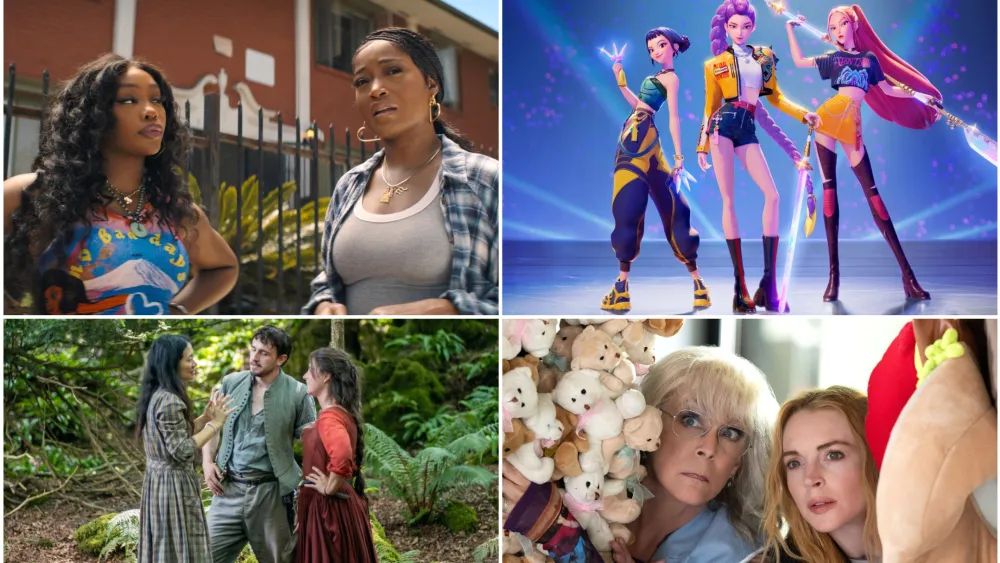
[Pictured above (clockwise): “One of Them Days,”“KPop Demon Hunters,““Freakier Friday“ and “Hamnet“]