
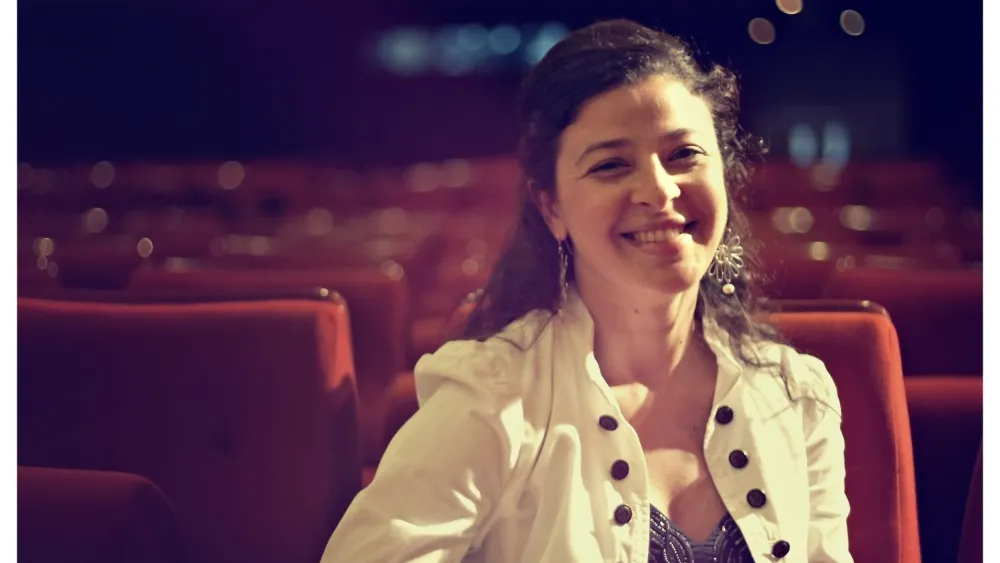
Hania Mroue, founder and director of Beirut’s beloved Metropolis Cinema — Lebanon‘s only arthouse movie theater — is planning to host the second edition of the South Screens (Écrans du Sud) Film Festival on Thursday evening, just as Israel is stepping up air strikes in Lebanon.
Mroue is forging head despite an airstrike Thursday afternoon on the suburb of Choueifat, close to Beirut’s international airport, the first attack close to the Lebanese capital since May 6.
“An apartment was bombed a few kilometers from the Metropolis, but we are maintaining everything and we are full house,” a rep for the fest informed Variety in a text message.
The festival, scheduled to run May 28-June 6, will kick off with Lebanese director Dima El-Horr’s documentary “And the Fish Fly Above Our Heads,” which depicts the current war-torn reality of Lebanon through the lives of three aging men — Reda, Adel and Qassem — who spend their days on a public beach in Beirut.
The South Screens fest will also feature works by Oliver Laxe — who will be on hand — Saeed Roustaee, Rungano Nyoni, Park Chan-wook, Lucrecia Martel and Cherien Dabis.
Located in Beirut’s Mar Mikhael district right across from where the tragic port blast occurred on Aug. 4, 2020, the Metropolis Cinema was inaugurated in its current new venue in December 2024 amid Israel’s ceasefire with Hezbollah following months air strikes and artillery attacks.
Below, Mroue spoke to Variety a few hours before the fest kicked off about what it’s like to run a movie theater and a festival during a war.
Metropolis Cinema barely shut down during the ongoing war. How did you manage to do that?
You know, we opened the cinema 20 years ago on July 11, [2006]. And the next day, a war started again. It was an Israeli war against Lebanon. So we are used to operating in a very unstable context. We learn very quickly to adapt to the situation, no matter what. We know we cannot change the situation. It’s a choice: either you do nothing while waiting for better circumstances, or you just have to find a way to adapt. And basically, we chose the second option.
To be honest, this war, when it started, it was so violent that we had to close the cinema for two weeks. But then we realized that wasn’t going to stop anytime soon, so we reopened, and it was a very big risk. We were scared. It’s a big responsibility to gather people, to bring in the cinema staff. Also, we didn’t know what to program — that was the most complicated thing, because you cannot program something that is completely disconnected from the context and you cannot program something that is war-related. People are already fed up with the news and the general atmosphere of fear and anger and frustration. So it was very difficult to make this decision. But it turned out to be a very good one, because [once the battering of Beirut subsided] we reopened with the release of this documentary, “Do You Love Me” by Nana Daher, a Lebanese film made with archival footage [it’s described by the director as “a love letter to Beirut, spanning 70 years of film, TV, home videos, and photography, exploring the Lebanese collective psyche”] that premiered in Venice.
How did that go?
We had a full month of sold-out screenings. So basically the cinema was full every day, despite the bombing, despite the stressful situation, which means that the audience is willing to take this risk as well, for many reasons. I think one of them is that they need to disconnect a little bit. But also it’s this feeling that we need to be together in a place. And Metropolis is one of the few places in Beirut that gathers people despite their political beliefs, their affiliations, their religion, their whatever. So, it’s really a place for being together. And that is very much needed at a time when there is a very big political polarization in the country.
Today, the South Screens festival opens at Metropolis Cinema, just as Israel is stepping up its air strikes in Lebanon. Talk to me about the significance of this.
Keeping the festival in this slot was a big decision and represents a challenge in itself because, usually, we like to invite the directors. For us, a festival is an opportunity to create encounters between filmmakers and the audience. We’re not interested in red carpets, stars and awards and stuff like that. But it’s a place for people to meet talents. Still, we decided to keep it, because we have a very nice program. We believe that it’s important also for us to say that, not only are we surviving the war, but we’re also able to to create something that has a meaning in this difficult context. This festival has a big significance for us, being situated in this geographical region. We are part of the Global South. So connecting our cinema experience from Lebanon, and from the region, with what is happening in the neighboring countries from the Global South is extremely important. And we’ve had some filmmakers who immediately confirmed their presence, one of them being Dima Al Har, who is present in Beirut, although she lives in Paris, and Oliver Laxe, who accepted to come from Spain. His response was not that he is coming despite the situation, but that he is coming because of the situation out of support and solidarity.
What is the situation in Beirut exactly? From what I’m reading, the airstrikes on Lebanon are escalating.
It’s an unprecedented situation where most of the South [of Lebanon] is being evacuated as we speak, because more and more villages are being threatened. And people are being asked to leave, which means people are displaced; they are staying on the street. There is also a constant threat of bombing Beirut, even though it did not happen in the past few days, but there is a constant threat that it might happen. There’s also a threat of infrastructure such as the airport being bombed. I hope it doesn’t happen, but that’s what we are hearing every day. I mean, there is a drone hovering above our head 24/7 so that’s also a constant threat and a constant source of stress, which means that even if the bombs are not actually falling above our head in Beirut, it doesn’t mean that we feel safe at all. And it doesn’t mean that things cannot escalate further. So there is this constant feeling that you have to operate on a day-by-day basis, even hour-by-hour. We don’t know what’s going to happen tonight. So yes, this is the general atmosphere.
I believe you had planned another bigger festival in July to celebrate the Metropolis 20th anniversary. Has that been postponed?
That event means a lot to us. It’s the culmination of 20 years of work, networking, building friendships and also building an experience. So for us, it was an occasion to celebrate with all the people who have been very supportive over the past 20 years — partner institutions, but also filmmakers that we’ve worked with. Unfortunately, something that big requires months of preparation in advance. And we are in a situation where it’s very difficult to predict where things will stand on July 11. So we are still planning on doing something to mark the date, and also hoping to have at least a few guests, and maybe something very symbolic and powerful. But we are adapting the program according to how the situation evolves.
Read more CNN Sues AI Firm Perplexity, Alleging It Engaged in ‘Massive Copyright Infringement’
This interview has been edited and condensed for clarity.