
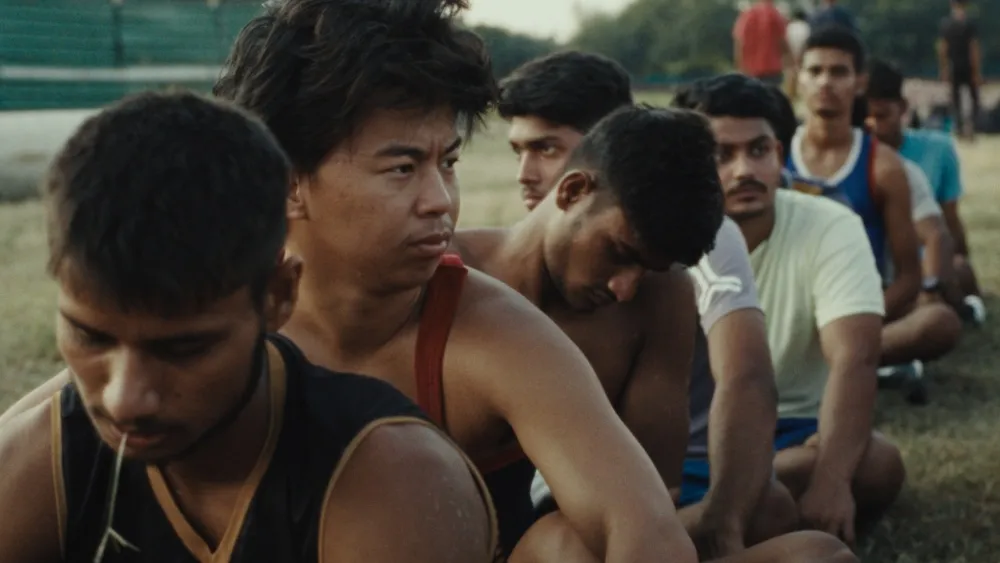
Vishwendra Singh’s debut feature “Khoriya,” bound for the Busan International Film Festival, leads Future East Film‘s 2026-27 slate, which also includes Ashim Ahluwalia‘s “Unidentified Actress,” Rayit Hashmat Qazi’s “Sawdust” and the India-Italy co-production “Heroic Frenzies.”
Read more Microseries Studio and Platform aTwist Officially Launches With First Slate of Originals
Ahluwalia’s “Unidentified Actress,” an India-U.K.-Germany co-production now shooting, centers on a documentary filmmaker tracking down a movie star who vanished decades earlier, set against the tangled film world and scandals of 1950s Bombay. Qazi’s Kashmir-set “Sawdust” follows a talented young cricketer trying to break free of his circumstances, only to be pulled back by his troubled relationship with a father he struggles to tolerate. “Heroic Frenzies” is based on the real-life exploits of a 16th-century monk who defied the church, dabbled in the occult and fled across the continent before the Inquisition finally caught up with him and had him burned at the stake.
Leading the slate, “Khoriya” will have its world premiere in the A Window on Asian Cinema section of the 31st Busan International Film Festival this October. The film, shot in Nepali and Hindi, is produced by Niharika Singh, Faraz Khan and Prayas Deepti, with Ahluwalia serving as executive producer. “Khoriya” is set on Delhi NCR’s outer edge, where two Nepali half-brothers run a poultry farm that collapses after a bird flu outbreak. One brother pursues a young woman working in a parlour who is trying to break free of her home life, while the other sinks into drinking and despair as both men struggle to hold onto their dignity in the city’s rougher margins. The film examines the position of Nepali migrant workers within Delhi’s urban economy, where their labor is essential but their presence goes largely unrecognized.
The story traces back to a documentary Singh shot in the summer of 2019, following migrant workers from Nepal and India’s northeast who were living and working on Delhi’s margins. That fieldwork became the foundation for a fictional narrative built around migration, masculinity, aspiration, labor and belonging. The film had earlier been part of the NFDC Waves Film Bazaar’s 2025 Work in Progress Lab, which awarded it a post-production grant.
“‘Khoriya’ began with my interest in people who have been deprived of a sense of home – people who leave everything behind and arrive in an unfamiliar city in search of a more dignified life,” said Singh, the film’s first-time director. “I wanted to stay close to their silences, contradictions, loneliness and tenderness, and to the struggle to hold on to dignity in a world that can make people feel disposable.”
Ahluwalia, who has worked with Singh for nearly a decade, described “Khoriya” as part of a new wave of Indian independent cinema operating outside conventional production structures. “What interested me was the way the film enters a world that is rarely represented on screen without turning its characters into an issue or an argument,” said Ahluwalia. “There is an intimacy and contradiction to these lives that Vishwendra captures very instinctively. For Future East, the film also represents our continued commitment to backing filmmakers who don’t necessarily fit existing categories.”
Niharika Singh, producer and partner at Future East, called the film emblematic of the company’s mission. “Vishwendra approaches the lives of Nepali migrant workers with tremendous intimacy, without reducing them to victims or symbols,” she said. “The film is specific to a community and a place, but its questions around dignity, aspiration and belonging are universal.”
Between 2016 and 2019, Singh was on staff at Future East, assisting Ahluwalia on titles including the gangster drama “Daddy” (2017), the horror-themed anthology “Field Guide to Evil” (2018) and the Netflix series “Cla$$” (2023). His first short, “Hauah,” made in the Braj language, played the New York Indian Film Festival, the Dharamshala International Film Festival, the Jagran Film Festival and Nottingham’s Arts Mela.
Future East Film, the company Ahluwalia founded, launched with “John & Jane” (2005). The film screened in Toronto and at the Berlinale, winning an Indian National Film Award, as well as a European Media Art Award, and it also became one of the first Indian titles HBO Films picked up for domestic U.S. distribution. “Miss Lovely” (2012) had its world premiere at Cannes before rolling out across the U.S., U.K., India, Germany, France, Japan, Taiwan and other territories. “Events in a Cloud Chamber” (2016) premiered at Venice and later played BFI London and IDFA, while “Daddy” paired a wide theatrical run with festival berths at Sundance, SXSW and Rotterdam. The company expanded into television in 2023 with Netflix’s “Cla$$,” which ranked as the streamer’s most-watched series in more than 22 countries within its opening month.
“Future East began before there was an independent film ecosystem in India,” said Ahluwalia, noting that the company’s history runs from “John & Jane” in 2005 through Chris Smith’s “The Pool” in 2007 and “Miss Lovely” in 2012 to “Khoriya” today. “We’ve moved between radical independent cinema and much wider audiences, including ‘Cla$$,’ where we carried that same sensibility into a Netflix series. We’re now turning that history and sensibility into a conscious slate.”