
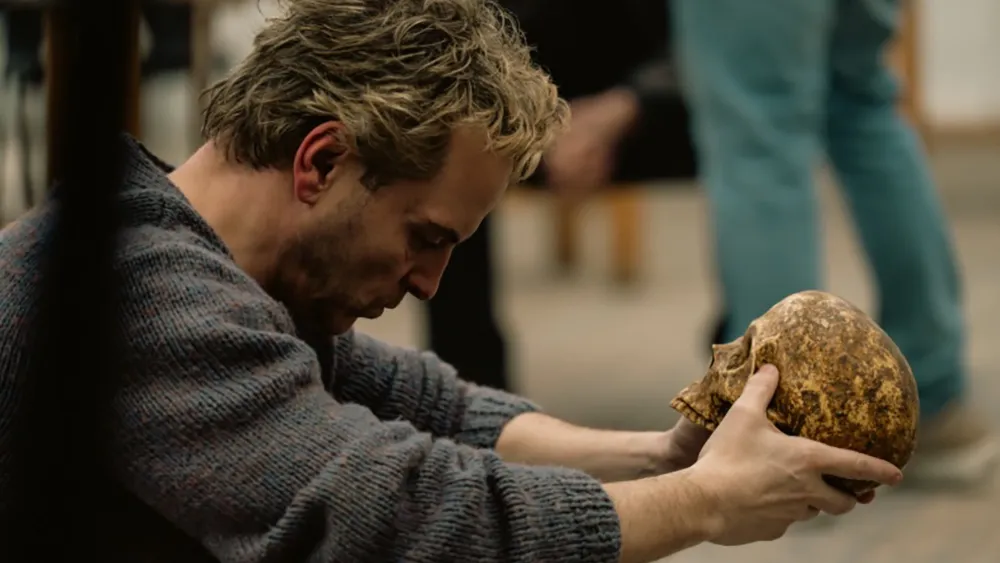
“Elsinore,” named for Hamlet’s castle, opens on a production of that Shakespeare play at the National Theatre in London — but we see it from the bored, amused vantage of the backstage technicians, who get seriously jarred when the doddering actor playing the ghost of Hamlet’s father keeps forgetting his lines, and the actor playing Hamlet gets so pissed off that he stalks off the stage in mid-performance. The year is 1989, and that fiery young actor is Daniel Day-Lewis. (Walking off that stage, never to return to the production, is the first famous thing he did that seemed…extreme.) At first we think: Is this some weird theater biopic in which the young Daniel Day figures in? Yes and no.
The movie is not about him. It’s about another classy, dashing, well-known-at-the-time British actor — Ian Charleson (played by Andrew Scott), who was one of the two stars of “Chariots of Fire,” which had come out eight years before. He played Eric Liddell, the devout Scottish Christian who ran his Olympic races for the glory of God. That movie won the Oscar for best picture, so it placed Charleson, with his blond WASP handsomeness and slightly recessive severity, squarely on the map. As “Elsinore” opens, we see that he’s been trying to make good on it ever since.
But the sad truth is that Charleson, at 39, is already a has-been. His Hollywood career hasn’t panned out, and wherever he goes, people remember him from “Chariots of Fire,” which has become his badge of shame (and, in the film, something of a running joke), since the thing everyone loves most about that movie is the whooshing romantic synthesizer score by Vangelis. (At one point he gets into a cab, and the driver sings it for him.) They’re not wrong. “Chariots” was a decent movie, but take the music out of it and you’re left with a stiff-upper-lip “Masterpiece Theatre” period sports drama that was not exactly a famously strong best picture winner.
Charleson was a momentary heartthrob, but now, with his two-tone frosted hair (like George Michael’s, or maybe like Day-Lewis’ in “My Beautiful Laundrette”), and his delicate and abashed manner, he’s a gay actor who’s trying to contort himself to fit into the roles he’s offered, which are mostly in trashy B genre movies. Is he in the closet? Not exactly. Out and about in London, in the pubs and discos, he lives a vibrant gay life. Yet he doesn’t broadcast it, because he knows that will hurt him professionally. He’s still trying to maintain a “straight” image in a mostly straight entertainment world. Early in his career, he made a movie called “Jubilee” (1978) with the transgressive gay director Derek Jarman (played here with whiplash ferocity by David Dawson), who is furious at him for having scrubbed that film from his resume.
So why are we watching a biopic about Ian Charleson? Because in 1989, he did something extraordinary. As we learn early on in “Elsinore,” he’s been diagnosed with HIV, which for him, thus far, has resisted erupting into full-blown AIDS. (He refuses to take AZT, which he considers a lame leftover chemo drug that does nothing.) Each day, he checks out his body with a hand mirror to make sure that there are no Kaposi’s sarcoma lesions. Then, one day, as he’s sitting in the make-up chair getting ready to go onto a movie set, he finds one — a small purple blotch on his right temple. He thinks it’s a death sentence. But karma has other ideas.
With Daniel Day-Lewis having dropped out of the “Hamlet,” the play’s director, Richard Eyre (Johnny Flynn), wants to replace him with Ian. Charleson had played the Prince of Denmark once before (in 1974, when he was just 25, and by his own admission too young for the part). But now he’s ready. It’s the role of a lifetime. But can he play it while dying?
I put it that starkly because full-blown AIDS, in 1989, was a death sentence, and “Elsinore” is the first movie in a while to take us back to that tragic and haunted era. But since we’re at a very different place now, and the scalding pain (and scandal of government indifference) that defined those years is now a part of our history, “Elsinore” is not trying to be a raw, in-your-face AIDS drama like “Longtime Companion.” Yet the film, written by Stephen Beresford and directed by Simon Stone, has every bit as much on its heart and mind.
“Elsinore” is about the shock and trauma of the AIDS epidemic. It’s about the culture of gay actors who felt compelled to hide their identities not out of shame but out of survival. It’s about the passion, and extraordinary heavy lifting, of performing the most profound and daunting of all of Shakespeare’s plays. And it’s about how all of this comes together in the quietly heroic person of Ian Charleson — who, just at the moment when he needs to be taking supreme care of his health, and not weakening himself by taking on the ultimate demanding theater role (4,167 lines of dialogue! Performed before a nightly audience of 1,100 on the hallowed Olivier stage of the National Theatre), decides that he must take on the role. He does it because it’s the chance of a lifetime, but more than that he does it to live. He does it to embrace the life of the theater, at its most incandescent, as a way to ward off death. And maybe he does it to embrace death too, since “Hamlet,” among other things, is all about death.
Andrew Scott, who looks remarkably like Ian Charleson, gives an astonishingly layered and moving performance. His Ian is a man who loves life — the life of a British celebrity, an erotic adventurer, and an actor who’s gifted and ambitious enough to think of himself as an artist. Yet the specter of AIDS hangs over him like the Sword of Damocles. Once the lesions start showing up, you feel how the awareness of the disease colors his mood, as his natural ebullience tries to fight off a crestfallen despair. That battle plays out in the clinic of Margaret Johnson (Olivia Colman), the physician whose care he comes under. She’s ahead of the curve in administering AIDS treatments and feels that she can extend his life. But she’s big on doctor’s orders, and the last thing on earth she thinks that Ian should be doing is playing Hamlet.
This is no quaint battle. Dr. Johnson is trying to save Ian’s life, and he’s saying, “Fuck that. I don’t care.” The tender power of “Elsinore” is the way that Scott’s performance takes us right inside Ian’s state-of-mind — his belief that what’s left of his life needs to mean something, and that playing Hamlet will give it that meaning. Colman, in stringy auburn hair, makes a crisply delectable antagonist (who is really, of course, on Ian’s side). But it’s the antagonism melting into hard-won communion that passes between Ian and Derek Jarman (who also has AIDS) that is most moving. For what that relationship is really about is the impossible situation these men are trying to navigate — how to be true to their art by being who they really are, even under the gun of overwhelming prejudice. By the end of “Elsinore,” that’s what Ian has done. He has used the role of Hamlet to look death in the face, and to lay bare his soul onstage. “Elsinore” is in many ways styled as an art-house crowd-pleaser, and on that score it faces steeper odds than a film like this one might have a few decades ago. But Andrew Scott makes it an indelible journey.
‘Elsinore’ Review: Andrew Scott Is Powerfully Moving as Ian Charleson, the ‘Chariots of Fire’ Star Who Played Hamlet While Ravaged by AIDS
Reviewed at Telluride Film Festival, Sept. 4, 2026. Running time: 111 MIN.
-
Production:
A Focus Features release of a Lucky Red, Magnolia Mae Films production, in association with LD Entertainment, StudioCanal, Canal+, Ciné+ OCS. Producers: Andrea Occhipinti, Gabrielle Tana, Pete Shilaimon, Mickey Liddell, Stefano Massenzi, Carolyn Marks Blackwood, Andrew Scott. Executive producers: Anna Marsh, Ron Halpern, Joe Naftalin, Michael Glassman, Joseph Yakob, Natalia Shilaimon, Ethan Silverman, Pierre du Plessis, Sudie Smyth, Stephen Beresford. -
Crew:
Director: Simon Stone. Screenplay: Stephen Beresford. Camera: Mike Eley. Editor: Valerio Bonelli. Music: Stefan Gregory. -
With:
Andrew Scott, Olivia Colman, Billie Piper, Johnny Flynn, Luke Thompson, David Dawson, Matthew Beard, Joe Locke, Monia Dolan, Georgie Glen, Sadie Soverall, Adeel Akhtar, Dickie Beau.