
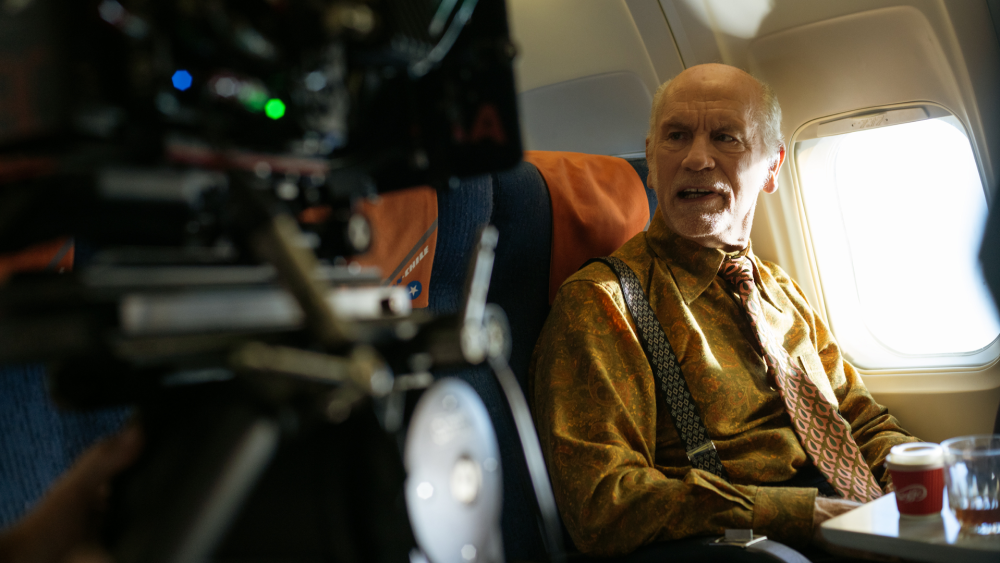
John Malkovich could finally have an Oscar secret weapon, and his name is Martin McDonagh.
“Wild Horse Nine,” the black comedy that bowed in competition at the Venice Film Festival — where it drew a 13-minute standing ovation — before turning up as Telluride’s surprise patron screening on Friday afternoon, drops a pair of CIA operatives onto Easter Island in the tense days before the 1973 Chilean coup, then lets the absurdity metastasize from there.
The ensemble is deep and soars — Steve Buscemi, Tom Waits, Parker Posey, Chilean breakout star Mariana Di Girolamo — but the film rests on its firm two-hander: Sam Rockwell and, in the performance generating the loudest awards buzz, Malkovich.
A McDonagh movie arrives with automatic awards gravity, and he’s earned it. “Three Billboards Outside Ebbing, Missouri” and “The Banshees of Inisherin” both turned festival launches into major Oscar players — the former landing seven nominations, the latter nine — and both proved his unusual ability to make the Academy take a particular kind of movie seriously: profane, melancholy and frequently very funny, with enough emotional heft to shrug off the label of “comedy.”
Searchlight Pictures, for its part, knows the route from the Lido to the Dolby — one of the last two ceremonies the Oscars will stage there before the show decamps to downtown L.A. and YouTube in 2029 — and has a long track record of positioning filmmaker-driven works as contenders without sanding down the eccentricities.
But the most intriguing Oscar question around “Wild Horse Nine” may not be best picture-related at all. It’s simpler: Is it finally Malkovich time?
He has two Oscar nominations, both in supporting actor — for “Places in the Heart” in 1984 and “In the Line of Fire” in 1993 — and he lost both. Then, essentially, the conversation stopped. “Dangerous Liaisons” fell in between; “Being John Malkovich” and “Burn After Reading” came after. None of it brought him back to the Academy’s acting conversation.
For more than three decades he has made movies, television and theater, delivering some of the most indelible performances of his generation without once returning to the Academy’s radar. That absence is exactly what makes “Wild Horse Nine” such a fascinating vehicle for a comeback. McDonagh’s films are populated by characters who are funny because they’re wounded, dangerous because they’re ridiculous and tragic because they can’t quite grasp what they want.
Malkovich, dropped into that tonal universe, has an almost unfair advantage. His signature gifts — menace at a whisper, deadpan absurdity, theatrical precision, and the knack for making even the strangest line land like an anvil. The role could become a classic overdue narrative without asking voters to engage in revisionist history. He has already been there. He just hasn’t been back since the Reagan and Clinton administrations.
Read more How to Watch the U.S Open Live Online
The Academy has always had an appetite for career reassessments, especially when an established actor lands in the right filmmaker’s hands — see Gary Oldman in “Darkest Hour.” But Malkovich isn’t walking in needing voters to discover him. He needs them to remember what made him singular in the first place, and McDonagh may be the filmmaker best positioned to jog that memory.
“Wild Horse Nine” has to prove the formula still works in a field that is destined to be crowded. A festival pedigree no longer guarantees a best picture nomination; Venice and Telluride will mint dozens of contenders, and the Academy’s appetite for difficult comedies runs notoriously hot and cold. McDonagh has earned the benefit of the doubt, but even his brand has to be reactivated. So the first question isn’t whether “Wild Horse Nine” can be nominated for best picture. It’s whether the film can become a top-tier contender. I think it can.
Malkovich is the obvious story for Searchlight, but hardly the only one. Rockwell could steamroll into supporting actor — where sources say he’ll campaign — and, much as his “Three Billboards” run helped pull co-star Woody Harrelson into the category alongside him, his momentum here could lift the veteran and criminally never-nominated Buscemi. Di Girolamo, the Chilean star Pablo Larraín introduced to the world in “Ema,” could break through with American voters and enter the supporting actress conversation.
Waits and Posey make the ensemble itself part of the film’s awards identity — an asset at the Screen Actors Guild Awards, where a group campaign can build momentum even when any single performance is fighting for oxygen. The Oscar math is trickier.
And then there’s the backdrop. “Wild Horse Nine” unfolds around the 1973 Chilean coup — one of the most consequential and contested episodes of the Cold War — and dropping CIA operatives into a black comedy set there hands the film an unavoidable political charge. How will voters read it in 2026? As history, as satire, as a commentary on American power or some volatile mix of all three?
The Academy has never been allergic to politically charged movies, but tone decides everything. A film that uses history to illuminate the present can feel urgent; one that seems to force present-day politics onto a historical story risks becoming a referendum on the moment rather than the movie.
For all the best picture, screenplay and ensemble possibilities, Malkovich remains the clearest story to embrace. There’s something inherently cinematic about a great actor returning to the Oscar race after such a long absence.
But the Oscars aren’t only about legacy. They’re about timing — and timing may finally be on his side. The Academy managed to forget Malkovich for the better part of 30 years.
Read more How to Stream F1’s Monza Grand Prix Live Online
Leave it to McDonagh to make that impossible again.
See all Academy Awards predictions
Variety Awards Circuit: Oscars