
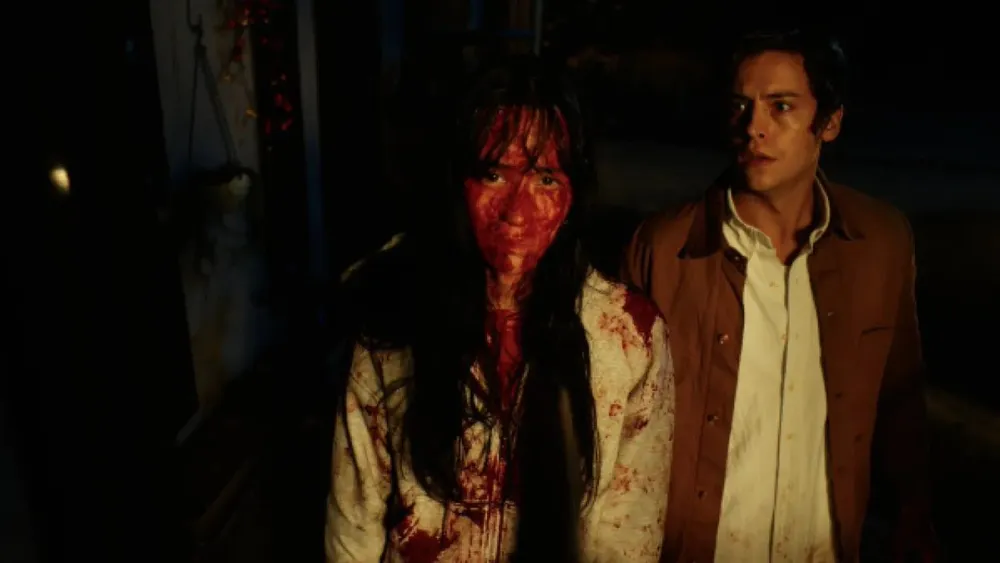
Eugene Kotlyarenko’s “Vintage Violence” is a movie that speaks directly to America’s phone-obsessed culture.
The kinetic action adventure, which has its world premiere Sept. 12 at Toronto International Film Festival, is about livestreamer Carter Tipe (Cole Sprouse) who stumbles upon a supply of vintage denim in a cave. He’s encouraged by a Japanese fan named Izumi (Kiko Mizuhara) to bring it to her country in order to sell it for a small fortune. Once there, things get frantic quickly as Carter is on the run from the police, criminals, hustlers and the Yakuza.
But “Vintage Violence” feels so modern thanks to its kaleidoscopic visuals. The screen is sometimes bifurcated between Carter’s livestream, which itself gets clogged with fan comments and emojis, and people watching it in Japan. The camera moves constantly and visual information — lights, split screens, colors, sounds, movement — floods the viewer. It feels like a film working to speak to an audience that grew up with second-screen culture, used to scanning their phones as they’re watching a film or show.
Kotlyarenko, whose previous film was the similarly internet-minded 2020 thriller “Spree,” says the online style was essential for the story he wanted to tell.
“My thesis at that point is that we’re so connected and deeply involved with screens that it rewires our brains to process information differently, to process storytelling differently,” he says. “Over the last two decades, I’ve seen how it’s changed not just our attention, but our expectation for what storytelling is and our participation. The lure of social media and video games, it’s active immersion rather than passive like cinema. So I thought it’s very important, grammatically, because these screens are so dominant, to figure out ways to aesthetically integrate them into cinema language, but also grapple with this new approach to viewing, which is so scattered, schizophrenic and all over the place. The challenge and the joy is figuring out how to guide and direct people on where to look, how to look, when to look.”
Even though Kotlyarenko’s technique is extremely modern, he is comforted by knowing that some of cinema’s greats are also into pushing visual and tech boundaries.
“One of the great adventures and joys of trying to innovate something is using those cinematic techniques and finding inspiration in other filmmakers,” he says. “There are filmmakers who seem very technologically in tune, like Brian De Palma, or Pedro Almodóvar is always doing something that feels very contemporary technologically. So I’m looking to what’s cool about how the masters think about stuff and then trying to put my own energy and spin on it.”
Read more ‘Hawaii Five-O’ Movie in the Works From ‘Spider-Man: Brand New Day’ Director Destin Daniel Cretton
Another important visual element came from nodding to Japanese film culture, as so much of the movie was shot there with a local crew. Kotlyarenko, along with his DP Sean Price Williams, was able to experiment in the footsteps of Japanese cinema legends.
“I’m working with a dolly every day. I’ve got Steadicam for a couple of weeks,” he says. “I’m like a kid in a candy store. I’m ready to move around and make it pop. The language of the Japanese filmmakers I love is very dynamic. When I think about Imamura or Ōshima or Miki or Obayashi, they’re constantly experimenting with different techniques within the same picture. I definitely wanted to capture that spirit as well. So it was really fun for me. And I think when you have fun filmmaking, I know it comes across on screen.”
Kotlyarenko’s insistence on tech-based verisimilitude included elements on set that would otherwise just be added later in post.
“Before we ever went to Japan, before our production really started principal, we had to shoot Carter in the cave because I needed to have an edit of that and the livestream,” he says. “I need to write the livestream so that Izumi, when she shows her boyfriend what she’s watching, it’s there. I don’t want to have a green screen on a phone. I want that to be ready so that the timing of what they’re interacting with on their phones is real.”
Ultimately, despite its modern feel, Kotlyarenko says “Vintage Violence” speaks to a core idea of cinema.
“If you’ve ever had an opportunity in a public space to just errantly see someone else’s phone, maybe by accident, maybe you’re peeking, that’s a really thrilling form of voyeurism,” he says. “The history of cinema is, in a way, the history of voyeurism. With phones, you have this awesome opportunity to engage in a type of voyeurism that has barely been explored in cinema, but it’s so real. That’s an exciting prospect for me.”