
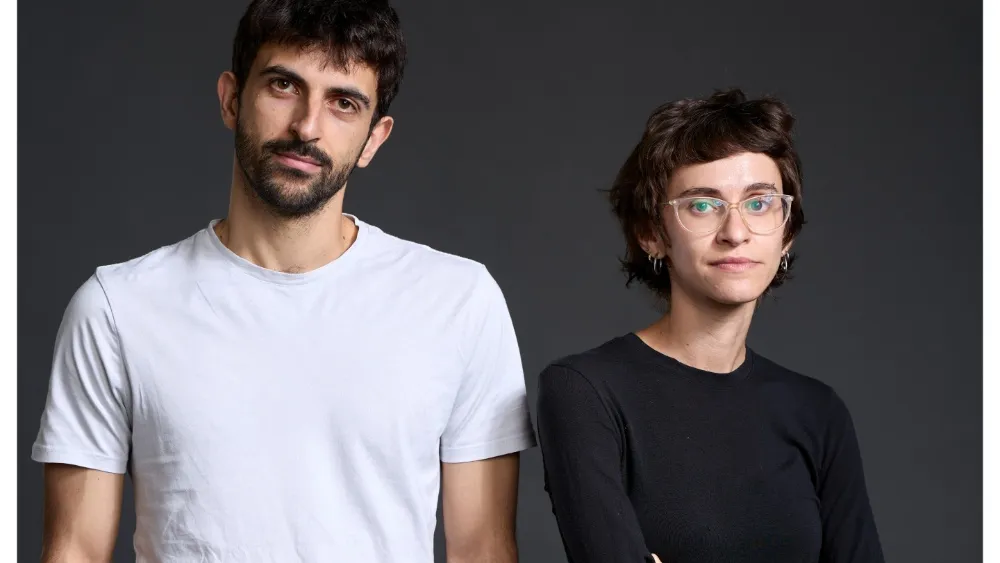
Israeli directors Yuval Abraham and Rachel Szor — who are two of the four co-directors of 2025’s Oscar-winning doc “No Other Land” — are at the Venice Film Festival with new hot-button documentary “NAZA.”
Read more ‘Ted Lasso’ Star Nick Mohammed to Host ‘The Traitors’ Stage Play in London
Shot at night on the rooftops of Tel Aviv, the film shows “in detail the systems behind Israel’s calculated mass killing of Palestinian civilians in Gaza,” as its official synopsis puts it. It features revelatory interviews with 24 Israeli military intelligence officers and soldiers — all of whom spoke on the condition of anonymity — who were involved in the surveillance or remote killing of Palestinian civilians in Gaza. Their appearance and voices were digitally altered to disguise their identities.
“NAZA” a term that appears throughout the documentary, is an acronym for collateral damage used by Israeli intelligence to indicate the number of civilians it expects will be killed in an airstrike.
The only documentary feature in this year’s Venice’s competition lineup, “NAZA” is produced by British newspaper The Guardian and James Wilson (JW Films) and executive produced by Jonathan Glazer. Wilson and Glazer are the Oscar-winning team behind the film “The Zone of Interest.”
Abraham and Szor sat down with Variety in Venice and spoke about how they went about providing an inside look at the Israeli military “as it carried out what all human rights organizations are saying is a genocide,” they say.
Talk to me about how this project originated. More specifically, how did you gain access to the Israeli military who make the harrowing revelations?
Abraham: Rachel and I, we’ve always felt a responsibility to document what our country is doing to Palestinians. And our focus, in “No Other Land” as well, has been on crimes that we view as systemic crimes. So, not some soldier making a mistake or some sporadic incident. But things that are really fundamental parts of the way the Israeli government, and the army, operate.
Obviously, “No Other Land” was about the systemic removal of Palestinians in the occupied West Bank. With this film, after Oct. 7 everyone was seeing the systemic bombing of Palestinians in Gaza, such as the killing of classrooms full of children, every day for two years. And the truth of that was, I think, apparent from the start. Because Palestinians were documenting their own destruction. As Israelis, we found ourselves wanting to use the kind of position that we have, the access that we have to our own society, to people that went into the military, to look at that system as it carried out what all human rights organizations are saying is a genocide. To look at it from the inside.
How did you gain that access? How did you find the 24 Israeli military intelligence officers and soldiers and get them to speak out?
Abraham: It was a challenge. It took time. I work as an investigative journalist, so for many years I’ve been searching for people from within the Israeli system. This piece is not the first time [revelations of this type are made]. It builds on investigative reporting published by The Guardian and +972 Magazine and Local Call. So there was a network of sources that I had from from the past. It was a very tricky and difficult process, especially because we had to do it totally in secret. We worked on this film for three years, in total secrecy. All the while assuming that the Israeli state, and perhaps other state agencies, would try to prevent us from from making it.
Of all the horrific things that we hear about in the doc, which do you consider the most emblematic of what you describe as the systemic killing of Palestinians?
Szor: Well, the film touches on the use of AI just to choose who will be a target. It touches on massacres that happen at humanitarian food distribution sites. It touches on the shootings of people who are just going back to their neighborhood, who have been displaced. For me, also as an Israeli, something that was important to hear is this choice of targeting the Palestinians in their homes. This is something that surfaces at a certain point in the film. And targeting them in their homes with their whole family. This is what gives the film its title “NAZA.” That is how the military officers call it, meaning the amount of civilians that will be killed as a target in the bombing. So I think for me, it’s the understanding that this is a systematic thing. The way the Israeli intelligence [services] look at mapping the houses, it’s an intentional thing. It’s one of the main reasons for the amount of civilians that are being killed.
Read more Yehuda Levi to Star in Cross-Border Action Thriller ‘The Escape’ for Keshet (EXCLUSIVE)
The Israeli military who speak out have been concealed in various way because there could be retaliation. They could be jailed. What about you guys? Do you think that after this piece you will be able to continue living in Israel?
Abraham: We live there. Our lives are there, our families are there, our friends are there. Also, our sense of meaning in life is about changing that place and making sure that these crimes, that the genocide and generally the controlled occupation of Palestinians, ends. And there is a political solution and good life for Palestinians and Israelis. That’s what motivates us to make this film and what we hope to be able to continue to do. You should ask the Israeli government, but I don’t see any reason why we shouldn’t be able to go back. At the end of the day, we are giving a stage and a platform to Israelis who believe — some of them at least — that they have an important testimony about crimes that they have committed to share with the world, of course, but also with other Israelis. I think potentially the Israeli state could try to retaliate against us. But I hope they don’t do that.
Going back to the testimonies from the military officers, what is your explanation for why they agreed to provide their harrowing testimony?
Szor: We talked about this a lot between us. We don’t have a full answer to that. But I think this is something that comes through in their testimonies. Our main interest was for them to describe what they did. But when they do this, they also describe a bit why they did it. I don’t know what the main reason is [for] why they spoke. But not a lot of people ask Israelis to speak about these topics. The mainstream media in Israel just doesn’t seek these [types of] testimonies. There’s no place for it. So I think it’s because so many Israelis took part in what happened in Gaza and not many people ask them these kind of questions. That said, I don’t have a clear answer about why they spoke.
What is your hope for the type of impact this piece can have?
Abraham: I think that this piece is likely to make the denial of what took place in Gaza — not only its genocidal nature, but really the specifics of what it looked like from inside the Israeli system — harder. We know there is a lot of denial happening. And to me, that denial is one factor that contributes to the crimes persisting. I mean, just this week, you had an 8-year-old girl, Wafaa Akila, who was killed in Gaza with her father. The same day, Israel bombed a school and killed a first grader. These things have been completely normalized by the international media by the mere fact that Israel has been doing them every single day for so long. And while this is still happening, there is such a big, powerful, often sophisticated, apparatus that is intended to sometimes deny and justify, but often keep things in a place where you can say: “Oh well, maybe there’s a valid reason for this.” This is a difficult thing for me to say because I think that it’s shameful that this denial is happening. I think the truth of the wars and the crimes happening in Gaza should have been clear to people from the first day by listening to Palestinians who have described them time and time again.
But it’s precisely for this reason that we live in a world where countries in Europe, and especially the United States, continue to give Israel unconditional military aid and diplomatic cover. There is still so much denial of much of what is happening that we felt we should probably use our kind of access to this system to give testimonies from inside the Israeli military system. I can’t say that I’m sure it will have an effect. I’m not. But I very much hope it will.
Speaking of hope, do you think that the October elections in Israel could change something?
Abraham: I’d like to say something really clear about this. Yes, I think that there there could be changes for Jewish Israelis, because obviously Netanyahu’s government is extremely corrupt. They’ve been harming what we would call democratic mechanisms for Jewish Israelis. I don’t think there is a democracy [in Israel], if millions of people can’t vote, as is the case with millions of Palestinians [living in territories occupied by Israel]. I think for Palestinians – and this is very important, especially for an international audience to understand – I don’t foresee any substantial changes. We’ve had a government of change before, in 2022, and the house demolitions and settler violence in the West Bank became worse. Their policies with regards to Gaza were almost identical [to the current government]. This is important, because I’ve often heard countries in Europe, especially Germany and Italy and others, and also politicians in the United States, explaining their reluctance to put sanctions on Israel and use different kinds of economic and diplomatic leverage by saying: “Oh, there’s going to be another government and things will be OK.” Unfortunately — and I’m saying this with a very heavy heart — in terms of the continuation of the military occupation of Palestinians and the policies in Gaza, there is an almost total consensus among the coalition and the opposition in Israel. Which is why we really need international pressure. I hope this will not be the case forever. I hope there will be change. But you have parties that we would consider the Zionist leftist parties not talking about the killing of more than 70,000 Palestinians in Gaza. This is a topic that does not surface in the Jewish Israeli political sphere, unfortunately.
Let’s go back to the film and its aesthetic and narrative aspects. Talk to me about your decision to shoot these secret conversations on the rooftops of Tel Aviv at night, and to keep footage of Gaza to a minimum.
Szor: To be honest, both of us are not real filmmakers. We didn’t study cinema. But because we made “No Other Land,” we felt that there is power to making a film. I think there are a few reasons why we chose to shoot on the rooftops. Cinematically we knew that the people would need to be disguised, so we felt that something needed to happen in the background. This idea of doing it in Tel Aviv was because Israel’s main military headquarters are in that city. And a lot of the intelligence officers who are being filmed and interviewed are serving there. It’s happening from that city. It’s also a place where you can have deep conversations and people open up just because it’s in the dark on a roof. As for the decision of not showing footage from Gaza until the end, there are several reasons. One is that the film shows life in Tel Aviv and how people are living there 60 kilometers from Gaza and they don’t really see [what’s happening there]. I mean, they can see, of course, because everything is being documented. You can just open your phone and see what’s happening. But there is something about this city that you can almost forget what is happening so close by. And, as we learn from the film, it’s happening with orders being made through computers from the city itself.
Abraham: We were influenced by what Jonathan Glazer, who is our executive producer, said when he was talking about his film “The Zone of Interest.” That the victims in the film are out of sight, but they are never out of mind.
Is there any possibility that this film could be shown in Israel?
Abraham: We really hope so. It won’t be easy for numerous reasons, but for us it’s very important to show it in Israel, and we will do everything in our power to make that happen. I think it’s a film Israelis should see. I think Israeli society should reckon with what the military did, what the government did and what so many people in society participated in. And we will try.
Read more Okada Junichi-Hosted ‘The Floor’ Quiz Format Returns to Nippon TV for Season 2 in Japan (EXCLUSIVE)
This interview has been edited and condensed for clarity.