
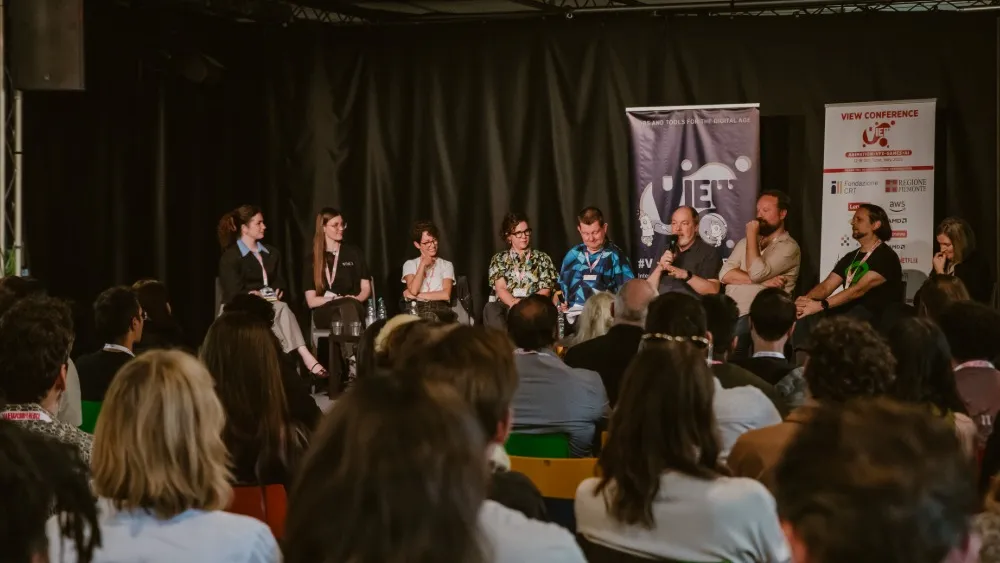
TURIN, Italy — “Culture is what you tolerate,” said Sony Pictures Imageworks president Michelle Grady, reflecting on bad bosses and how studios build a workplace where people can thrive.
“You work, you put a lot of energy into building it, emulating it, encouraging people to understand what it is, and then, you know, make some hard decisions along the way,” said Grady, who admitted it is a phrase she probably overuses.
Speaking Monday at Turin’s View Conference on the Leadership & Mentoring: Training the Next Generation of Leaders panel, moderated by the University of Hertfordshire’s Saint John Walker, Grady joined Janet Lewin senior VP, general manager and head of ILM, Skydance Animation president Holly Edwards, Pixar’s head of RenderMan creative engagement Dylan Sisson, Guerrilla Games studio director Jan-Bart van Beek and the National Film Board of Canada’s Eloi Champagne to discuss changing expectations of studio leadership and the challenges of developing talent.
Asked by an audience member about “anti-mentors,” Grady acknowledged that difficult experiences can offer valuable lessons.
“We’ve all probably had pretty tough bosses at a certain point in our lives,” she said. “You understand what you want in a boss and what you really don’t appreciate in a boss.”
Lewin agreed that companies must be deliberate about the leaders they appoint and the behavior they accept.
“It’s our job as leaders of a company to create the culture and exhibit the values that we want to see in other leaders within the organization,” she said.
At ILM, that means coaching, mentoring and intervening when managers struggle, rather than simply hoping problems resolve themselves.
Younger Staff Want a Voice
But studio culture is also being reshaped by changing expectations among younger employees.
“This business used to be so top down,” Grady said. “It didn’t work then particularly well, but that democratic participatory leadership is the way. It’s a better way.”
“I think this generation wants to have a voice,” she added.
Lewin described ILM’s employee forums, town halls and open-door policies, designed to give executives access to perspectives that might otherwise be filtered through layers of management.
“A good idea can come from anywhere,” she said, citing ILM veteran John Knoll. But collaboration has its limits: “It’s wonderful to encourage participation and hear different perspectives, but someone’s got to make a decision.”
Leaders Make the Hard Calls
Leadership also means making painful decisions. Asked about the most difficult decision of her career, Lewin pointed to the closure of ILM’s Singapore studio, which ILM announced in August 2023 and which employed more than 300 people. She said it was a business decision, made with others, about staying cost competitive.
“It had nothing to do with the talent that was there at the studio. They were doing incredible work,” she said.
Lewin went to Singapore to meet with staff. “It was heartbreaking,” she said, adding that ILM retained around 60% of the talent through moves to its other locations.
Studios Rethink Leadership Training
The industry has also had to rethink how it prepares people for leadership in the first place.
For decades, Grady said, studios routinely promoted exceptional artists into management without providing adequate training.
“We’d take them off the box and make them leaders and just shove them into the chair and let them figure it out on their own.”
Formal programs are now helping address that problem. ILM has introduced a six-month mentorship initiative pairing aspiring leaders with senior executives. Imageworks’ mentorship program, which began as a diversity initiative with about 30 participants, is now oversubscribed every year, Grady said.
“What’s been really interesting is it’s a two-way street,” Lewin said. “Getting the younger generation to participate has been super beneficial to me and to ILM because it’s a different point of view and a different vantage point.”
Sisson said he never really had a mentor. “When I was a kid, Pixar didn’t exist,” he said, so his generation largely figured things out as it went. Pixar has since built a mentorship program into its RenderMan Challenge, which he said has “helped change people’s trajectories and their careers.”
Edwards, who began her career as a production assistant, recalled learning from a producer over several films, absorbing lessons about both the leader she wanted to become and the behaviors she wanted to avoid.
Champagne described a turning point at the NFB. Frustrated with how things were run, he wrote a manifesto listing what needed to change and gave it to his boss — “risking potentially my job,” he said. “From that point on, the answer was, ‘O.K., now you’re going to be part of the decision, and you’re going to help us fix those things.’ So sometimes complaining can pay.”
Games Can’t Gamble on Talent
Opportunities to develop emerging talent are becoming harder to find, particularly in video games, van Beek said.
“Maybe you can’t gamble on talent anymore,” he said, noting that major projects can take six to eight years to complete. He pointed to Pixar’s animated shorts as a model for allowing new directors to gain experience on smaller, less commercially risky productions.
The Next Generation Steps Up
Sharing the stage with the executives were two members of the generation the panel was discussing. ILM concept artist Emily Bland and concept artist Isobel Hine each founded organizations to address a lack of representation and mentorship in their field. Bland’s Women in Concept Art connects junior artists with professionals. Hine’s Women’s Concept Art Association runs studio-style training through its Studio Jam program and includes artists at every career stage, from students up, on its core team.
Both urged studios to push younger staff, particularly women, into leadership sooner. “We have a habit of self-selecting out if we do not fit every single point within criteria to a T,” Hine said.
“I think it’s our role as leaders to kind of help lower the ladder for the next generation,” she added.
Read more Toni Collette’s Directorial Debut ‘The Best Of’ Among 75 Projects Backed by Screen Australia