
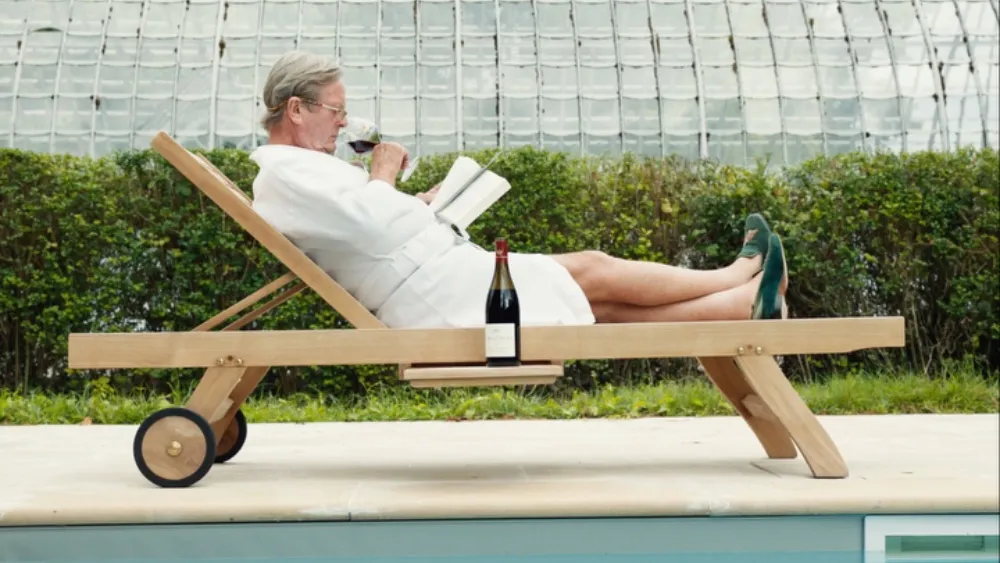
“The Truffle Hunters” directors Michael Dweck and Gregory Kershaw look for the perfect wine in their new doc “Burgundy.” So do their characters, from winemakers to sommeliers and wine critic Guillaume, who dreams he’s literally drowning in it.
“He tastes over 100 wines — a day! For him, wine has a spiritual component. It’s the sensory experience of consuming something that has a magical quality,” says Kershaw.
“It’s not just about a glass of wine, or maybe I should say that the glass encompasses much more than just a drink. It’s about the history of the land, the composition of the soil, the generations that have worked the land and the personality of the winemaker.”
He adds: “That’s what we realized as we spent time in this region. For people who’re deeply in this world, it’s never just a glass of wine.”
Dweck reveals: “When Guillaume asks what year you were born, he doesn’t care about your age. He wants to know if it was a good year for wine. He goes: ‘Oh, ’96? It was a rainy year. ’97? Much better. Drier. More acidic’.”
The people they show, dedicated to preserving dying traditions, don’t always have it easy.
“What drives all the films that Michael and I make together is this desire to go to places that have held onto connections lost today. They’re really hard to find because the digital world and modernity have chipped away at those things,” says Kershaw.
“For us, it’s a bit of an obsession. Our filmmaking process is about getting to know these places and the people really deeply, and letting the audience feel the joy, mirth and the fullness of human existence.”
Dweck adds: “That’s what we felt there. We’re trying to transmit how it feels when you’re fortunate to be part of such a community.”
Sold by Charades and produced by Beautiful Development Company, the doc premieres at Venice Film Festival.
They visited different wine regions before settling on Burgundy and a place Dweck dubs “a village of pleasure.” As always, they first established relationships. Only then did they start looking for stories.
“It’s almost like a casting process and it’s quite intuitive. There’s no script, honestly,” says Kershaw.
“Burgundy has become the center of the wine world. In the last 30 years, its profile has gone through the roof and it’s become a very wealthy area. When you talk to a Burgundy winemaker, they describe themselves as ‘farmers,’ but they’re like global rock stars because there’s so much demand for their wine. It was interesting to see this traditional community experience such a huge influx of money.”
This led them to tackle the subject of class, perfectly exemplified by the ambitious Enzo, who’s trying to enter the world of elite winemaking.
“And it has become a world that is nearly impossible for outsiders to enter! You have to be either born into it or be a billionaire who can afford to buy a domain and lose money on it,“ Dweck says. “Enzo’s learning the code of the winemaker — the code of the wealthy — but he’s not part of that family. It’ll only go so far. That was very disenchanting for him.”
Aspiring sommelier Céleste is also reconsidering her options in the film. At one point, they both decided to try their luck elsewhere.
“It ended up being one of the most miraculous and fortuitous things that could have happened to us. But we’d been filming for a year and a half when Enzo said: ‘I don’t want to be a winemaker anymore. I want to be an oysterman.’ Around the same time, Céleste said: ‘And I don’t want to be a sommelier.’ We went: ‘We don’t have a film,’” recalls Kershaw.
They still followed them, though.
“It ended up making the story much bigger because it reflected all these different Burgundian realities: the impossibility of entering a class, becoming a domain owner or an elite sommelier. This idea of having the ambition to become something great and realizing it might be impossible, and having to reinvent yourself… We’re finding out that so many people can identify with that moment.”
Or with the fact that, at some point, everyone needs to let go and find someone else to take over: just like the seasoned maître d’hôtel, Patrick.
Dweck says, “Our friend decided to treat us to a meal at [the three Michelin star restaurant] La Maison Lameloise and Patrick was the first person we met walking in. He floats on air through the dining room. He welcomes you in, knows everything about you and suddenly, you’re dreaming. For him, every night is a theater performance.”
Kershaw admits their work is an “ongoing quest for things that are fascinating, things that are beautiful, things that move us somehow and that people haven’t seen before.”
This time, they also want the audience to feel a bit tipsy while watching the film.
“In Burgundy, people drink a lot. And when you drink a great glass of wine, it changes how you perceive the world. Through slightly drunken eyes, everything’s a little heightened. Everything’s a little softer and more perfect, the way you wish the world could be.”
Dweck notes: “We want people to experience the film the way we felt in the region. Even though pleasure has some consequences.”