
Something has been pulling audiences past the screen. For a century, the best entertainment asked you to lean back and watch, and a great film or show is still one of the most powerful forms of storytelling. But audiences want in — to belong to something, to feel part of a community, and to know the person on the other side of the work. That desire sits at the heart of what’s driving the creator economy, and by every measure, we’re still in its early days.
In many ways, the creator economy is a 40-year trend. The first shift was about creation: desktop publishing and the software that let anyone make professional-grade work. The next was about distribution: social platforms, and the phones and networks that put an eventual studio in every pocket and a global audience within reach.
What’s different now is that both creation and distribution are moving at once. It’s a destabilizing moment, the kind that seems to rhyme with the end of one era and the beginning of another. The open question is what the next one looks like.
You can already see the answer taking shape in the places the industry gathers. At Cannes Lions, the advertising and creative world’s biggest annual festival, the program built for creators has moved from an isolated rooftop to a marquee footprint on the beach, now in its third year. It’s a small detail with a larger meaning: creators are no longer operating alongside the creative industry. They are increasingly helping define it.
If we zoom out enough, every time the door to making things has opened wider, the same worry has surfaced: more people would mean a lower bar. It has never once worked out that way. The bar keeps going up.
The real opportunity isn’t making creativity easier. It’s making more room for creativity to matter.
I don’t say that as a bystander. I started my career at The New York Times, with a front row seat to what happened when journalism collided with a new era where anyone could publish and platforms rewarded reach above all else. The Times found its footing; many others didn’t. A similar pressure has reached the rest of the creative industries now, and it would be dishonest to pretend the transition won’t be tough. The pain isn’t evenly shared: parts of traditional Hollywood are contracting, while headline after headline tells the story of creators thriving. This is what the remaking of an industry looks like from the inside.
Read more Pablo Larraín’s Upcoming Netflix Feature ‘Once’ Gathers Top Cast and Crew (EXCLUSIVE)
You can hear the change in how creators talk about their own work. As Brandon Baum, a visual-effects founder in Adobe’s Creative Collective, puts it, “The conversation has moved from ‘Should I be using AI?’ to ‘How do I use it in a way that’s actually mine?’ That’s a much more interesting question. It’s not about the tool. It’s about what you build with it.” That’s the right question, because a tool has no agency. A person does. Used well, technology doesn’t supply the intent — it accelerates it, removing friction between the spark of an idea and the ability to bring it to life. “AI is not some almighty piece that replaces the whole puzzle, but it does help us move through it faster,” Baum adds. The real opportunity isn’t simply making content. It’s creating space for judgment, taste and imagination.
As a result, the smartest media companies and brands have stopped treating creators as a distribution strategy and started treating them as creative partners from the very beginning. Some talent agencies are now putting capital and production muscle behind top music video directors to build out full creative universes around their work. Legacy broadcasters have stood up dedicated creator studios to develop franchises alongside digital talent, rather than treat them as a line item. Even the money is reorganizing around them, with dedicated creator funds from venture firms, ongoing creator-led investment vehicles, and a new $250 million venture jointly backed by a major talent agency and a global investment firm.
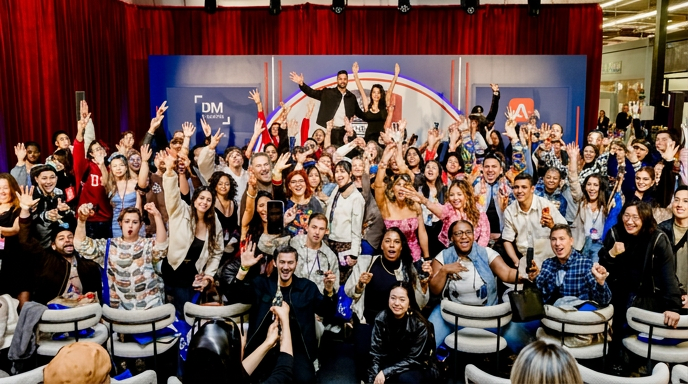
At Adobe, we’ve tried to build the same way. When we worked with Dhar Mann, creator and founder of Dhar Mann Studios, who turned his own following into a 125,000-square-foot studio, we didn’t send a brief, ask for assets and mail a check… we opened his doors to 250 up-and-coming creators for a day of real mentorship, widening access to knowledge, resources and relationships. “Adobe and I partnered around a shared belief: the next generation of creators should have the tools, access and support to bring their biggest ideas to life,” Dhar says. “The best brand-creator partnerships go far beyond a transaction. They open doors, create culture, and make communities feel part of something bigger. That’s exactly what we were able to build together.”
It’s early for this model. Soon it will be the standard.
Which brings me back to that beach at Cannes. The move from the periphery to a prime location isn’t really about real estate. It’s recognition. A sign of who the industry now understands it is building for and with. The lesson holds wherever you are, festival or not: creators have earned their spot in the sun.
Creativity has never been defined by the people who had access to the tools. It has always been defined by what people do with them.
The tools will keep changing, the way they always have. But what excites me is that with every new era, we get the same chance again: to widen the door without lowering the bar.