
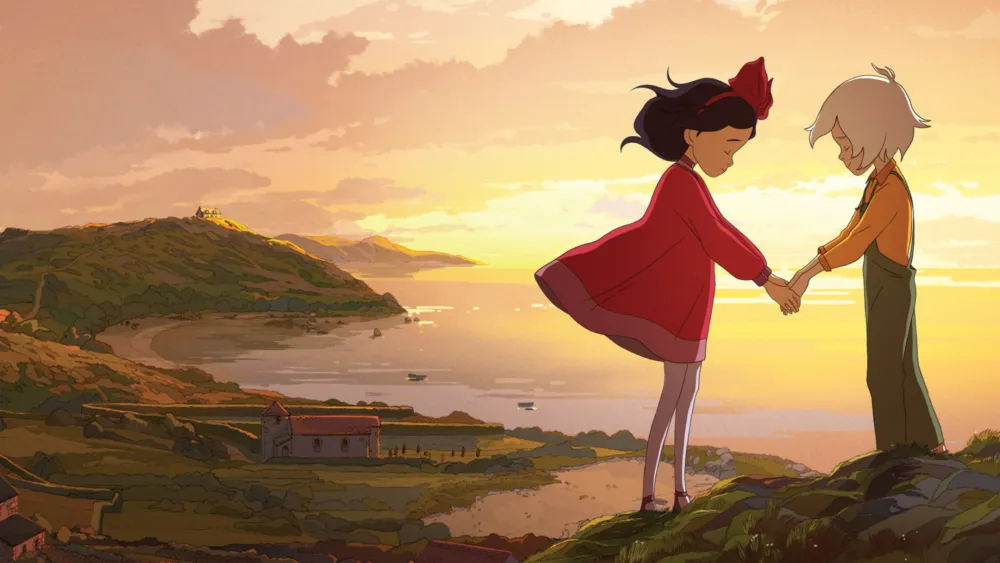
From the blockbuster stage and screen iterations of “War Horse” to the underseen “When the Whales Came” to the recent, BAFTA-winning “Kensuke’s Kingdom,” the books of English author Michael Morpurgo have reliably made for sturdy, literate family films of a comfortingly old-fashioned stripe. That streak continues with “Lucy Lost.” A handsome and emotionally involving wartime adventure cleverly adapted from Morpurgo’s 2014 book “Listen to the Moon,” the film marks a most promising feature directing debut for French animator Olivier Clert, who brings a pleasingly cosmopolitan sensibility to a story set predominantly on Britain’s remote, tranquil Isles of Scilly.
Following a well-received premiere as a special screening in Cannes, followed by a main competition slot in Annecy, this French-language work has the potential to resonate with young audiences globally, given the right distribution and multilingual dubbing. English-language backers may be inclined toward star voice casting, but would do well to honor the rich regional specificities of the film’s setting — as Clert has done in the film’s gorgeously rendered landscapes, frequently lit like an English Romantic painting. The director was previously a creative consultant on Netflix’s “Klaus” and a storyboard artist on “Little Amélie or the Character of Rain”; “Lucy Lost” bears some tonal resemblance to the latter, though it’s more broadly accessible, with a visual style clearly influenced by vintage Studio Ghibli, particularly in its character design.
There are echoes of Ghibli’s “When Marnie Was There,” too, in the film’s story, a growingly sophisticated construction that begins as a simple, bucolic portrait of childhood isolation, before its timeline splits, flips and is realigned in quite surprising fashion. The structural liberties taken with Morpurgo’s text by Clert and co-writer Helen Blakeman pay off cinematically, though children much younger than the book’s preteen target audience may be left a little adrift.
The year is 1915, and while the First World War may be raging in Europe, the sleepy Isles of Scilly — off England’s Cornish coastline — seem distantly removed from the conflict. Still, its reverberations are felt by the locals, particularly regarding the mysterious backstory of Lucy (voiced by Charlie Rosenzweig), a frail 11-year-old girl whose hair has been bleached white by trauma, and who is repeatedly visited by hallucinations. Not all of them are disturbing: One is an ebullient imaginary friend her age named Milly (also Rosenzweig), who claims to be visiting across time and space from her home in America.
Milly is also the only friend Lucy has, bar her protective older brother Alfie (Zach Valentin-Dattas). Their parents, Mary (Jessica Monceau) and Jim (Quentin Faure), insist on keeping her at home and away from other children, claiming she needs to recover from an unspecified accident; cruel rumors circulate through the community that the mostly housebound child is a witch. One type of social prejudice expands into another as the film’s scattered narrative fragments gradually come together. “Lucy Lost” is slow to show its hand in its gently paced first half, but that’s no bad thing: Clert gives patient viewers time to invest in these variously damaged or repressed characters before boldly reconfiguring their relationship to each other, and ours to them.
Simple line creations, with wide eyes and large heads atop spindly bodies, the characters are appealingly if not very distinctively drawn, but the world they inhabit is realized with rather more depth and texture: Clert is attentive to the region’s grassy natural beauty and the mineral-slate palette of its sky and sea alike, while local flora and fauna are evocatively woven into Lucy’s island exploits when she does venture outdoors. Musically, meanwhile, Anne-Sophie Versnaeyen’s lovely score ranges from sparse, lilting strings to a full orchestral sweep as the story builds in scale and scope, somehow swelling from soft village parable to hefty historical fiction, even taking in the famous sinking of the Lusitania. How Clert’s ambitious adaptation achieves this, in under 90 minutes to boot, is best experienced in real time.